Monday, March 11, 2013

Barrels and honey

Some unfinished business from the weekend and back to the start of February:

Flounder Brewing produced its first batch of beer for sale on Saturday, and Kane Brewing is doing a tap takeover at Cloverleaf Tavern in Caldwell that features some of the Ocean Township brewery's beers taken to the hardwood.

The event itself is a bonanza of 17 brews – IPAs, browns, Belgians and stout.

Anyone who's been to Kane knows the brewery has a pretty cool rick of wood going, and the folks there cycle some interesting beers through those Jim Beam and Wild Turkey barrels. (Barrels are the brewery's Facebook avatar.)

Brewing started at Kane in July 2011, and the brewery has been giving its beers the barrel treatment from the get-go.

Last year's beer to made mark the company's first anniversary, 365, was a product of some barrel aging and blending. Kane's brew for the second anniversary will be all barrel-aged.

Here's owner Michael Kane from early February talking about what was sitting in the wood earlier this winter:  

"Head High and Overhead, we have Drift Line – we've done than before and it came out good, so we did six barrels of Drift Line. Then, there's some Belgian quad, some imperial stout, last year's anniversary beer, there's some of that."

And definitely more going forward.
----

While work was being done to finish up the brewery's cold box on Saturday, Flounder Brewing mashed in for its first official batch of a pale ale-amber beer crossover, Hill Street Honey Ale. 
Made with locally sourced orange blossom honey, Hill Street's a really quaffable beer, at 5% ABV, balanced with a gentle aroma of citrus grove, like you're standing at a produce cart of oranges.

The finish is an alternating embrace of honey and hops – really it's like those to ingredients are making out; there's a lot going on between them. 

Jeremy "Flounder" Lees, who launched the Hillsborough brewery with his brothers, brother-in-law and cousin, acknowledged the first brew with some relief and humor.

(The brew comes a year after being licensed and with some slight detours. It will be followed up with another brew day in mid-April. The brewery is still bringing some fermenters online.)

"As weird as it sounds, it's awesome to know that I'm actually going to pay taxes on this. Because it means it's official," he says. "It's only been several years … It's the most ingredients we've ever used, it's the biggest batch we've ever done, and so far so good.

Soft openings are planned for mid- to late May, with regular tasting room hours to start in June. 

"Because this is only one barrel at a time, we only have so many kegs and so many cases we can get out of this. I want to get another one or two full batches brewed and under my belt to have the inventory," Jeremy says. "It's still all about us getting our feet wet and figuring out our game plan and everything before we go too crazy. And that's fine with us."

Anyone who has started a brewery as a new career or side venture can tell you that behind the beer is someone whose understanding and patience is to be thanked. 

Standing at his Blichmann brew set-up, Jeremy gave his version of whom to thank:

"Everybody. Particularly family, and my wife, my very understanding wife, especially since we have 8-month-old twins at home. She's been very understanding in taking the kids when I've got to come down here work."


Saturday, March 9, 2013

Blackthorn Brewing buildout under way

Blackthorn Brewing is: Jason, Jacqui and Chip
New Jersey's recent streak of adding at least one craft brewery a year appears safe for 2013.

The run started with the opening of Iron Hill's Maple Shade brewpub in 2009, at the time the first new brewery in the Garden State in 10 years. Amid continued craft beer industry growth, nationally and regionally, New Jersey's chain has gone unbroken since.

Now, Irish-themed newcomer Blackthorn Brewing is poised extend the streak to a fifth year, as the  production brewery in development forecasts opening in Toms River some time in 2013. 

"Originally, we were hoping to be up and running by Memorial Day weekend. That might be a little tight at this point," says Jackson resident Chip Town, who founded Blackthorn with his daughter, Jacqui.  

Tight is a realistic assessment. 

Blackthorn is well into a brewery buildout at its 6,500-square-foot unit in a business park along Route 37, the main commercial artery that takes Toms River from the Atlantic Ocean west toward the Lakehurst Navy base, immortalized by the 1937 Hindenburg explosion.

The brewery's floor drains are in, and a work crew has been framing out the tour taproom, positioned forward from the brewhouse area, where other interior work is taking place. The front office is being furnished, and U.K. brewery-trained Jason Goldstein, hired last month as Blackthorn's brewer, has begun piloting recipes (so far a session blonde ale) on a Tippy brew setup delivered a week ago. 

It's progress, but there's still plenty to do, especially with the big, shiny stuff that makes a brewery a brewery.

Blackthorn's 25-barrel brewhouse and 50-barrel fermenters are expected to arrive in mid-April. They're on order from Florida-based Brew-Bev, the company founded by retired Anheuser-Busch engineer Neal Knapp that has been affordably equipping U.S. and Canadian craft brewers with Chinese-made brewhouses and tanks. 

"It's coming out of China; that's the reason it's being delayed," Chip says. "But it's incredible prices; nobody could touch it. There are (some) problems with Chinese steel, but (Neal) tripled the industry warranty. To make everybody happy, he put a three-year warranty on all the steel and all the welds."

Taproom framing in progress
Chip, 56, who handles Blackthorn's business matters, says the obligatory licensing and tax paperwork is being finalized for filing with federal and state regulators. 

A bottling line is also part of the brewery start-up plan, to backstop Blackthorn's draft business in the target craft beer market of Monmouth and Ocean counties. (A red ale and stout will be among a quartet of Irish- and English-style beers that Blackthorn plans to brew.)

"We didn't want to limit ourselves to just the kegs. For bars that don't have the tap space, we wanted to have an alternative, and then also the opportunity of going to the liquor stores," says Jacqui, 27, whose duties include Blackthorn's marketing and sales. "If we can start with a few different options and go slowly, with the kegs and the bottles in the bars and the bottles in the stores, we're hoping that'll give us greater exposure within the market in general."

Tailoring the beer offerings to work with supportive bars also figures into Blackthorn's model. The same thinking goes for the brewery's taproom – treat the tour patrons to one-off, reserve brews.

"Around here, I can find beers that are from anywhere, like the West Coast," Jason says. "However, what you see is their mainstream beers. You don't see their local beers, the things you'd only find if you were maybe within 25 miles of that brewery – the small batches, the 5-barrel batches. Things like that.

"That's what we can pride ourselves on. You can come down here, you can come into the taproom, and this beer you will only see here, and maybe at a few bars in the local area that really are excited about our products. Why not give back something to them for being excited about our products, something to separate themselves from every other bar?"

Taproom work 
There's room in that scenario for cask ale, too. 

"Eventually, when we're settled, I'd like to have cask in our taproom and have cask any place that's willing to undertake that," Jason says. "That's a very large venture for a bar to go into: a shorter shelf life and a lot more knowledge for the cellarman."

Once licensed, Blackthorn stands to become the 13th production craft brewery in New Jersey, and the ninth Garden State craft brewery to be licensed since 2009, including two that went out of business (Great Blue in Somerset County and Port 44 Brew Pub in Newark).

Blackthorn could also become the first brewery  licensed since the state relaxed regulations for craft brewers last fall. (Among other things, the regulatory change did away with the limit of two six-packs on brewery sales to the public. It's a change that could prove critical to fledgling breweries, giving them a vital source of income outside wholesale distribution.)

If you're keeping score, New Jersey now has 25 craft breweries (a dozen production breweries and 13 brewpubs), plus a trio of brands whose beers are contract-brewed. (The newest contract brand is Bolero Snort, launched in January-February; the company's beer is brewed at High Point Brewing in Butler, but plans call for Bolero Snort to have its own brewery sooner rather than later.) Besides Blackthorn, there are two other breweries in development: Tuscany Brewhouse in Oak Ridge and Pinelands Brewing in Little Egg Harbor. Additionally, Iron Hill expects to open a second location in Voorhees in July.

Chip, a 17-year homebrewer with a couple years removed from a banking industry career, and Jacqui, a College of New Jersey alum who also worked in sales, took Blackthorn from idle homebrewer conversation to an on-paper idea in 2010-11, to finding space last year for a brewery. 

Located four miles west of the Garden State Parkway, their brewery space once housed part of the Bacchus School of Wine School and a gymnastics studio. Blackthorn leased the space last summer and started the renovation work last month. Jacqui and Chip have also used the brewery development time to build a rapport with Tipperary Pub in Lakehurst, a likely first draft account.

Says Jacqui: "I started homebrewing with Dad once I moved back home from college. He always did it, and I said, 'Yeah, whatever, he's making beer.' Once I came home from college – I had a chemistry background – I started kind of taking an interest in the chemistry and the biology of the beer. So when I came home I said 'I'm going to start brewing with him, see what it's all about.'"

It wasn't quite grad school, but certainly a new frontier of study for Jacqui. She then stocked up on books about yeast biology and brewing chemistry.

"I got really into the geeky side of it. In 2010, in the summer, we were just making a bunch of batches of beer and said it would be kind of cool to have a brewery," she says. "It was just a fleeting thought. We started thinking about it more seriously, started doing a little bit more research. I was doing marketing-type research, market analysis; Dad was checking out the numbers, seeing if it would be feasible.

"Little by little, we started doing more work on it and more work on it. Summer of 2011, we were both let go from our jobs within two weeks of each other and sat home unemployed, and said this is a door that just opened for us. Our full-time job became finishing our business plan."

Originally from Queens, N.Y., Jason, 23, comes to Blackthorn with a Campaign for Real Ale background. A passionate homebrewer, he studied food science at Ohio State University and worked part-time at Elevator Brewery and Draught Haus in Columbus. He studied brewing at Brewlab in the UK, and worked at Mordue, Double Maxim and Darwin, all CAMRA/cask ale-style breweries. 

Ohio State's food science program, and its dairy industry emphasis, offered clear advantages for Jason, who applied them to hobby brewing. 

"I had a little bit better homebrewing equipment than most people would, because I was working in multimillion-dollar labs using steam-pressure boilers and things like that," he says. "I could have even pasteurized my beer if I wanted to just because that equipment happened to be there."

Hobby brewing, for Jason, went from small step to giant leap.  

"It was a baby-step thing," he says. "I was homebrewing and going the food-science path. My homebrewing kept expanding. It's definitely an addicting hobby, to the point I was doing 5-gallon batches; it grew to 10-gallon batches, all of a sudden going from 10-gallon batches to building a $5,000 home brewery ..."

Now, as Jason works out the recipes, Chip orchestrates the brewery buildout, and Jacqui pores over a list of bars across the state to plot marketing strategy.

"We're putting dots on a map of where everybody is," Jacqui says, "taking out the summer bars where everybody wants just whatever's on special – Bud Light, Miller Lite, so excluding those for now – and going to the pubs and the inns in Seagirt and Spring Lake where there's a lot of Irish Heritage, and the Irish pub, just looking at those. We're looking at places that are going to have the demographic that's going to be asking for the type of beer we have."

Wednesday, March 6, 2013

Funds Unleashed, Sandy; take that

On a day when another coastal storm is buffeting the Jersey shore with 40 mph winds and 60 mph gusts, there's this comforting news: The beneficiaries of the Flying Fish FU Sandy beer have been announced:

Sales of FU Sandy, a wheat-pale ale mashup beer brewed with experimental hops, generated $45,000; the cut for each relief organization is $15,000 (Habitat will divvy its share amongst the three chapters.)

In the case of the Hurricane Sandy New Jersey fund, the relief organization chaired by New Jersey first lady Mary Pat Christie, Flying Fish's contribution is the second shot of cash raised by the state's craft beer industry to aid the state's rebound from the Oct. 29 storm. 

Last month, East Coast Beer Company announced it made a $4,000 contribution to the fund. That donation was raised from case sales of the Point Pleasant Beach company's Beach Haus beers.

As for Flying Fish, FU Sandy was the first new brew to come out of the brewery's new home in Somerdale. It's pretty much gone from the bars now (most of the tappings of the stores and bars' single kegs happened Feb. 16), but there are a few places yet to put it on: High Street Grill in Mount Holly (March 14), The Shepherd & The Knucklehead in Haledon (March 21), and the Atlantic City beer festival (April 4-5).

Flying Fish continues to raise money for Superstorm Sandy relief via sales of glassware and T-shirts.

Monday, March 4, 2013

Believe it or not, a Climax double IPA


For a brewery that embodies feet-on-the-ground English and German styles and approaches, this may seem a little like entering the forbidden zone: making big beers in double-digital alcohol content fused to a wall of hops.

For Climax Brewing, actually, it's just a Second Coming.

For the first time since launching his Roselle Park brewery in the mid-1990s, Dave Hoffmann will come out with a double IPA, a beer that reflects Garden State beer enthusiasts' continued lust for towering ales that happily swarm the palate with hops. (No craft beer drinker these days is out of the loop on double IPAs. The style dates to 1994 and started getting traction six years later. A lot American craft beer trends are like the weather – they go west to east. This style is one of the biggest in that vein.) 

The beer was brewed last week as Climax's inaugural offering in a rebranding effort, a new series called The Second Coming (yes, there's some wink-wink, nudge-nudge innuendo to that name). It's targeted for a late-March/early-April release at Barcade in Philadelphia. (Dave's is the process of organizing that event; he expects to have it available at Barcade in Brooklyn and Jersey City afterward.)

Dave's no stranger to high-gravity beers. But in his time as a brewer, such beers have been a style he was been inclined to hold at arm's length, unless it was doppelbock time, or another special occasion.

Or a business decision like now.

At 80 IBUs, the new double IPA's alcohol content will be second only to the barleywines Dave made to mark his brewery's 10th anniversary in 2006 and 15th in 2011. Those brews clocked in at 11.5% ABV. (A Russian imperial stout made last year was 8.7%, in the same ballpark as his doppelbock.)

"We just checked the gravity – it's only been fermenting for maybe five days," he says. "So far it's like 8.2 percent alcohol now. I'd like to get it to ferment out a little bit more, so it's going to probably be between 9 and 10 percent. 

"It's a lot lighter in color than my regular IPA. It's straw leading into an amber color. It's going to have a decent malt backbone to it. It's not going to be one of those super hop bombs that everybody makes lately.

"It's going to be real hoppy, but there will be enough malt backing it up. It'll be a little dry, but it's still going to be balanced and easy to drink for how strong it is. The first taste you get is like orange marmalade, then it leads into tangerine notes. There are no double IPAs out there that taste remotely close to what this tastes like."

Dave at a 2008 Oktoberfest in Toms River
The tangerine notes come from the use of Newport hops, a recent American cultivar that's a high-alpha bittering hop. "It's been around maybe five years, but not a lot of people use it," Dave says.

The other four hop varieties are: First Gold, Galena, Cluster and Centennial.

Dave intentionally steered away from hops that would impart a resiny signature in the beer. "Everybody and their brother makes one of them," he says.

Climax Brewing launched as a production brewery in the winter of 1996, after being stalled from a 1995 opening, on the heels of the Ship Inn (Milford) and Triumph (Princeton) brewpubs. The holdup resulted from the government shutdown amid the duel between the Clinton White House and the Newt Gingrich-led House of Representatives.

Climax's signature has been ales and lagers that speak to English and German leanings – traditional IPAs, brown ales, ESBs under the Climax label, and helles, hefes, doppelbocks and maibocks under labels that bear Dave's surname, Hoffmann Lager Beer. (Dave is German by heritage: both of his parents are German.)

Those styles not only reflect Dave's preference in beer, but also speak to how his business developed from a homebrew supply shop in the Cranbury-Roselle Park area to a 4-barrel brewery in his dad's machine shop in Roselle Park. (Dave's a machinist by trade.)

The new double IPA, Dave says, comes at the urging of distributors, bar owners and the desire to reach fans of big beers. The latter group cuts a large swath across the craft beer spectrum and overlaps younger and older craft beer demographics. Dave's Russian imperial stout, called Tuxedo and named in tribute to the brewery's jet-black cat, followed a similar course. 

"Everybody wants these big, strong weird beers, so that's what I'm making," he says. "I don't know what the next one's going to be. It might be a big, hoppy, West Coast red ale or something. I like Red Seal Ale; it's real hoppy, but it's nice and good and easy to drink. So, I might do an imperial red ale, a West Coast imperial red ale."

The double IPA isn't all that's new at Climax.

Reacting to the recent change in New Jersey craft beer regulations, Dave has opened the brewery to tours and tastings on Friday evenings and retail sales during all brewery hours. His first open house was Feb. 22; he also plans to trick-out the brewery to better accommodate tour guests. 

Tours are practically de rigueur at production craft breweries, but they've always been something Dave skipped: too little bang for the buck from selling two six-packs or filling two growlers per person, the former New Jersey limit, he says. Last fall's law change cleared the way for production breweries to retail kegs and cases directly to people and pints of beer to tour guests.

"From now on, I'm going to be open on every Friday from 6 'til 9 for tours and tastings. I usually have four beers on tap when I do open houses," he says.

FOOTNOTE:
•It's getting to be maibock time. Dave's 2013 incarnation comes out in April. He also brews at Artisan's brewpub in Toms River and will tap a batch of hybrid oatmeal/foreign stout at the end of this week or early next for St. Patrick's Day.

•The video was shot in summer 2011, when Climax added 12-ounce bottles to its packaging.

Friday, March 1, 2013

Flounder Brewing's upcoming first batch

Just two days past their first anniversary of becoming an official craft brewery in New Jersey, Flounder Brewing will fire up the kettle for the Somerset County brewery's first commercial batch of beer, a brew day that's been a long time coming, and one that has traveled a somewhat circuitous path.

Making the batch of Hill Street Honey Ale (5% ABV, 25 IBUs) is on the calendar for March 9 at the 1-barrel brewery in Hillsborough. The ale's a time-tested recipe from the Flounder guys' days as homebrewers in Lyndhurst, one they hope to follow up with Murky Brown Ale and a pumpkin ale in the fall. The Hill Street ale is made with orange blossom honey and fermented with East Coast Yeast's Old Newark Ale strain, a progeny of the strain used to make Ballantine ale. Flounder Brewing is a partnership of Jeremy Lees, his brothers, Mike and Dan; brother-in-law Greg Banacki Jr.; and cousin William Jordan V.

A pallet of 2,000 bottles is due to arrive late next week at the brewery located in a business park (yes, even at its small size, the brewery plans to bottle using a counter-pressure filler more likely to be found filling growlers in some brewpubs like Iron Hill); there's some big warehouse racking inside the brewery, stocked with T-shirts and pint glasses; growlers are on order, and a soft opening is planned for around mid-spring. 

The Fox & Hound Tavern in Lebanon (Hunterdon County) is a likely candidate for a first bar draft account. Morris Tap and Grill in Randolph (Morris County) is also on the draft-account target list. But it's tasting room sales that will play a substantial role in the brewery's business plans, especially now that a change in state law last fall eased restrictions on retailing both packaged beer and beer by the pint to people who stop by for tours. 

"We're going to be careful that we're not a taproom," says Jeremy, the Flounder in the brewery's name (yes, that's Jeremy's nickname, à la Animal House). "We will be serving pints to people who want to buy a pint. There are going to be limits, because we're small.

Jeremy 'Flounder' Lees in tasting room
"If you get 20 people to come in for a 2 o'clock tour, in my brewery that tour is done at 2:10. If all of those people want to drink a couple pints, and you have another 20 people coming at 3 o'clock, next thing you know you've got 40 people in your tasting room – I can only have 15 to 20 people ..."

Unofficially, the March 9 brew will be the third by Flounder Brewing. The brewery did two pilot batches at half volume last fall and early winter to work out mechanical bugs in the brewing system – it turns out the kettle had a leak – and to gauge how the honey ale recipe fared on a new brewing setup. 

After a year as a licensed entity, to say that Flounder is finally making beer commercially may be accurate. But it's also a little too predicated on the idea that time is money. 

State regulators indeed licensed Flounder Brewing on March 7, 2012. But the Flounder guys never considered their licensing to be a starter-pistol shot. Back then, there were still some odds and ends to deal with to finish out the brewery before striking an mash. There was no race to have beer for sale before the ink was dry and the license was framed and hung on a wall. 

As a business, Flounder Brewing was founded with a mindset that homebrewer enthusiasm could spill over into a commercial enterprise in an individualized fashion, writing your own script, holding onto the day jobs that pay the bills and not disrupting family lives. 

"The brewery was never set out to be, at the get-go, drop everything and it's your job now" says Jeremy. "It was always turning our hobby into the brewery. Without a doubt, one day I would love to be running a brewery and brewing beer, and that's my day job. But our business plan wasn't, 'All right, in the first two years we can all quit our jobs because we're pulling in this income.' 

"We have flexibility, because really our only overhead is the rent we pay and our yearly licensing."

Nonetheless, Flounder Brewing experienced a delay, and it had some very specific reasons, for which the go-slow approach proved beneficial: Jeremy and his wife Melissa's twins, Lyla and Ethan, decided to show up a little early, as in premature. As such, the twins' extended hospital stay and subsequent getting settled at home meant the brewery business would have to slip to a lower priority.

"It was a life-changing event. There was a lot of shifting around, but that was also the intention of starting the way we were starting, at the size we were starting, to give us the flexibility without having our houses on the line, or whatnot, for when things do come up or get twisted or turned around," Jeremy says. "We'd planned to have children, but didn't expect it to be two, and the complications that were there, too, kind of just pushed it. 

"That's when we found ourselves all of a sudden we're heading into another winter ... here we are again, it's another season, and here we are coming up to the license (anniversary)."

And now the upcoming brew day. 

Of course, getting to that point – getting back on track – involved finishing out the brewhouse area. The pace was again slow, tethered to a pay-as-you-go imperative for piping the brewery. Brewing fittings aren't cheap. When your personal wallet's involved, there's no rushing. 

"When I was doing the hardware on the system, I did it all on the stainless tri clover piping everywhere. It's a pretty penny for that kind of stuff," Jeremy says. "I had to do it in two phases, because I had to do it with money from paychecks. It had to be done over phases. We did it. Even though it's just 1 barrel, it's a homebrewer's dream of a system now."

And now a group dream unfolding to a reality: selling the public beer that has its roots in a homebrew kettle in Lyndhurst eight years ago, with the Flounder folks celebrating their home-made beer as an experience around the barbecue pit and camaraderie.

"We got into this game to just have a good time and enjoy what we're doing. That's what we've been doing," Jeremy says.

They hope New Jersey's craft beer enthusiasts will soon get to experience the beer, too.

Wednesday, February 27, 2013

Cash for Sandy, an IPA & a Beach Haus brewery

A new beer, a shot of cash for Superstorm Sandy relief and efforts toward a new brewery ... East Coast Beer Company has been busy lately.

OK, the Point Pleasant Beach contract-brew enterprise, like all of the state's beer purveyors, is always busy. 

But if a beer release targeted for next month isn't enough, the guys behind Beach Haus pilsner, Winter Rental schwarzbier and Kick Back amber ale are also hoping that by the end of 12 months they will have their own brewery in New Jersey.

Here are the latest details:

Kicking Sandy
If you live at the Jersey shore or its environs, then by now you're used to seeing the green-orange-and-white Servpro vehicles buzzing around (or, happily, you are seeing fewer of the flood-cleanup company's vans and trucks at this point). You've probably likewise grown accustomed to the buzz of saws and rapping of hammers. 

The shore is bouncing back from the Oct. 29th hybrid storm (a $30 billion hurricane cum nor'easter) that rewrote New Jersey's coastline, and displaced a lot of people. 

Getting back to normal has taken time and money. East Coast Beer's founders are shore denizens, from northern Ocean County, an area that saw extensive damage  from Sandy. As such, the guys felt compelled to help.

In short order after the storm, John "Merk" Merklin and Brian Ciriaco committed themselves to raise money through sales of their beers and channel it to storm relief. Three of their distributors – Kohler, Ritchie & Page, and Harrison Beverage – backed them up on the endeavor.

Last week, East Coast announced $4,068 had been raised for the Hurricane Sandy New Jersey Relief Fund, the organization founded just days after the storm by first lady Mary Pat Christie. 

"We went to the distributors simply with a print request, saying 'Hey, we're going to look to donate 50 cents for every case we sell to this fund, can you just print up the flyers and make sure to get the information out?" Merk says. "Our distributors said, 'You know what? This is a great idea. How about we match you?' So it wound up becoming a dollar for every case."

A dollar for every case, plus what others may have been inspired to donate after seeing the flyer. Merk says there were some instances of that kind of giving.

Beer No. 4
Beach Haus Cruiser IPA, East Coast's fourth beer to come to market in bottle and draft, is due out in mid- to late March. It's the company's hoppiest beer to date, a combination of Centennial and Horizon hops that clock in at 60 to 65 IBUs on top of about 6.5% ABV maltiness. (For comparison purposes, that's the flavor-profile neighborhood of Oskar Blues Dale's Pale Ale.) 

For hops fans, the beer will be familiar (think West Coast inspired) and assertive, but not over the top. "It's what you would expect from an IPA; you get all of that hop flavor. But we're not out for the moon on this one in terms of IBUs. For us, that was not the objective," Merk says.

Cruiser's about embracing the IPA style, a beer that is "something you can put a couple back, and do it having fun with the experience," Merk notes.

The beer has been on East Coast's drawing boards for quite a while. It would have seen introduction in late 2011, on the heels of the company's flagship pilsner, were it not for a reshuffling of the lineup plan. The reordering put it behind Winter Rental, which debuted as a fall season in 2011, and Kick Back, which came out in spring 2012.

Drafting new approaches
For any beer company or brewery, fine-tuning production is an ongoing matter. For East Coast, that has translated into some tweaks in managing their draft beer production, generally now treating it as seasonal while bottles are year-round. (The company distributes to six states now: New Jersey, New York, Pennsylvania, Connecticut, North Carolina and South Carolina.)

"We've had some success with the draft market, with obviously local accounts, and even national chains like Applebee's," Merk says. "But we noticed no matter who the account is – and there's a few exceptions which we're absolutely thankful for – we're never going to grab two (draft) lines. It's very difficult for anybody, let alone us, to say, 'Hey, we're going to have Winter Rental on one line and Kick Back on another.'  

"So what we've done is, we've kind of said, unofficially but just operationally, that our draft is somewhat seasonal. For instance, Kick Back is available for three months of the year; it's going to fall into late summer, early fall this year. The bottle (version) is available year-round. The pilsner ... again, draft is going to be available late spring throughout the summer, but the bottles are obviously available … Same thing with Cruiser. It's going to be early spring, mid-summer availability in draft, but you're always going to be able to get packaged."

Further tweaks to that are likely. 

"We don't see how producing draft year-round – it doesn't work out to our favor right now," Merk says. "The good part is, we're holding onto lines more and more. There are a number of accounts – it's starting to grow where we have 12-month presence with at lease one of our beers. But it's probably less than a dozen where we've got folks pouring two of our beers."

Homesteading
With the help of Tom Przyborowski, East Coast's R&D-brewer, Merk and Brian entered New Jersey's craft beer market in 2010 with Beach Haus Classic American Pilsener, brewed under contract by Genesee in Rochester, N.Y. Amid that, having a brewery in their home state was always on their minds. 

But back then, logic dictated that a brewery take a back seat to building the core brand in what has become a rapidly expanding craft beer market in New Jersey. Almost a year ago, though, East Coast began to give the brewery part of their business model more attention. Now it's front and center, with the company scouting locations and working through the options for equipping a brewery (i.e. new versus used equipment). 

"We're looking to be in a decent-size space, be a decent-size brewery, something that people want to come visit. We're pursuing it, operationally committing resources to it," Merk says. "It's going to help our business evolve. It's going to give us greater flexibility in terms of putting out styles and such. We've talked to a number of new equipment manufacturers; we've kept our eyes on the industry classifieds."

But, of course, settling the matter of a location must come first. 

"You have to get the location, and the location's got to get the approvals, so when you put equipment on order, it's not going to just sit in a warehouse after it's done," Merk says.

Just exactly where East Coast is looking to put a brewery is being held close to the vest. But some options look promising.

"There's a particularly interesting location, again without naming it, where it's fairly drop-and-go for us," Merk says. "Structurally, there's not much to do with the building. We'd like to get this done in 12 months. But this is a business where people say, 'twice as long and three times as expensive.' I certainly hope it's not twice as long. But there's a couple of properties we're looking at that, if it were to go through, we could be in and up and running in as soon as 12 months. It's exciting. It's driving us right now to make this happen."

East Coast's timing is appropriate, too.

Governor Chris Christie signed into law last September new rules that grant some freedoms that had long been kept out Garden State craft brewers' reach, namely lifting restrictions on how brewers could retail directly to the public during brewery tours. The result is, production craft brewers can now mine an additional revenue source to supplement the traditional channel of beer sales through distributors.

"Between tasting rooms and little retail rooms, it's amazing how much that can pick up the slack where you don't make money or where you lose money, between the licensing and being in compliance in various states, things like that," Merk says. "It's a good opportunity from a business-model perspective; it makes a ton of financial sense to do it. That wasn't always the case."

Tuesday, February 26, 2013

It's time to Snort, Bolero style

Via their website:

Bolero Snort beers hit your glass beginning tonight through Saturday with a quintet of launch parties across North Jersey, which for now is a ground zero for the newest brand on the state's craft beer landscape, but one founders Bob Olson and Andrew Maiorana will certainly look to break out of as their company grows.

Here's the launch rundown:

Tonight: Jersey City, Barcade, 7-9 o'clock, Ragin' Bull from the tap, a firkin of Blackhorn Double Dry Hopped (whole leaf Amarillo)

Wednesday: Taphouse Grille, Wayne, 7-9 p.m., Ragin' Bull and Blackhorn draft, firkin of Jittery Blackhorn (vanilla and coffee bean aged)

Thursday: Cloverleaf Tavern, Caldwell, 7-9 p.m., Ragin' Bull and Blackhorn from the taps

Friday: The Shepherd & The Knucklehead, Haledon, 7-9 p.m., Ragin' Bull and Blackhorn drafts

Saturday: Copper Mine Pub, North Arlington, 3 p.m. start time, Ragin' Bull and Blackhorn from the taps, specialty lineup of Ragin' Bull aged on hazelnuts (firkin) and Blackhorn aged with rum-soaked oak and a dash of coconut (pin, plus another pin).

FOOTNOTE: Here's our chat with Bob from January.

Wednesday, February 20, 2013

Holy Smoke: Exotic Wood in Your Beer

By Kevin Trayner
Ace of Beers

Using wood in beer is nothing new to craft brewing, and barrel aging has enjoyed a renaissance of sorts in the past few years. 

Step into practically any Garden State craft brewery and you're likely to see wooden barrels. (Kane Brewing in Ocean Township, for example, has quite the rick going. Owner Michael Kane has squirreled away over 40 wooden barrels for aging beers produced at his Ocean Township brewery.)  

Using wood to smoke malt by hand is less widely practiced by craft brewers, especially when that wood is the “holy wood” of South America, Palo Santo.

But Triumph Brewing in Princeton took a shot at it.

Inspired by Palo Santo Ahumado from Dogfish Head, brewer Tom Stevenson turned in a 5.9% ABV malty ale made with about 40% pale malt smoked over Palo Santo wood. (Palo Santo Ahumado was brewed with 44% Palo Santo smoked malt, by the way.)

“I sort of smoked out the kitchen, when I did it,” Stevenson grinned – he used the barbecue smoker in the kitchen of the restaurant to smoke the malt. Burning the gray-brown and white-striped wood produces a pleasant, but not overwhelming aroma – somewhere between the earthiness of piñon and Far East nature of frankincense. In fact, even before burning, the wood is quite fragrant.

Palo Santo, or Bursera graveolens, as Tom would properly call it, is prized for its aroma and is used as an essential oil or incense, like its distant relative frankincense. Peruvian shamans burn the wood, which is traditionally only harvested from fallen branches, to clear negative energy and remove bad spirits. 

Stevenson, a botantist by training before he ever touched a brew kettle, is keen to point out the pitfalls of using common names for plants: “Different plants can often have the same common name, and vice versa.” 

For example, Lignum vitae, the densest wood in the rain forest (part of a group of dense woods often referred to as “Ironwood”), is also confusingly sometimes called Palo Santo. (Bursera graveolens is fairly light and floats in water, and has a more aromatic nature.)

Tom's a fairly traditional brewer in some ways. But he likes to experiment with exotic flavors in moderation. Stephen Harrod Buhner’s "Sacred and Healing Herbal Beers" (a mix of anthropology, plant lore, mythology and homebrewing) inspired Stevenson to brew a gruit ale (the beer of Europe until the advent of hops). He sent a bottle to Stephen, who wrote back praising the brew.  
  
Exact adjectives to describe Palo Santo aroma are elusive: “It certainly has an incense-like quality,” Tom says. “Frankincense? Patchouli? I’m not exactly sure.” 

For the brewing, Tom opted for moderation in the beer’s alcohol, malt and hops, to “let the wood come through.” Dogfish Head’s version is based on a London porter, but Triumph’s appropriately named “Holy Smoke” is a simple pale ale base served in a cask.
  
The result's a malty, smoked ale with a murmur of incense in the background. The wood comes through slightly in the aroma, but much more so in the flavor – middle and finish, with a slight chewiness in the body. Having never tasted the DFH Ahumado, I can only compare Holy Smoke to the DFH's more popular and weightier Palo Santo Marron brown ale. And one can definitely taste that unique incense-like flavor, which I for one, have not discovered in any another beer. 

Tom liked his results and definitely plans to make another cask of the brew. After all, it’s not every day you can drink an interesting beer and cleanse negative energy as well.

– Kevin Trayner is a longtime beer writer in New Jersey and Princeton-area homebrewer.

Sunday, February 17, 2013

And then FU Sandy poured

FU Sandy tap
Yep, FU, Sandy
It doesn't take long to kick a freshly tapped keg when it's pouring for a good cause. 

Bars and packaged goods stores with growler stations were doing just that Saturday, selling pints and jugs of the hybrid wheat-pale ale, FU Sandy.

Flying Fish brewed FU Sandy, its first new beer for 2013, to help raise money for hurricane relief. And has been noted since the announcement in December, the brewery will steer all proceeds from the beer to a Jersey-based charity to be chosen from suggestions offered by Twitter and Facebook followers of the brewery. 

All 86 kegs of Sandy are long gone from the Somderdale brewery, dispatched into the hands of the bars and stores that got one each; many of those establishments followed the brewery's request to tap the beer on Saturday, but some did so the day before; others will feature FU Sandy at later dates. Check here for the the list. (Glassware and shirts will continue to be available.)

Denise at the Office pours Sandy
Whatever the case, when the beer was tapped, business was brisk, with lines for growler fills. 

At Spirits Unlimited, a Sandy line
At The Pour House, the keg kicked around 2 p.m. The bar in Westmont in Camden County put the Facebook shout-out up around noon. The Pour House's faithful promptly did the rest.

Then there was the Passion Vines store in Somers Point, an Atlantic County shore town not far from where the center of the storm made landfall but did considerably less damage (that's because it's the northeast quadrants of hurricanes that are the worst: storm surge and sheering winds).

Over in Toms River, in central Ocean County, two kegs of FU Sandy were flowing across the street from each other: at the Office Lounge & Restaurant and the growler station inside Spirits Unlimited, in a plaza across busy Route 37, within sight of the Office's parking lot. 

Both locations were symbolically fitting, given that Ocean County's barrier islands got shredded by Superstorm Sandy on Oct. 29th and the hurricane-nor'easter's full-moon high tide.

A lot of repair work is taking place up and down the coast (such as Belmar's boardwalk repair getting under way last month), and there's been plenty of progress. But the tracks of the Star Jet roller coaster rising from the surf in Seaside Heights still make you think you're staring at the ruins of a civilization. Rebuilding the boardwalk reminds you otherwise. 

FU Sandy growler
A fill for the cause
Perhaps its fitting to also take a moment and remember those still displaced from their homes ruined by Sandy. In either case, that's where FU Sandy comes in, a little help and a resonant name.

And at the Office, a lot of people were saying "FU Sandy," promising to kick the keg before the afternoon was done. By 3 o'clock, the bar had already run out of the commemorative pint glasses that were also for sale.  

Located just off the Garden State Parkway's exit 82, the Office is a Toms River fixture. It's within walking distance of the county courthouse, a proximity that makes it the Ocean County Bar's bar. It's a place that's a bit ahead of its time, too.

Back in the mid-1980s, long before it featured the respectable craft beer lineup that it has today – and well before New Jersey had its wave of craft breweries – you could get Bass ale in bottles, a huge contrast to what was the norm then. 

Office beers include Jersey beers
The Office is also known for its signature quirk of handing cash-paying patrons $2 bills and 50-cent pieces back as change (nowadays dollar coins, too).

Thomas Jefferson looked up from a 2 in the stack of bills parked in front of Anthony Petrocelli, an Office regular who sipped a pint of FU Sandy in a logoed glass, one of two he would later take home. 

A phys-ed teacher in Asbury Park, Anthony lives in Toms River (his uncle is Rico Petrocelli, Bo-Sox shortstop and third baseman: two homers in Game Six of '67 Series, a .308 hitter in that classic Reds-Red Sox '75 matchup).

Anthony's sister, Aurora, a banker and new mom, also lives in Toms River, only she can't return to her home on the east side of town. The storm surge that rode over Barnegat Bay sent 4 feet of water through her place. An uncle of Anthony's with property in Point Pleasant Beach to the north is in the same displaced situation. 

Anthony Petrocelli: FU Sandy 
So Saturday afternoon found him at his regular bar, for reasons well beyond thirst and college basketball on the bar's TVs.

"A friend of mine works here, and she told me they were getting a keg of FU Sandy," Anthony says. "So I said I'm going to come here and have a beer or two, get a couple glasses, give her one, I'll take one, and help support all the victims." 

Monday, February 11, 2013

FU Sandy, and the storm you rode in on

Flying Fish has released it's fundraiser beer, FU Sandy.

To find the hybrid wheat-pale ale that's intended to raise money for people affected by the Oct. 29 superstorm, check here.

The beer was a limited run in draft only, so hurry. Also, each bar that got a keg will have a case of FU Sandy glassware to distribute.

Saturday, February 9, 2013

Seriously, Cape May ain't so little anymore

New brewhouse. Next up wiring and plumbing
The previous brewhouse is now in Michigan, its stay in New Jersey quite brief.

The original brewing set-up is in pieces, its frame and other bits converted into a keg washer, while another more recent component sits on an overhead ledge, looking like a giant, unlabeled soup can on a shelf.

Cape May Brewing Company is growing – again.

Cape May's 2nd kettle
New Jersey's southern-most brewery has begun yet another expansion, taking delivery of a 15-barrel brewhouse from G.W. Kent of Michigan, on Friday morning, promptly proceeding with an initial installation that saw the mash tun, kettle, heat exchanger and brewhouse scaffold freed from their packing and, by early afternoon, standing in place along a freshly cut drain trench.

Now, the spanking-new brewhouse is just days away from striking a mash for Cape May IPA, followed by a honey porter, both in the biggest batch sizes ever for the 19-month-old brewery. 

Righting the kettle
On Thursday, a crew from Rare Bird Brewery and Taproom in Traverse City, Mich., came for the 4-barrel brewhouse Cape May had used since late last summer, a brewing system the folks at Cape May had hoped would help them keep pace.

That it didn't is a success story framed in a problem many breweries wouldn't mind having, meaning steady demand for the beers.

The new brewhouse is a familiar brewpub-style arrangement of a mash/lautern tun atop a hot liquor tank, with the kettle situated to the right of the scaffold. The brewery will add a pair each of 15- and 30-barrel fermenters, expected to arrive in a month. Rectangular wine fermenters the brewery has been using, in what became an intermezzo basis (to borrow a music term), are being sold. The wine tanks were being used in addition to some conicals, by the way.

Danny Otero clears some rough edges
Cape May decided to triple its brewing capacity when it became clear that the demands of their draft accounts and tasting-room retail sales after tours would seriously stress their output by this summer, if not by spring. 

The order for the new system was placed in December. Delivery in early February represents a fast turnaround, given the number of brewery start-ups in the U.S. these days has translated into a seven-month waits for new equipment orders. (Meanwhile, prices on the used market make new equipment, minus the wait time, attractive for start-ups and capacity upgrades.)

Mash tun and kettle after delivery
Original brew stand now keg washer
"It was perfect timing," says co-founder Ryan Krill. "They (Kent) already had one in the process, and it was one that we wanted. In this small space, this combi system works really well for us."

The new equipment marks the second major – but by far the biggest – step-up in size for the brewery in Lower Township, beside Cape May County Airport.

Besides keeping up with a growing demand, the upgrade likely will enable Cape May to make a move toward widening its distribution reach farther north and west. (The brewery self-distributes.)

"This is going really to take us to a whole new level," Ryan says. "This is probably what we should have started with."

That Cape May Brewing didn't brew 30-barrel batches when it started putting its beers into the market on Independence Day 2011 probably spoke more to the business need for caution while becoming a beer producer at the Jersey shore.

Compared to the west side of the state, and the northern end for that matter, the shore region, especially in South Jersey, has embraced craft beer at a much slower pace in the near 20 years since better beers have been available in the Garden State. 

Mark McPherson at the 4-barrel system
Shore-area brewpubs Basil T's (Red Bank), Artisans (Toms River) and the Tun Tavern (Atlantic City), plus a few beer bars, were oases in a region where Coors Light long held sway (and still does in some stubborn pockets) until two or three years ago.  

But Cape May, like Monmouth County beer-makers Kane Brewing (Ocean Township) and Carton Brewing (Atlantic Highlands), have been marketplace reinforcement for the established home-grown craft brands that knocked on the shore's door a decade before. (It wasn't until last year – its seventh – that the Atlantic City beer festival did a Jersey-themed beers section. Incidentally, Carton, Cape May and Kane all launched around the same time in 2011.)

So in deepest South Jersey, the otherwise traditionally seasonal market that is Cape May, it's no surprise that Cape May Brewing would start with batches the size of a 15-gallon keg – what a dedicated homebrewer would likely brew. 

Righting the mash tun
What followed was some baby-stepping up to a barrel and a half more than a year ago, and 4-barrels in late summer 2012, after acquiring a brewhouse from a Maryland brewpub.

What also followed has been the fortunate surprise of a market that met having a local brewery like a gold rush. Weekend tour crowds have continued to be heavy. In fact, as the new brewhouse was being moved into place in early afternoon, people braved a nasty cold rain outside to show up for tours and samples in the tasting room.

Setting the scaffold
"We were shocked," Ryan says. "Even this time of year, it's been so busy – the taproom and the accounts. We needed this just to be able to keep up with what we (expect) from this coming summer. Cape May County has been so supportive of us. All the folks around just really seem to embrace having us, having us in their backyard."

Tuesday, January 29, 2013

Brewers and roasters, the quest for flavor

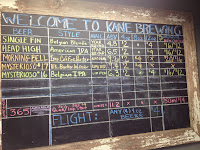
Kane's tasting room board
A couple of draft-only coffee brews emerged on the New Jersey craft beer landscape in January.

Aside from being well worth your glass, they train a spotlight on a couple of New Jersey coffee roasters and underscore how the pursuit of great coffee mirrors the quest for good beer.

Rojo's Roastery, a must-stop for any flavor-seeker visiting Lambertville, lent its expertise to River Horse Brewing for a coffee turn on the brewery's oatmeal milk stout seasonal. The roaster worked with River Horse to select the right variety of coffee bean to give the the 6.7% ABV stout some added bounce. (See Rojo's coffees here.)

Likewise, Rook Coffee Roasters teamed with their neighbor, Kane Brewing in Ocean Township in Monmouth County, for a velvety infusion of cold-brewed Sumatra in an imperial porter, called Morning Bell, that rings the bell at 9.2% ABV. 

Jamie Arnold and David Waldman
Taphandle says it 
Rook, located about a half-mile from Kane, has the added distinction of plying the coffee craft in the building where Heavyweight Brewing produced artisanal beers before exiting New Jersey in 2006 to re-emerge as a brewpub under a new identity in Philadelphia.

"They're like-minded people," says Michael Kane, whose eponymous brewery took last year's St. Patrick's Day collaboration with Rook to the next level with Morning Bell. "What's important to them about their coffee is as important to us about our beer business here."

Such is the bond among artisans, says David Waldman, who opened Rojo's in a north-end neighborhood in Lambertville in 2006. "There's a mutual respect for the respective crafts we practice," he says.

Rojo's coffees are prepared from organic, fair trade beans with a 1956 Probat roaster, a machine that echoes a golden era of coffee bars (think Beat Generation and Jack Kerouac), a roaster that David can trace back to its only other owner in Lille, France. He lovingly rebuilt it for his shop and has declined requests from the manufacturer to buy it back for their museum. "This is what we do. We don't put them in a museum," David says. "We put them to work, as they're intended."

Holly and Shawn
Founded by Shawn Kingsley and Holly Migliaccio, Rook opened three years ago with a small roaster in the Oakhurst community of Ocean Township. Another shop in Long Branch, a quick trip north, was added a little over a year later, as was the location near Kane, where the company's roasting of organic, fair trade coffees is done (on a new larger roaster) and their cold-brewed Sumatra coffee is made (Cornie-kegged and bottled) for their retail shops, including a new one in Little Silver. (Check out their coffees here.)

"Holly and I have an appreciation for anything craft. We love wines and beer and coffee," says Shawn. Collaborating with Kane "has been a great opportunity. They're in line with what we're focused on, which is craft, quality, service ..."

Says Holly: "It was such a great experience; our eyes were opened to the world of brewing beer. Then we found out that this particular location used to be a brewery."

Two worlds, single-minded passions
Coffee people move in a world that parallels their beer bretheren: Producers and aficionados are both drawn to exploring the global regions that are home to fine beers (Belgium, for instance) and beans (Costa Rica). And, among people who have experienced the rest, then became compelled to find – and/or make – the best, some overlap is inevitable.

Like coffee beer. 

Coffee beans for roasting
But that said, coffee in beer is hardly new. For that matter, neither is prevailing on local roasters to provide the beans. Yet, as a go-to beverage, coffee always suggests a new day, revisiting an old friend  – or idea. Thus, the coffee-beer combination enjoys healthy representation among stouts and porters, even Irish reds. Plug the word "coffee" into BeerAdvocate's search engine, and you'll get nearly 300 beer-name hits, nearly 50 for "java". (That doesn't even count brews like Flying Dog's Cujo, which opt for less-linear names, like Morning Bell.)

Jersey brewers are wont to give their brews espresso expression, too. The list of Garden State coffee beers includes both brewpubs (Basil T's, Triumph, Long Valley, Iron Hill, and Tun Tavern) and production brewers (Tuckahoe's New Brighton Coffee Stout and Flying Fish's Imperial Coffee Porter, both using beans from roasters local to the breweries). 

Barley and beans
At River Horse, jazzing up the oatmeal milk stout the brewery has been turning out since 2008 meant an opportunity to share some flavors the brewery staff appreciates at Rojo's in a one-off beer. (The stout is out now; check River Horse's Facebook page for availability. But hurry; it's a limited brew: Only about 60 barrels were produced.)

"It's phenomenal coffee. It's where we get our coffee from," says head brewer Chris Rakow. 

Chris teamed with Jamie Arnold, a roaster at Rojo's, to get the surest coffee flavor from the most complementary variety of bean. They chose a Guatemalan bean (Huehuetenango growing region) over Brazilian and Cost Rican, favoring its more harmonious tones and lower acidity; they opted for whole bean over a grind to minimize oxidation of the coffee and control how much coffee was imparted into the stout. They also decided to let the beer itself do some of the work post-fermentation.

"The majority (of brewers), what they will do is cold-brew and add the coffee," Chris says. "What our idea was, instead of cold-brewing it with water and adding it in, we would age the coffee on the beans. Essentially, you're doing a cold-brew with the beer and not water."

The beans were roasted on a Monday, then added two days later to the beer in a conditioning tank, a proportion of 20 pounds per 40 barrels of beer. 

"That also lends clarity to the finished product," Jamie says, "and this way, your window is a lot bigger, like when you're going to get the right amount of flavor added. The difference is in days."

Adding the cold-brewed coffee to the beer, though effective, wouldn't, for their palates, allow for the nuance they were seeking, Jamie says. "You're deciding right there how much coffee flavor is going in, and once it's in, it's in," he says.

The result of their efforts is a layered stout that unfolds with inviting coffee aroma and a friendly coffee flavor that doesn't overwhelm the beer, but rather, gently wakes it up. 

"Next year I'd like to do a specific coffee beer with them. This was just real quick," Chris says. "We just decided to take one of our beers and age it on coffee. Next year, we might try to do a separate recipe for a coffee beer."

Next year is this year for the folks at Kane Brewing. 

The question there was, how to revisit the success of last year's additions of Rook coffees, including their Sumatra, to create variations of their 6.2% ABV Port Omna Stout, done for a St. Patrick's Day tasting room event, without just repeating themselves (not that the brewery's fans would mind much). 

The answer was go back to the drawing board. Michael explains the Kane-Rook collaboration's second act: 

"People wanted us to do a coffee stout, or make more of that coffee stout. I really liked the way it came out, but I thought if we brewed a beer specifically with that coffee in mind, we could make it a little better than just adding coffee to the stout we'd already made.

"What I wanted to do was to make it a little bit different, make it a bigger beer, something that would stand up well to their Sumatra roast – the dark roast. We wanted to make it a porter base style to back off on the roasty malts that would have been in a stout, the roasted barley, the black patent – the darker roasts – and not have so much of that in the base beer.

"We thought it would be good to maybe pull a little bit from the milk stout category and pull in some of those unfermentable sugars, sweeten it up a little bit. We thought that would balance the roast and bold flavor of the coffee. We thought the higher alcohol, a bigger beer would stand up, because that's a pretty dark roast they use; we used a really concentrated version of that.

The brewery did three or four pilot batches, winding up using 15 gallons of the Sumatra cold brew in the porter. The result is a velvety porter, deep and flavorful. (Morning Bell came out the second week of January; check the brewery's Facebook page for availability and bars.)

That coffee in it, by the way, has a wide following among Rook's fans.

"It has a dark, syrupy tone to it, with chocolate notes," says Shawn. "We characterize it like dark chocolate. When you cold-brew it, it produces this concentrate, which is must less acidic than hot coffee ... When you mix it into something, it holds its flavor. Usually, when you have hot coffee poured over ice, it sometimes gets diluted. This is very smooth, very rich, very flavorful."

Rook and Kane landed on each other's radars via Nip-N-Tuck Bar & Grill in Long Branch. Holly and Shawn are friends of the owner, Bob Burtchaell. The bar's also one of Kane's draft accounts. 

"We we first went to him and started pitching the beer to him, he brought up Rook, that they're really good people, and it's a local product," Michael says. 

The same thing about Kane Brewing was pretty much happening in conversations Holly and Shawn had with Bob. 

For the brewery, one that has sourced locally produced apple cider, hops and even yeast for some of its beers, Rook was another great find. What followed was a mutual appreciation and ultimately a friendship. And opportunities to work together.

"We had tasted their beer locally," Holly says, "and knew it was far superior than other things we'd tried. So we were very excited."

"And humbled," says Shawn.