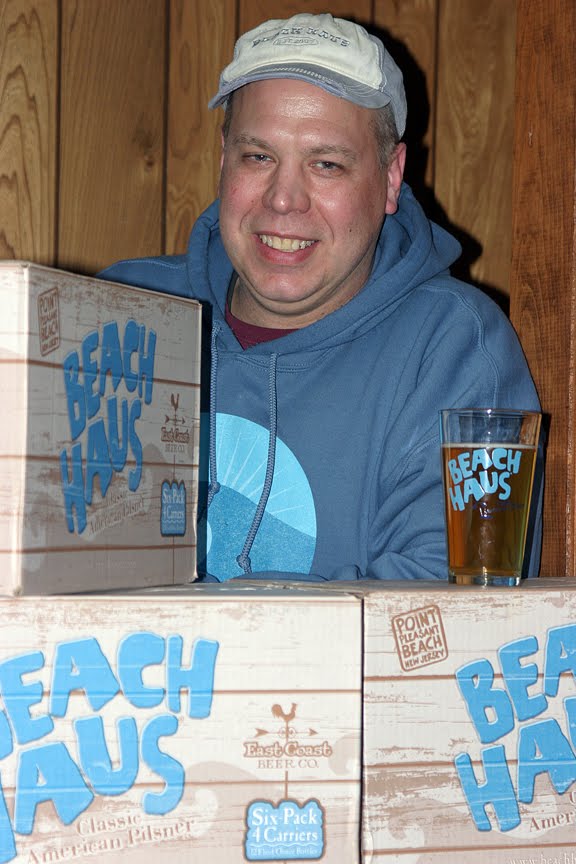
Showing posts with label Beach Haus pilsner. Show all posts

Wednesday, February 27, 2013

Cash for Sandy, an IPA & a Beach Haus brewery

A new beer, a shot of cash for Superstorm Sandy relief and efforts toward a new brewery ... East Coast Beer Company has been busy lately.

OK, the Point Pleasant Beach contract-brew enterprise, like all of the state's beer purveyors, is always busy. 

But if a beer release targeted for next month isn't enough, the guys behind Beach Haus pilsner, Winter Rental schwarzbier and Kick Back amber ale are also hoping that by the end of 12 months they will have their own brewery in New Jersey.

Here are the latest details:

Kicking Sandy
If you live at the Jersey shore or its environs, then by now you're used to seeing the green-orange-and-white Servpro vehicles buzzing around (or, happily, you are seeing fewer of the flood-cleanup company's vans and trucks at this point). You've probably likewise grown accustomed to the buzz of saws and rapping of hammers. 

The shore is bouncing back from the Oct. 29th hybrid storm (a $30 billion hurricane cum nor'easter) that rewrote New Jersey's coastline, and displaced a lot of people. 

Getting back to normal has taken time and money. East Coast Beer's founders are shore denizens, from northern Ocean County, an area that saw extensive damage  from Sandy. As such, the guys felt compelled to help.

In short order after the storm, John "Merk" Merklin and Brian Ciriaco committed themselves to raise money through sales of their beers and channel it to storm relief. Three of their distributors – Kohler, Ritchie & Page, and Harrison Beverage – backed them up on the endeavor.

Last week, East Coast announced $4,068 had been raised for the Hurricane Sandy New Jersey Relief Fund, the organization founded just days after the storm by first lady Mary Pat Christie. 

"We went to the distributors simply with a print request, saying 'Hey, we're going to look to donate 50 cents for every case we sell to this fund, can you just print up the flyers and make sure to get the information out?" Merk says. "Our distributors said, 'You know what? This is a great idea. How about we match you?' So it wound up becoming a dollar for every case."

A dollar for every case, plus what others may have been inspired to donate after seeing the flyer. Merk says there were some instances of that kind of giving.

Beer No. 4
Beach Haus Cruiser IPA, East Coast's fourth beer to come to market in bottle and draft, is due out in mid- to late March. It's the company's hoppiest beer to date, a combination of Centennial and Horizon hops that clock in at 60 to 65 IBUs on top of about 6.5% ABV maltiness. (For comparison purposes, that's the flavor-profile neighborhood of Oskar Blues Dale's Pale Ale.) 

For hops fans, the beer will be familiar (think West Coast inspired) and assertive, but not over the top. "It's what you would expect from an IPA; you get all of that hop flavor. But we're not out for the moon on this one in terms of IBUs. For us, that was not the objective," Merk says.

Cruiser's about embracing the IPA style, a beer that is "something you can put a couple back, and do it having fun with the experience," Merk notes.

The beer has been on East Coast's drawing boards for quite a while. It would have seen introduction in late 2011, on the heels of the company's flagship pilsner, were it not for a reshuffling of the lineup plan. The reordering put it behind Winter Rental, which debuted as a fall season in 2011, and Kick Back, which came out in spring 2012.

Drafting new approaches
For any beer company or brewery, fine-tuning production is an ongoing matter. For East Coast, that has translated into some tweaks in managing their draft beer production, generally now treating it as seasonal while bottles are year-round. (The company distributes to six states now: New Jersey, New York, Pennsylvania, Connecticut, North Carolina and South Carolina.)

"We've had some success with the draft market, with obviously local accounts, and even national chains like Applebee's," Merk says. "But we noticed no matter who the account is – and there's a few exceptions which we're absolutely thankful for – we're never going to grab two (draft) lines. It's very difficult for anybody, let alone us, to say, 'Hey, we're going to have Winter Rental on one line and Kick Back on another.'  

"So what we've done is, we've kind of said, unofficially but just operationally, that our draft is somewhat seasonal. For instance, Kick Back is available for three months of the year; it's going to fall into late summer, early fall this year. The bottle (version) is available year-round. The pilsner ... again, draft is going to be available late spring throughout the summer, but the bottles are obviously available … Same thing with Cruiser. It's going to be early spring, mid-summer availability in draft, but you're always going to be able to get packaged."

Further tweaks to that are likely. 

"We don't see how producing draft year-round – it doesn't work out to our favor right now," Merk says. "The good part is, we're holding onto lines more and more. There are a number of accounts – it's starting to grow where we have 12-month presence with at lease one of our beers. But it's probably less than a dozen where we've got folks pouring two of our beers."

Homesteading
With the help of Tom Przyborowski, East Coast's R&D-brewer, Merk and Brian entered New Jersey's craft beer market in 2010 with Beach Haus Classic American Pilsener, brewed under contract by Genesee in Rochester, N.Y. Amid that, having a brewery in their home state was always on their minds. 

But back then, logic dictated that a brewery take a back seat to building the core brand in what has become a rapidly expanding craft beer market in New Jersey. Almost a year ago, though, East Coast began to give the brewery part of their business model more attention. Now it's front and center, with the company scouting locations and working through the options for equipping a brewery (i.e. new versus used equipment). 

"We're looking to be in a decent-size space, be a decent-size brewery, something that people want to come visit. We're pursuing it, operationally committing resources to it," Merk says. "It's going to help our business evolve. It's going to give us greater flexibility in terms of putting out styles and such. We've talked to a number of new equipment manufacturers; we've kept our eyes on the industry classifieds."

But, of course, settling the matter of a location must come first. 

"You have to get the location, and the location's got to get the approvals, so when you put equipment on order, it's not going to just sit in a warehouse after it's done," Merk says.

Just exactly where East Coast is looking to put a brewery is being held close to the vest. But some options look promising.

"There's a particularly interesting location, again without naming it, where it's fairly drop-and-go for us," Merk says. "Structurally, there's not much to do with the building. We'd like to get this done in 12 months. But this is a business where people say, 'twice as long and three times as expensive.' I certainly hope it's not twice as long. But there's a couple of properties we're looking at that, if it were to go through, we could be in and up and running in as soon as 12 months. It's exciting. It's driving us right now to make this happen."

East Coast's timing is appropriate, too.

Governor Chris Christie signed into law last September new rules that grant some freedoms that had long been kept out Garden State craft brewers' reach, namely lifting restrictions on how brewers could retail directly to the public during brewery tours. The result is, production craft brewers can now mine an additional revenue source to supplement the traditional channel of beer sales through distributors.

"Between tasting rooms and little retail rooms, it's amazing how much that can pick up the slack where you don't make money or where you lose money, between the licensing and being in compliance in various states, things like that," Merk says. "It's a good opportunity from a business-model perspective; it makes a ton of financial sense to do it. That wasn't always the case."

Monday, October 3, 2011

Oct. 18 release for new Beach Haus brew

East Coast Beer Company is poised to release its second label, a fall-winter seasonal follow-up to its Beach Haus Classic American Pilsner, which debuted in the Garden State craft beer market a little over a year ago.

Beach Haus Winter Rental, a German schwarzbier-inspired black lager (5% ABV), was brewed a couple weeks ago in Rochester, N.Y., at High Falls Brewing, East Coast's contract brewer.

East Coast president John Merklin says the beer will be bottled and kegged Oct. 17 and brought into New Jersey Oct. 18.

John describes the dark-ruby colored brew as a medium-bodied beer with a maltiness and roastiness, a hint of chocolate and some subdued hops.

"We think it's really in line with what we're trying to do as a beer company – accessible but rich styles. We gravitated toward that as a style because it's the right fit for us," he says.

Don't look for a big release party, but John says the East Coast crew will be hitting the trail soon, radiating out from the company's Point Pleasant home base to promote the new addition to the Beach Haus brand. (A pale ale that has been on East Coast's drawing boards for a while is being targeted for April.)

"We're going to be here, there and everywhere, talking about Winter Rental with folks," John says.

Since East Coast's launch into the New Jersey craft beer market around Labor Day of 2010, the company has extended its reach outside the Garden State.

Beach Haus entered the Pennsylvania market back in June (it's in 14 counties now), and East Coast has met with New York distributors, although it has not signed on with anyone yet.

Back at home, Beach Haus cracked into the suburban chain restaurant scene (the pilsner is in 25 Applebee's locations up and down the state), where craft beer in general has been making deeper inroads against the likes of Bud Light and Coors Light, the long-established brews found at the eateries flanking the malls and shopping centers.

Craft beer's growing presence in such establishments (think Harpoon's IPA at TGI Friday's) is a reflection of its surging popularity. Finding Beach Haus, or any other Garden State brand for that matter, mirrors that trend.

Wednesday, April 20, 2011

Beach Haus fall seasonal in pipeline

East Coast Beer Company will follow up its Beach Haus pilsner with a dark lager as its second label on the shelf and its first seasonal.

Named Beach Haus Winter Rental, the new brew is being targeted for the close of the summer season, says John Merklin, of one the founder's of the contract-brewed brand.

"If we can debut it Labor Day weekend, which is the same time we debuted Beach Haus Classic American Pilsner, it would be all the more fitting," John says.

The new lager is leap-frogging over an ale that Point Pleasant-based East Coast had in the pipeline. The ale is now being tabbed to early spring 2012,

"It's the logical, best next step for us. We always wanted to have a fall-winter seasonal to accompany the pilsner, even though it's a year-round beer," John says. "We wanted to further the brand with a seasonal."

The lager was actually being developed along with the ale, both brewed in pilot batches going back to the end of 2010. John says the new lager will share some flavors with Beach Haus pilsner, especially from the use of Horizon hops in both.

"But you're going to see much different body from it, both in color and in flavor, probably increased maltiness to it, certainly not overbearing," he says. "We'll continue to make these – we like to call them accessible beers – where both the high-end craft beer folks and some of the craft beer newbies are going to be able to enjoy different aspects of it."

Sunday, February 27, 2011

A talk with Beach Haus' Tom Przyborowski

East Coast Beer Company is pilot-brewing an American pale ale to hit the market this year as its second label.

Once again the Point Pleasant Beach company is turning to Tom Przyborowski to shepherd a brew from test batches on a half-barrel homebrewing rig in neighboring Brick Township to commercial production at Genesee Brewing, the beer-maker contracted to produce East Coast's first label, Beach Haus Classic American Pilsner.

A 20-year homebrewer with a taste for English ales, Tom, 48, pilot-brewed Beach Haus, helping to shape the brew that East Coast entered the New Jersey marketplace with late last summer. (Tom has ties to Rochester, N.Y.: It's where he studied photo illustration at Rochester Institute of Technology, and yes, drank plenty of Genesee Cream Ale.)

Tom recently shared a sample pint of the upcoming ale and talked about its R&D progress, what it was like to create Beach Haus pilsner, and revealed that the composers of "Autobahn" were a catalyst to his taking the The Beer Guy job title with East Coast.

BSL: You're now full-time with East Coast Beer. How did your affiliation with the company, with John Merklin and Brian Ciriaco, come about?
TP: I met the founders through a mutual friend, one of my best friends worked with them at their old jobs. He introduced me one day – actually he sent me an email – and he said he wanted me to meet the guys because they wanted to discuss a business venture that involved beer. So I said, "Sounds good, what's the worst that can happen? I'll have dinner and some beers" ... With John I had a mutual connection, the band Kraftwerk. I knew he was a fan; my friend and I were huge fans; he was a huge fan, and although we had never met, we had this kind of a bond through some emails. So I knew that at least he would be a decent guy just because of that.

BSL: What was it about East Coast Beer Company that seemed like a good opportunity?
TP: When they told me what their plan was, basically doing this model, I was on board right away. Every homebrewer dreams of taking the next step. A lot of them find, if they're living in New Jersey, they've got to move to Colorado if they want to take the next step.

SBL: Like Charlie Papazian ...
TP: You gotta move away because it wasn't happening here. So this gave me the opportunity to go from doing 10-gallon homebrew batches to doing 15,500 gallons at a clip, which is pretty overwhelming.

BSL: You guys launched Beach Haus at the tail-end of last summer, and it was pretty popular at some of the festivals then. Talk a little about the R&D of that beer.
TP: The style of beer we were going to do was an accident. We were throwing around the idea of a name in email. John mentioned the words "classic American pilsner" as the name for the beer, and I replied that's a style of beer that no one is really doing.

BSL: Where did the recipe for Beach Haus come from?
TP: By reading some historical information, some older magazines that talked about (the style), and just trying find as much information from old recipes, about the breweries in Newark, the breweries in Brooklyn that were doing that kind of beer, we came up with the recipe for Beach Haus.

BSL: What were some of the early test batches like?
TP: I always do a two-step mash; regardless of the beer I'm doing, I always do a two-step mash. They say you don't need to, but maybe it can't hurt. Also I really think it helps with the head retention, which is obvious in a beer like Beach Haus, because the head just lasts forever. And not all the grains are malted the same way, even though they may be highly modified ... So the two-step mash really, I think, makes a difference, for anybody that's brewing at all.

What I was doing for some of our earlier test batches, my second step, the temperature was too low, and we were making beer that was close to like 7 percent (ABV), but still this light-colored, easy-drinking tasting beer that ends up getting you really wasted because the alcohol was too high. So we modified that second step so we had a more reasonable alcohol (content). But there weren't a lot of changes in the recipe, which is kinda cool.

BSL: How does this translate with Genesee, are they following your specs on this?
TP: Absolutely. We're very involved and they're very receptive. And they really want to make sure they give us what we want. And we do do a two-step with that because the classic American style dictates that you have to have a certain amount of corn. We use corn grits, not corn syrup, so there is a two-step ... the main part of the grain bill starts out at lower temperature while the grits are cooking, then they're added, and it makes that second step.

BSL: What does the corn add?
TP: It actually ferments out fully; it adds a little bit of dryness to (the beer).

BSL: When you were piloting this, you were using the corn?
TP: Yes, flaked maize. It was always part of the grain bill. There's a certain element of flavor that is added – subtle, very subtle, as far as what you taste.

BSL: You guys are in the business of making a beer that reaches a wide audience, but also at the same time you're making a beer that reaches people who are part of the craft beer wave. How does it appeal to those two groups?
TP: People that are into craft beers get it. It's such a pleasure to be at the beer fests and guys come up to the table with their tasting glass and say, "What do you got here?" And you tell them, Classic American Pilsner, and they look at you funny; their beer of choice is Belgian tripels, they have dubbels for breakfast, tripels for lunch, beer tough guys. They'd look at it and see a light-colored beer in front of them; they'd taste it, and then they'd have this look on their face, "Yeah, yeah, this is pretty good."

You'd see that reaction a lot. They all appreciate it for what it is, a style of they're not use to drinking because 10 years ago they stopped drinking pilsner beers when they discovered everything else, and they kinda forgot how good it could be. So when they try it now, people who haven't had it for a while, they respect it, they think it's good beer.

At the same time, they can also take it to other people's (homes), if they're going to visit, instead of bringing a bottle of wine, bring a sixpack of Beach Haus. It won't sit in the refrigerator in the back until the beer geek uncle comes by nine months later and drinks whatever's left over. It'll get drunk by the hosts; the host and hostess will enjoy it as well.

The beers that we make going forward will hopefully have the same level of drinkability, accessibility. We want to have a lot of people like it, and we don't want to have anything, to start out with – (like) our next product that's coming out – too over the top, too overwhelming. We want them to all go along well with food. We want them to be part of the meal, not the appetizer, not one of the courses in the meal, to go along with the meal.

BSL: And so now you're heading back down the path of research and development with an ale.
TP: An American pale ale, yes. Hopefully it will be a year-round (brew). My hope is that it has a really good hop flavor and aroma, with just enough bittering hops that you're drinking something that's a little bit more. But again, not overwhelming. I want it to have that nice floral finish, refreshing, appeal to hop heads but not be overwhelming in the beginning on the tongue.

BSL: We're talking about what kind of alcohol content then, around 5?
TP: Yeah about 5, less than 5 and half. We'll see; we're still tinkering.

BSL: How many incarnations have you produced, and what level of the process are you at?
TP: This is about the fifth different try. We're pretty close. We want to do it a few more times. Hopefully we'll get it sooner than later, of course, but we're not going to just say, "OK, we're done let's just get it out there." We have time now, since it's early in the year, to continue doing test batches. We'll do as many as we feel we need. But now we're zeroing in; we're certainly much closer.

BSL: What are some of the nuances in this process?
TP: Part of the issue is when you go to a different facility, what their yeast is going to do overall. I've done the test batches to be not relying heavily on the yeast.

BSL: You're using a fairly neutral American ale yeast then?
TP: White Labs 001.

BSL: When you go to Genesee, how do they handle the pilot brews?
TP: They'll analyze a sample in their lab and tell us more than we can ever imagine to know about the beer. They'll have the parameters in front of them, and we can go over each element of that.

BSL: How many trips have you made to Rochester?
TP: With Beach Haus we were up there four times before we actually brewed, and for our brewing we were there on the brew day. We were there again for a taste panel, and then we were there again for bottling. We've brewed more than once, so we're always driving up to Rochester; it's better now that the speed limit's faster than when I went to college. But still it's a long drive.

BSL: Which is the harder style to make? Do you think it's more forgiving to be developing an ale versus the pilsner?
TP: I wouldn't say forgiving, but I would say maybe less nerve-wracking. You still have to be as careful, but there's a little more leeway. It's a little more relaxed, because ales themselves are. I'm having fun with the variations (of the test batches), whereas when we did Beach Haus we didn't have any variations. We were always very strict about it.

BSL: You mentioned Summit hops for the ale. You chose that variety why?
TP: It's higher alpha, but you still have the citrus notes, but it has that lower cohumulone.

BSL: How will you know that you've got it, that you've nailed the ale recipe?
TP: Part of it will be, when I first drink it, even when it's still in primary fermentation, transferring to secondary, and maybe while it's doing a little bit of cold conditioning, try it each time and you'll kinda know. If you think of a certain flavor in your head before you drink it, and that matches, you'll kinda know.

But part of it, too, is all the other people who might try that test batch. If 20 other people try it, you can just tell when they're drinking it that they like it. If I know I like it, and 20 other people like it, then hopefully 20,000 people will like it.

This one will be more by committee ... If people who aren't craft beer drinkers like it and people who are craft beer drinkers like it, then you hit the mark. And when it happens we'll know.

Wednesday, February 9, 2011

Beach Haus' splash & an ale for 2011

Contract brewer East Coast Beer Company notched a run of 600 barrels for the final four months of 2010, and the company is setting its sights on releasing an ale this year to join the lager that launched its brand.

Based in Point Pleasant, East Coast hit the Jersey beer scene last August with their Beach Haus pilsner (draft and bottle), produced under contract with Genesee Brewing in Rochester, New York. Beach Haus proved to be a beer that made an impression and quickly found favor among beer drinkers, even fans of exotic and hop-heavy brews.

Founder John Merklin says East Coast now has statewide reach with Beach Haus, and the 2010 production runs puts the company's pace "slightly ahead of where we wanted to be."

But the beer business is an uphill game, and John says there's still plenty of work to be done to build on that early success and market splash.

"Our distribution continues to expand, and we pretty much have the entire state of New Jersey covered. We are having lots of regional success in Cape May and Atlantic counties, which were just added to our portfolio in December," John says.

Last week, the East Coast crew began some some final phase work on the recipe for a year-round ale to join the company's pilsner label toward late summer. Tom Przyborowski, who had been doing brewing consulting work for East Coast and helped develop the pilsner recipe, is now working with the company full time.

'"Tom studied under Dave Hoffmann (of Climax Brewing) for a number of years, and we think he provides a neat aspect of New Jersey brewing legacy to our mix," John says.

Monday, August 9, 2010

East Coast Brewing, Part 4

East Coast Brewing is now licensed by federal regulators, and the folks behind the brand expect their contract-brewed lager to be in distributors' hands later this month.

That's from John Merklin, who says the first production run of the Point Pleasant company's Beach Haus pilsner was finished in the early hours of July 29th at East Falls Brewing in Rochester, N.Y. (East Falls is the maker of Genesee Cream Ale).

"You can’t punch the smile off our faces at this point!" John says via email. Aug. 23rd is the target date for getting the beer to the wholesalers.

John founded the company with Brian Ciriaco as East Coast Brewing. However, they'll be doing business as East Coast Beer Company, the name you'll find on all labeling and branding efforts. The shift was a nomenclature adjustment undertaken to appease regulators.

A pre-Prohibition pils, prototype batches of Beach Haus tasted reminiscent of a Vienna lager, a little deeper in character and bolder than the typical pils.

FOOTNOTE
Hops: Mount Hood and Horizon at 42 IBUs; ABV: 5.5%.

Monday, July 12, 2010

East Coast Brewing, Part 3

By now, the folks at East Coast Brewing had hoped their contract-brewed pre-Prohibition lager would be on store shelves.

But John Merklin and Brian Ciriaco have found the industry regulators to be a little fussy.

So the launch of their Beach Haus brand pilsner has been pushed to next month. You could hear the frustration in John's voice this afternoon as he spoke from the company headquarters in Point Pleasant. Beach Haus' launch was supposed to happen in June.

Federal regulators, he says, raised some flags about the corporate name (the feds wanted it clearer that East Coast will be contract brewing) and squawked about some fine print and other minor details regarding the label for the pilsner, the prototypes of which – made on a 15-gallon hobby system – tasted reminiscent of a Vienna lager, certainly deeper in character and heartier than your typical pils. (For the curious, the beer will be brewed with Mount Hood and Horizon hops – 42 IBUs – and weigh in at 5.5% ABV.)

So the upshot is this: John and Brian say they've addressed regulators' concerns and have a July 26th brew date set with Genesee Cream Ale-maker High Falls Brewing in Rochester, N.Y., with whom the two Jersey shore guys (they live in Ocean County) struck a contract-brew deal. (In a world not foiled by regulators, that brew date would probably be the top news here.)

If all goes to plan, John says, Beach Haus pils will launch around mid-August.

In the meantime, he and Brian have been developing some ales to eventually roll out under the Beach Haus banner.

And as for their pils, well, the two will tell you that August is still certainly beach weather.