Saturday, January 26, 2013

1-barrel brewpub in the works

The scenic top part of the Garden State is in line to get another brewpub.


Maryann and Dion Harris, owners of Tuscany Brewhouse, a restaurant-bar that already keeps its patrons' glasses filled with craft beers, plan to add a 1-barrel brewery setup to create their own line of house ales. (Nearby brewpubs in the area are Krogh's, nine miles west in Sparta, and Long Valley, about 30 miles south in Washington Township.)

Tuscany Brewhouse filed an application for a restricted brewing license with state regulators a little over two months ago. The application is among at least four pending with the Division of Alcoholic Beverage Control, and one of three for licensing as a brewpub.

The year-old establishment (it celebrated its first anniversary last month) sits along Route 23 in Oak Ridge, a community that straddles West Milford in Passaic County and Jefferson Township in Morris County. The area is New Jersey's black bear country, hilly and picturesque with lakes and streams.

Tuscany Brewhouse is a place were you can find Jersey-made beers, such as High Point's Ramstein Winter Wheat doppelbock, plus regional brews like Victory's Hop Devil to go along with a surf-and-turf dinner or burger. 

"We have 16 beers on tap ... Ramstein, everyone loves Ramstein; Ithaca IPA, we sell a lot of that ... Cricket Hill over in Fairfield, beers from Vermont ... We try to put on a lot of local or regional beers," says bartender Tom Gilroy, whose mother owns the restaurant and is a longtime restaurateur. 

The idea to add a small brewing system in the restaurant basement is part business, part beer enthusiasm. It evolved, Tom says, from positive feedback on the homebrews (some IPAs and pale ales) he made and shared with family and friends. 

"It started off with the love of good beer and brewing your own beer," says Tom. "It didn't start off with the idea of making money." 

Keith Jennings, another Tuscany Brewhouse bartender, will share brewing duties with Tom. Production is targeted to be about 4 barrels a week. The restaurant is looking at equipment (including bright tanks) from Stout Tanks and Kettles.

Friday, January 25, 2013

Catching up on Iron Hill-Voorhees

Architect rendering of IH Voorhees facade
If you've been keeping score on Iron Hill brewpub, then you've noticed their second location in New Jersey – their 10th overall – hasn't open in Voorhees yet.

Last summer's announced date of winter 2013 was, of course, a projection, subject to how quickly the business could speed through any needed approvals, get the necessary renovations done and the doors open. 

It's a process. And, alas, things don't always follow the forecast.

But despite the delay, there is a bright spot: The folks at Iron Hill have started renovation work – the underground plumbing – at the site in the Voorhees Town Center (what used to be Echelon Mall) and now forecast to open Monday, July 15.

"We started last week. We're under way. We'd like to have been open by now …" says Mark Edelson, who founded the brewery-restaurant with Kevin Finn and Kevin Davies. 

Once the plumbing work is done and concrete gets poured, construction will shift to putting up walls. The brewhouse installation is expected to happen in May. The system is already built. The company moved forward with their equipment order from Canadian manufacturer Specific Mechanical Systems (Victoria, British Columbia) to avert any delays on that part of the project.

"That's the one thing we didn't hold off on because it's usually late. It's done. It's sitting in storage. It's brand new: It was constructed, made, and it's sitting in a warehouse right now," Mark says.

Iron Hill is a longtime customer of Specific Mechanical. Even the occasions in which Iron Hill has acquired used brewhouses (Maple Shade's equipment came from the shuttered Independence Brew Pub in Philadelphia), they've been ones made by Specific Mechanical.

"We want our brewers all working on the same equipment," Mark says. "We were on a tear for a while, when used equipment was available we were buying it. With the proliferation of breweries right now, the used market has dried up essentially. The price went up, so used equipment costs the same as new."

This month, Iron Hill marked the first anniversary of its ninth location, Chestnut Hill in Philadelphia. That project, from drawing table to opening went comparatively smooth, Mark says, given the location and the fact that the space pretty much needed a complete makeover to convert it from a former clothing store to a restaurant-brewery.

"It was built for light retail, and we're not light retail, and with all the infrastructure for power and gas and sewer that a restaurant takes, it wasn't there." he says.

If you're a craft beer fan, take that as a good sign for Voorhees.

NJ craft beer goes bullish with Bolero Snort

Two brews down, and many more to go. 

But if Bob Olson and Andrew Maiorana had their way, Ragin' Bull and Blackhorn would have been flowing from New Jersey bar taps a year ago, if not earlier. 

As things stand, though, the two lagers are now in fermenters at High Point Brewing Company, the contract-brewer for Bob and Andrew's Bolero Snort Brewery, based in Bergen County. 

After six months of planning and a year of dealing with regulatory paperwork, the developing craft beer enterprise that has been widely followed and anticipated by a lot of beer enthusiasts across North Jersey is beginning to take its place in New Jersey's growing craft beer scene. 

Last week brought the brewing of Ragin' Bull, a sessionable (5% ABV) amber lager that Bob says would beckon the likes of a Bud or Coors Light drinker to something fuller in flavor; the more-assertive Blackhorn (6.5% ABV), an American black lager, was brewed on Tuesday. 

"For the craft beer enthusiast, Blackhorn would be right up their alley from day one," Bob says.

Like a lot commercial beer-makers, Bob and Andrew come to the industry as accomplished homebrewers, with the laurels of finishing in the winner's circle at homebrew contests to boot. Bob, 29, has a day gig as a construction industry consultant. Andrew, 27, is a CPA at JP Morgan Chase.

Bolero Snort (the name is Robert Olson anagrammatized) got off the ground not unlike the Boaks Beer route. Brian Boak founded his beer business through a contract-brewing arrangement with Greg Zaccardi's High Point Brewing in Butler, the makers of the Ramstein lineup of German wheat brews and lager beers, like the top-rated Ramstein Munich Amber Lager (Oktoberfest), a wheat doppelbock that yields the brewery's Icestorm eisbock. 

Like Brian, Bob and Andrew bought a fermenter and had it installed at High Point in December to ensure the brewery had capacity to accommodate their contract brews. (Brian had a tank installed at High Point in April 2009.)

But unlike Brian, Bob and Andrew intend to takeover production in their own brewery. Siting and construction for that are calendared for next year, barring any planning hiccups.

In the meantime, the agreement with High Point guarantees monthly brews of Ragin' Bull and Blackhorn. The early going will see draft-only brews, but March and April are being targeted for bottling.

Bob and Andrew will self-distribute in North Jersey but plan to tease their beers in South Jersey in April at the Atlantic City beer festival, the state's biggest craft beer festival stage.

Thursday, January 24, 2013

Jersey's Finest, and a new age of NJ craft beer

Sen. Norcross draws first pint
Call it a great beer collaboration, if you want.

But Wednesday evening's release event for Flying Fish and Iron Hill's third swing at a Jersey's Finest brew had the hallmarks of a new day dawning, an ushering in of New Jersey Craft Brewing Industry, Version 2.0.

An American IPA dosed with experimental hops was the feature, the vehicle to celebrate the camaraderie of Jersey craft brewing; the industry neighbors that production brewer Flying Fish and brewpub Iron Hill are; and the growth spurt that New Jersey's industry has been experiencing on either side of an overhaul of the state's regulations. 

New Jersey has moved into a new era, thanks to the state Legislature and a bill signed by Gov. Chris Christie last September. Flying Fish president Gene Muller and Iron Hill co-owner Mark Edelson walked point on the legislation, logging a lot of hours talking to lawmakers and attending committee hearings.

Jersey's Finest ice sculpture
Coming at the end of a Garden State Craft Brewers Guild meeting, Wednesday's event was attended by a bevy of Iron Hill-Maple Shade faithfuls, plus new and longtime Jersey craft beer industry faces, and featured a trio of other brews put on tap for the occasion. 

On had for the ceremonial first pour were Michael Kane, founder of Kane Brewing (Ocean Township);  Ryan and Bob Krill, owners of Cape May Brewing (Rio Grande); Becky Pedersen and Ben Battiata, owners of Turtle Stone Brewing (Vineland); and Tim Kelly, brewer at the Tun Tavern brewpub (Atlantic City). 

Michael Kane and Casey Hughes
Kane and Cape May Brewing both celebrated first anniversaries last summer; Turtle Stone's one-year mark is coming up in March.

Flying Fish, as many people know, is up and running in a newer, larger home in Somerdale, while Iron Hill just started work on its second New Jersey location (its 10th overall), targeted to open in Voorhees in mid-summer.

If you looked a little closer in the crowd you would have spied John Companick, whose Spellbound Brewing is on the drawing board.  (Savvy beer folks know of John's association with Heavyweight Brewing, the former Monmouth County brewery that closed up shop in New Jersey in 2006, but morphed into the Earth, Bread + Brewery brewpub in Philadelphia.)

A closer listen to crowd chatter would have cued you to the news that Bolero Snort Brewery just launched and has two beers that will soon be hitting taps in North Jersey.

Such growth, lawmakers say, was the goal when they and the governor updated New Jersey's craft brewing rules. State Sen. Donald Norcross, who took the honor of drawing the first pint of the Jersey's Finest IPA, calls the current quick pace a bonus.

The senator, a Camden County Democrat, was a key sponsor of the legislation that freed New Jersey craft breweries from a regulatory chokehold that made it not just tough to launch a brewery in the Garden State, but to keep one in business. One of the event's brews, a dry-hopped, cask-conditioned blend of Flying Fish Hopfish and Abbey Dubbel, paid tribute to the legislation, taking its name for the Senate bill number, S-641.

"There was an article today (Wednesday) about Pennsylvania," says Sen. Norcross. "They have gone from 10 to over a hundred breweries in the last decade, and that's the type of expansion we're looking for in the state of New Jersey. The design was to try to increase the productivity of our craft brewers in the state. We have the added benefit that this is actually turning out the way we had it planned."

From left: Ryan Krill, Tim Kelly, Casey Hughes
Indeed. 

New Jersey's first craft brewery, Ship Inn, opened in 1995.

Until Iron Hill opened its Maple Shade brewery-restaurant in 2009, New Jersey slogged through a 10-year drought of new, home-state beer-makers. Though still not the friendliest of business climates in which to site a brewery, the state licensed five new breweries in 2011, and two last year.  

Right now there are at least four brewery license applications, such as one from Pinelands Brewing in Ocean County and Tuscany Brewhouse in Passaic County, pending with state regulators. Other projects across the state are in various stages of development, like Spellbound Brewing.

"If not for that bill passing, we were seriously thinking about putting our production site in Pennsylvania or New york," says Bob Olson of Bolero Snort Brewery. "The fact that it has will definitely keep us here." 
Gene Muller (right) talks to Ben Battiata

Bolero Snort launched this month with a pair of contract-brewed lagers, Ragin' Bull and Blackhorn. Bob, who spoke by phone Thursday, says the business plan for self-distributing Bolero is to have its own brewing facility, ideally sometime next year. In the interim, High Point Brewing (Butler), makers of the Ramstein wheat and lager beers, will do their brewing, stocking Bolero's warehouse in Bergen County.

Working together
Brewery collaborations continue to be popular. In Garden State, the Jersey's Finest banner owes to a Garden State Craft Brewers Guild initiative from a few of years back. 

Flying Fish and Iron Hill were the first breweries to put their minds together for a Jersey's Finest beer, offering a mashup of stouts (chocolate and coffee versions brewed independently and later blended) in January 2011. The Tun Tavern and Basil T's in Red Bank followed suit with a brace of chocolate-chili pepper beers. 

By that summer Flying Fish and Iron Hill's brewers, Casey Hughes and Chris LaPierre, were working together to produce August 2011's Iron Fish, a black Belgian IPA that, with a tongue-in-cheek nod, employed about every beer trend you could think of back then.

Flying Fish and Iron Hill's latest round of collaboration is much more straight-forward, using some hops from a Washington State farm that also grows apples and berries. 

"It's a nice hoppy IPA, using all experimental hops," Casey says. "I'm really happy with it. I think it turned out really nice: golden, light, dry, crisp, drinkable with a nice hop character, nice bitterness to it. 

"We kind of went by the seat of our pants and just brewed, and played around with the hops as we had them. It's funny. If you look at our recipe, it says 'high alpha hop, low alpha hop, and Roy Farms hops.'"

Monday, January 21, 2013

Fresh momentum for Pinelands Brewing

I
Exterior of industrial park units

 An odyssey of sorts is coming to an end for Pinelands Brewing, a South Jersey brewery project that's been on the drawing board since 2010.

Founder Jason Chapman says the 1-barrel brewery he's planning to launch has the green light to move into a 1,000-square-foot unit in an Ocean County light industrial park, ending a siting process that's taken Jason and his project partner, Luke McCooley, through three or four counties. 

The search has led the two from Egg Harbor City in Atlantic County, to Belleplain in Cape May County, and now to Little Egg Harbor Township, a bayfront town at the southern tip of Ocean County. 

Little Egg Harbor officials have been receptive to the project. Late last year the town's planning board gave its blessing, granting approval for a manufacturing business that the town does not list as a permitted use in its code book. 

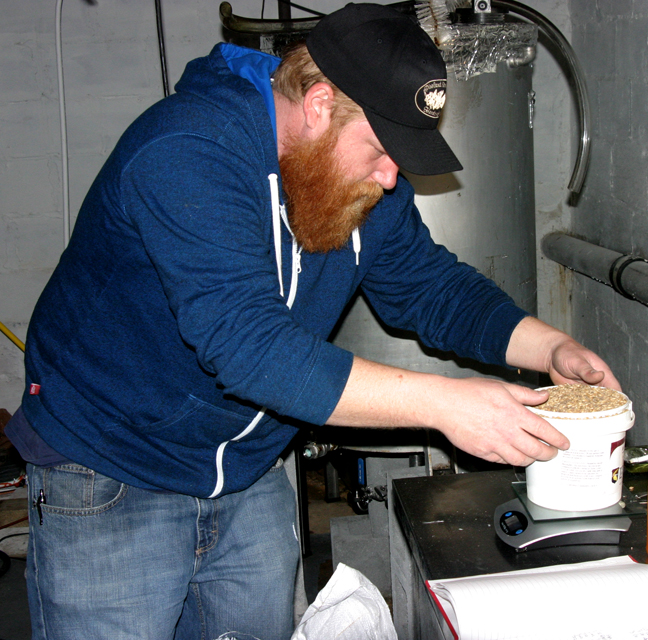
Jason weighs some specialty grain
That approval, on top of settling on a location, represents fresh momentum for Pinelands Brewing, whose application to the state Division of Alcoholic Beverage Control for a production brewery license has been pending for for nearly a year. (The application to state regulators is dated April 9, 2012.)

"Though it's taken a long time to get to this point, it's been worth the wait, just dealing with the different towns," Jason says. 

Little Egg Harbor officials seemed the most agreeable to having a brewery in town, he says. 

"We've gotten positive feedback. Our approval was unanimous, and they took a guy to task for a pool and shed project, and a (planning) board member voted against that," Jason says.

So a key hurdle has been jumped. 

Now the task shifts to getting inside the building and turning it into a brewery so it can be inspected by regulators and licensed. "The landlord said we could move in February 15th," Jason says.

In the meantime, he says, a web page is being built, and paperwork with federal and state regulators will be given some new attention.

Saturday, January 19, 2013

River Horse's countdown to Lambertville exit

The brewery seen from across the canal
Say you own a craft brewery that turns out some quite popular beers. 

And for every batch of beer you make, part of the cleanup chore involves some aerial maneuvering: raising the forks on your forklift all the way up their mast so you can fetch a bin of spent grain raked from the mash tun at your second-floor brewhouse.

Try dealing with that about six times per brew day. Doable, but a little tricky, certainly logistically cumbersome, and a huge mess if one of the bins should accidentally fall.

Graining out the hard way
Here's another scenario ...

Your distributors are due to pick up pallets of beer. So you need to know if they're bringing the 40-foot truck or one about half that size. Uh, it's the long one? Please get here early. 

The cramped local road your brewery sits along is the only access, and it's dotted with some homes, offices and galleries ... it's not exactly ideal, having big commercial trucks navigating that narrow lane.

So what would you do under those circumstances? Probably move. 

River Horse Brewing is. 

For those reasons and more, River Horse is exiting its 17-year home of Lambertville, heading about 15 miles south to Ewing, outside of Trenton, to a single-floor, stand-alone building in a business park along Graphics Drive. 

The new location on Graphics Drive
The new location in Mercer County promises to cure a lot of River Horse's current headaches, big and small, as it serves both immediate and future growth needs. 

"It's been a cautious path, this move," says Chris Walsh, who bought the brewery with co-owner Glenn Bernabeo in 2007, a time when River Horse was pretty much a withering brewery, a label in some serious trouble. 

"We wanted to do it for a long time, but in the beginning we had to fix the business. A move then, it would have been too much. We had to get the brand stable."

They did. And then some. 

The brewhouse on the 2nd floor
River Horse is New Jersey's second-largest craft brewery, coming in behind Flying Fish Brewing, which itself moved just last year from its original home of Cherry Hill to nearby Somerdale. 

These days, River Horse cranks out almost 10,000 barrels of beer a year, a tide of draft and bottled ales, both big and sessionable, in five year-round brews, plus five seasonals (brewer's reserve beers, too). 

Packaging River Horse Special Ale
The lineup includes a trifecta of Belgian styles (Double Wit, Belgian Freeze dark ale, and Tripel Horse), and once boasted a popular lager that had to be retired for the sake of freeing up tank space for production. 

(Dunkelfester, a dark lager made for Oktoberfest 2008, though a hit with the brewery's following, met a similar fate for similar reasons, having never seen its planned seasonal reprise.)

At 25,000 square feet and with four high loading docks to accommodate delivery trucks, the new location is expected to goose production by 30 to 40 percent over time and enable the return of that idled brew, River Horse Lager. 

"That's the short-term thing we'd like to do. It  had a big following," Chris says. "But the whole lager family is now open." Like a pilsner, a perfect warm weather style to slip into the seasonal lineup beside the brewery's über-popular Summer Blonde Ale.

Seek and find
Situated in the shadow of Ewing's town hall and police department, the new location was most recently used as warehouse space by The Mega Group, a public relations and marketing company that counts AAA Mid-Atlantic and Verizon among its clients. 

Siting the new location proved to be an arduous task. Chris says the brewery enlisted the help of Mercer County to find suitable space. After 30 to 40 prospective sites, the Graphics Drive property got the nod, pretty much to the delight of Ewing officials, who were happy to be drawing an industry with a rising profile.

Taps in the tasting room
Right now, floor drains are being installed, along with a mill room and a mechanical room. The brewery looks to leave Lambertville behind sometime in early spring, with its 25-barrel brewhouse and accompanying fermenters and bright beer tanks up and in use in Ewing around the start of April, a time when the brewery gets pushing out that Summer Blonde. 

Over time, as production needs demand, the brewery plans to replace its current brewhouse with a 50-barrel system and swap out its 40-barrel fermenters for 150-barrel tanks.

As bright as the horizon looks, and as sorely needed as the extra space is, saying so long to Lambertville is still bittersweet. The old Original Trenton Cracker factory, a 10,000-square-foot building that sits along the Delaware Canal, has been River Horse's only home since launching in 1996. 

Sure, the brewhouse is on the second floor, an arrangement that doesn't lend itself well to brewery tours. Yeah, there have been times the forklift has been driven beyond the loading bay, out to delivery trucks waiting on the street. Sure, the ceiling buckled under heavy, wet snow a few winters back, and the building flooded about 10 years ago when torrential rains swelled the canal beyond its banks. 

Oktoberfest 2008 crowd
But those are less complaints than realities, conditions on-the-ground, so to speak. For all that, the building and Lambertville have been a big part of the brewery's identity. Lambertville's an artsy Hunterdon County town you get around in mostly by walking, taking in the specialty shops, art galleries and restaurants.

That kind of foot traffic invariably makes its way to the brewery, whether during the annual ShadFest in the spring, Oktoberfests each fall, or just whenever. Both of those events, by the way, have always pulled in large crowds, making the brewery a point of interest in the town. 

"It's been home, part of the community since '96," Chris says. "We're certainly giving up some stuff, no doubt about it."

Friday, January 18, 2013

Drink up, and fix the shore

Here's how you can put your beer dollar to a good cause:

Flying Fish plans to release a wheat-pale ale next month to raise money for hurricane relief efforts.

The beer, F.U. Sandy (the FU stands for forever unloved, and perhaps what else you're thinking), will be the first new brew coming out of Flying Fish since it moved to Somerdale from its founding location of Cherry Hill last year.

The brewery describes the beer as a 50-50 balance of two-row pale malt and American white wheat, hopped with ADHA 483, an experimental hop donated by the American Dwarf Hop Association. F.U. Sandy is an inaugural use for the hop in a beer, the brewery says.

The 100-keg production run will be draft only, but Flying Fish left the door open for something further, saying on its website "we'll see what happens."

OK, that said, here's the really important part: The brewery forecasts raising $50,000 to be steered to a New Jersey-based, grassroots charity dedicated to storm relief. The brewery is taking nominations on which charity and you can send yours via email: info@flyingfish.com.

Now, $50,000 may not sound like a lot of money (it is for a comparatively small company) when the damage from the Oct. 29th superstorm – a hurricane that swallowed a nor'easter and went on a major tear – rivals the entire state budget and that Long Beach Island alone got shredded to the tune of $1 billion.

But it is this: It's private industry contributing, and it's an example for other businesses that can to follow. Furthermore, at a time when holdouts in the U.S. House of Representatives suggest the private sector play a role (which it has – $400 million raised from relief drives/events, including the 12-12-12 concert) and prefer to play politics, stalling votes on aid, trying to blow up the aid package, and just generally and needlessly screwing things up, every little bit helps. (See The Daily Show's Jon Stewart size things up here.  And here. The rants are the both second segments in the show.)

Also, there is a serious problem at play here: The House finally approved $50 billion in aid; the Senate approved $60 billion by a far more bipartisan vote; the two versions have to be reconciled before they can get anywhere near a presidential pen for signing. And last week saw evidence of further skirmishes over the aid package, so this could get drawn out even more. Meanwhile, the Star Jet roller coaster sits in the drink.

So, by all means, fill your growlers, raise a pint and raise some money. Because it really matters.

Tuesday, January 15, 2013

Cape May Brewing ain't so little now

Chris Henke, Ryan Krill, Mark McPherson
 There's a constant thread in craft brewing: A lot of the folks who get into the business gravitated to it from other careers.

In most cases, those people take a lot of the knowledge of their previous occupations and vocations into their new beer careers.

And so it goes for the new faces at Cape May Brewing, New Jersey's southern-most brewery. Take Mark McPherson, who jumped into brewing from a family-owned concrete business, joining the brewery 14 months ago part-time – he's been full-time for 10 – as it ramped up for a big growth spurt. 

"I'm local down here and heard about the brewery opening up. I met these guys and saw them brewing on a small scale," Mark says, standing just off the brewhouse, pausing from an early afternoon task of tending a mash.

Taproom bar
Mark checking the kettle
Cape May launched in July 2011 in Lower Township. At that time, it was just the owners – Ryan Krill and his dad, Robert, running things from the margins of their day jobs (finance and pharmaceutical consulting), while Ryan's college friend, Chris Henke, broke clean from his engineering job to be full-time at the then-half barrel brewery and to make the beer.

The brewery and its lineup of 10 draft-only ales has been growing rather exponentially since, taking over two more units of the small business park building it calls home beside Cape May County Airport. 

The extra space houses a 4-barrel brewhouse picked up last year from a Maryland brewpub; some repurposed rectangular wine fermenters; a 30-barrel conical tank used as a bright tank; a cold box for kegged beer; and a new tasting room that features a 40-foot polished concrete bar with 12 taps hovering behind it. (The tasting/taproom is open five days a week, by the way.)

"My dad is going to be full-time here in the spring," says Ryan. "He's checking out of consulting. He's part-time now, comes down during the week and on the weekends when we need help in the taproom."

Those weekends have been big, with brewery tours drawing enviable crowds; they've been positively booming during the summer, a peak season for any business at the Jersey shore. But that summer success has spilled over into other parts of the calendar.

Count 'em: a dozen taps 
All roads lead to beer
"It's just been busier and busier," says Ryan.

Ryan had planned to make the full-time jump this spring but did so last August and handles the distribution end of the brewery. "Every month our gross number has been increasing. Even though the summer has tapered off, it's just accelerating here for us."

Their list of draft accounts in Cape May County numbers 25 now and includes the Cape May-Lewes Ferry terminal. Their top-selling beer remains their Cascade-hopped IPA, but their seasonal honey porter sees high demand as well (a just-brewed barleywine will further their lineup; bomber bottles of special brews, like that barleywine, are also planned). Weekly production has surged, topping 20 barrels.

"It's not a consistent number for us, because we're still feeling things out," Ryan says. "We're gaining a number of new accounts. Even though that's a few accounts every week, as a percentage of the total, it's a lot for us. So we're still trying to feel out where we need to land for the winter."

Yet, that growth has meant the fledgling brewery needed more hands. 

Taproom manager Danny Otero
Thus, Mark was among a clutch of full- and part-time hires the brewery made to help it keep up. So was Danny Otero, a former corporate chef for Nordstrom's, who now manages the brewery's taproom in addition to handling some cellar duties.

For Mark, 38, signing on at the brewery meant making a decision to leave the family business, McPherson Masonry, in Erma (a section of Lower Township where the brewery is located). 

Peeling away from a family business where he was fourth-generation was a little stunning to his uncles, father and brother. But they were also impressed by the brewery and the realization of suddenly having a brewer in the family.

"It was a shocker," Mark says. "It was a shocker just to have a brewery in our area. The second big shocker was for me to be able to work in a brewery."

Cape May Brewing half barrels
But it's been very advantageous for Cape May Brewing, picking up a skilled construction worker at a time when it was shedding the skin of a very tiny operation. 

In fact, the most popular place in the operation is where you'll find some of Mark's handiwork: He built the tasting room bar.

"I did this section, too," he says, smiling and motioning to another part of brewhouse room. "I jackhammered out the concrete and put in the floor drains and repoured the concrete. I was a valuable asset. They needed a lot of concrete work."

There were advantages for McPherson Masonry, too.

"It alleviated a lot of the pressures, I believe, on the company, my coming here, one less mouth that my dad had to worry about," Mark says. "The housing industry has been very, very tough the past five years in Cape May County, because we're largely a tourist (area), a seaside resort. When the economy is bad, people don't vacation as much. They're not up to buying second homes or fixing up the second homes that they do have."

Friday, November 9, 2012

Marines turn 237 & do it with beer

Event notice
Most craft beer enthusiasts know food and beer these days are a much-talked-about ticket.

Thanks to that, beer enjoys a vaunted status like wine (set aside for now the argument that beer has always deserved that place in culinary discussion).

Food takes high-brow beer even higher. So this dish may make for a head-scratcher hearing it mentioned beside craft beer.

But since the lowly creamed chip beef on toast is on the buffet menu for the Tun Tavern brewpub's 15th observance of the founding of the US Marines this Saturday, it deserves some attention, as far as beer pairings go. (Iwo Jima Chili is also on the buffet, by the way.)

The emblematic comestible of dogfaces and jarheads (the dish has a 100-plus year association with the US military), cream chipped beef goes by a few handles in GI slang, like Stew on a Shingle, Something on a Shingle, or the more memorable Shit on a Shingle.

Yeah, it's a borrowed phrase
But what beer goes with it?

Tun Tavern brewer Tim Kelly recommends dialing back the hops. Malt flavor, too.

"Maybe Tun Light, or Irish Red because of the cream," says Tim, who did a hitch in the Army.

We're going to suggest giving a pint of Leatherneck Stout a try next to that plate of SOS. The hops aren't upfront, and the roastiness just might balance with the cream.

But whatever.

For the Marine Corps birthday bash, you'll find the Leatherneck Stout and the Tun's house-made light beer on the tap lineup beside regulars Devil Dog Pale Ale and All American IPA, plus pair of seasonal pumpkin beers  – Tim's traditional pumpkin lager and a 9 percent imperial pumpkin ale.

Semper Fi and the birthplace of the Marines
Craft beer fans in New Jersey know the Tun Tavern as Atlantic City's only brewery, located across from the Convention Center, which itself sits at the foot of the Atlantic City Expressway. (Tun owner Monty Dahm is a former Marine, and his establishment is outfitted in Marine Corps trappings. This video will give you a taste for what the event is like.)

On Nov. 10th, 1775, at the original but now long-gone Tun Tavern in Philadelphia, the Marines were founded. It was a marshaling of troops for the cause of, well, revolution, for getting the king of England out of everyone's face, an endeavor that had begun with a can't-turn-back-now moment over the previous April.

By that November, things had grown into a call for a few good men.

The rest is history. And beer.

What:
237th birthday of US Marines
Where: Tun Tavern, Atlantic City
When: 7 p.m. Saturday, Nov. 10th
Cost: $12.95 for buffet, $2 pints of beer

FOOTNOTE:
The Tun Tavern deserves some applause for pitching in during Hurricane Sandy. The brewpub is located on the west side of the city, where the elevation is a little higher, so it was spared flooding by storm surge (the high water did come up the veranda, though). The Tun lost power for about three days, but pressed some gas grills into service to feed emergency responders.

Saturday, October 13, 2012

Medal works

Call it the Bronze Age, Iron Fish edition.

Flying Fish, now officially calling Somerdale, NJ, its home, took a bronze medal at the Great American Beer Festival, while Iron Hill Brewery notched a silver, plus a pair of bronze medals. (Here's the complete winners list.)

Bronze finisher Exit 8, a chestnut Belgian Brown ale, debuted just before spring 2012 as the last new Exit Series brew to come out of Flying Fish's founding location of Cherry Hill.

You may recall FF's Exit 4 won gold in 2009, while its Abbey Dubbel won a silver the year before.

Speaking of Exits, Exit 16 is now a year-round beer in 12-ounce bottles and draft, giving Flying Fish shelf and tap representation in the double IPA heading.

That tidbit has been out in the beer headlines for a little while now, but it's worth repeating. Double IPAs have been immensely popular for sometime now, and this wild rice take on the style is worth your glass.

Meanwhile, Iron Hill kept its winning streak alive with a silver medal for its Rauchtoberfest (Lancaster, Pa., location), and bronze medals for its Roggenbier (Phoenixville, Pa.), Black IPA (Wilmington, Del.) and Russian Imperial Stout (Media, Pa.).

This year's medals extend Iron Hill's impressive winning streak to 16 years. That's how long the nine-location brewpub chain has been in business and more than half the existence of the GABF. 

About the pictures:
Flying Fish held an open house back on Sept. 29, an event that coincided with a town festival in Somerdale. It was a one-off open house, since the brewery is putting some finishing touches on the new digs before it begins brewery tours on a regular basis. Check the brewery's multiple feeds (Facebook, Twitter and website) if you have any questions about tours.

Thursday, October 11, 2012

Photo dispatch from GABF

Mid-Atlantic Brewing News' correspondent for New Jersey, Mark Haynie, is in Denver at the Great American Beer Festival.

He fired off these pics of J.J. Bitting brewer Chris Sheehan and Harvest Moon brewer Kyle McDonald.


Wednesday, October 10, 2012

River Horse: 5 years under new owners

River Horse Brewing wrapped up its Oktoberfest last weekend, featuring its fall seasonal Hipp-O-Lantern Imperial Pumpkin Ale (among other brews), plus a cask version of its Special Ale, dressed up with bourbon-soaked oak chips, cinnamon and vanilla bean.

The crowd that packed into the brewery and its back loading area made quick work of that cask Special Ale and jammed once again to brewer Chris Rakow's band, Ludlow Station.

If you're keeping score with the Lambertville brewery, then you'll know River Horse crossed a milestone at the end of this summer, something that the annual Oktoberfest was symbolic of.

Five years ago in August, River Horse gained new owners, a changing of the guard that not only rescued a troubled brewery but set it on a steady course that has delivered Garden State craft beer enthusiasts not only a more diverse and quality beer lineup but some really creative beers in the mix as well.

Oh, and the hippos on the six-pack packaging got a makeover, too.

But it was at the 2007 Oktoberfest, then a two-day affair at the brewery (it's now a more manageable single afternoon), that Glenn Bernabeo and Chris Walsh got to really mix with those beer drinkers who remained faithful to the brand and let them know that the new owners were a couple of guys who really appreciate beer and were dedicated to rebuilding the brand.

Back in 2007, River Horse, the about 10 years in business, had fallen into inconsistency with its product quaslity, and among package store beer managers, the name was one that many were beginning to skip.

"A lot of folks thought we were out of business when we had that one and were a little surprised when they heard that things were not good," Glenn says, recalling that 2007 Oktoberfest. "That wasn't the case, obviously."

The turnaround, for a lack of a better term, involved restoring quality, shaking up River Horse's lineup that included a clutch of Belgian styles, some 1990s craft beer standards like amber and hoppy ales, and a lager. It also meant refocusing the River Horse market, ditching some distribution areas that one could easily argue had overextended the brewery.

"What we've done since we've taken over is pull the footprint in to be way more local," Glenn says. "When we started we were in Virginia; we were in D.C.; we were in Delaware; we were in Maryland; we were in Rhode Island; we were in Boston; we were in upstate New York ... We've pulled those territories in, and right now, though production-wise we're much higher volume (but), it's concentrated in a much smaller area.

"We've become focused on being a local brewery. We're predominantly in New Jersey; we're in Philadelphia/five county; we're in Lehigh Valley, out to Lancaster a little bit, Manhattan, Brooklyn, southern Connecticut ... and that's it. That's been working for us."

Something else that has worked is sharpening the brewery's business approach. It didn't hurt the brewery added tank capacity, but Glenn says production efficiencies paid off as well.

"We have added physical capacity with respect to tank space. We've also done a lot of work around our yields; we've done a lot of work around our production timing and the production flow," he says. "At the time we weren't even getting the most out of the capacity we had. So we've grown volume even more than we've actually added tanks because we've gotten a little bit sharper at how we operate the business.

"Now we're very, very regimented in terms of what our brew schedule is, how our product is launched, our packaging schedule ... We have scheduled down days just for maintenance (and) quality control. We always had the mentality that if we get the product right first, then all of the other things are going to fall in line. So far, that's been true."

So what's next for River Horse?

"We're always experimenting. We've got a Scotch ale on the horizon, some smoked beers on the horizon," Glenn says. "We're going to continue to expand our product line and try to keep things interesting and fresh."

Monday, October 8, 2012

Talking to Trap Rock brewer Charlie Schroeder

The recently enacted law that gives a boost to New Jersey's 25 craft brewers probably helps the dozen-plus brewpubs across the state the most, allowing those breweries to get their names out before the public like never before.

Unlike production brewers that could put their beers in bars and on store shelves, brewpubs in New Jersey had been relegated to selling beer from the place they made it. That restriction limited exposure for the pub breweries' beers and left a drinking public somewhat bewildered at the idea of being unable to get those beers at packaged goods stores. After all, Sly Fox, for example, had a couple of restaurant-breweries in Pennsylvania, yet it's beers were on store shelves.

The new law changes that in New Jersey. Brewpubs, like their production brewer colleagues, can now sign up with beer wholesalers for distribution, giving the pubs a much wider reach than the foot-traffic into their establishments ever allowed.

But imagining that happening is easier to do than making it happen, given the expense of taking on expansion to serve not only the pubs' patrons, but carving out a niche in the crowded and competitive craft beer markets. (Brewpub owners can also own up to 10 locations.)

Still, that idea of a wider reach was fast on the minds of the folks at Harvest Restaurants, which operates nine establishments in upscale areas of Union, Somerset and Morris counties and counts Trap Rock brewpub in that mix.

Harvest is uniquely situated to quickly take advantage of the new regulatory changes and has envisioned putting the beers made at Trap Rock in Berkeley Heights on tap at its other restaurants. It's Hathor Red and Ghost Pony lagers are have been contract-brewed at High Point (Ramstein) for the other Harvest establishments for a while now.

But with a major change in the rules – a change that, in effect, hits the reset button for the state's craft beer industry – it makes sense for a restaurant company that has a brewpub under its ownership to bring things in house.

From that vantage point, Trap Rock brewer Charlie Schroeder took time out from a busy end of the week brew day to discuss such growth and what it would entail.

BSL: Talk about how busy Trap Rock has become. Craft beer has been in New Jersey since 1995, but has really grown hot with the national trend for about four years now.
CS: I'm selling more beer this year than I did last year, and last year was a very big year for me. I finally did over 500 barrels, and I'm beating that this year. Keeping up with demand, even with the new fermenter, isn't easy. I could probably use another fermenter. I'm trying to sell more kegs, but I don't have enough room to store kegs, and I run into the issue of running out of beer, especially the Oktoberfest. This is the first year I'll make three batches of that.

I don't sell a lot of kegs, but it's an important part of the business because people will drink it at their house. (Their guests) will want to know what it is, then they'll be interested and then they'll want to come here and purchase a growler or have a pint here. So it's really about getting the name out there. That's really the only way we can get the beer out there to market, is for customers to buy it and take it home.

BSL: The recently signed craft brewing legislation liberates brewpubs, lets them sell through wholesalers. Because Harvest Restaurants has a number of establishments, the bill signing could conceivably make Trap Rock the supplier of house brands. What's the process of moving forward?
CS: It may mean we find a bigger location or keep the current location and expand possibly next door, or find a bigger building ... I'm not sure yet. We haven't sat down and talked about it because it (the bill signing) just happened a couple weeks ago.

BSL: But this is definitely something that's out there?
CS: There have been conversations (in the past). It's just a matter of sitting down and strategizing, figuring out what's going to work. This legislation is something I have been waiting for for the last five years. The owner has always wanted to do something. Back in 2000, 2001, that's when we first started contract-brewing the Ghost Pony and the Hathor Red at Ramstein.

What we want to be able to do is have my India pale ale on draft, a wheat beer, a dark beer, Belgian beers, and put them in bottles, too. That is something they want to do, and this gives us that opportunity now to do that.

BSL: With some necessary changes.
CS: Now there's a need to expand. Before, when you're just selling within your own walls here, there's no way can expand because you're just selling to who comes in through the door. And you're hoping that you're getting more and more people each year, then you run out of room in the brewery to make more beer.

BSL: In terms of branding, it's important to be able to bring all of the beers here to the other Harvest restaurant locations?
CS: Absolutely. (Patrons) ask all the time 'Why can't I get the beers you make here at those locations?'

BSL: So in effect, the law change and letting you work with a wholesaler could make Trap Rock a focal point of Harvest Restaurants identity.
CS: Oh yeah. It ties it all together.

BSL: So what kind of timeframe are we looking at, in the best-case scenario, of being able to site something and everything comes in at reasonable expense for brewing equipment?
CS: I think it's going to take six months to a year to really get it where it needs to be. I don't think it's going to happen any sooner than that. There are other restaurant projects (the owners) are working on; I don't know where I fit into that. They could decide they want to do it now, and it could be three months, or they need to wait to get certain locations lined up, and then we would do it.

BSL: Have you talked to any distributors yet? They were watching the legislation's progress.
CS: I've been approached ... I have one that wants to talk to us, and another one I can talk to ... There's three, three of them. But I don't negotiate that. That's up to the ownership.

BSL: When the craft brewing bill was working its way through the Legislature, one of the talking points focused on job creation. What's a conservative forecast for jobs that could come from a bigger Trap Rock operation?
CS: I have two people now that are working with me. There's a strong possibility of a third depending on how big of an operation I get into next year ... So I have two guys right now that would come on, and a third person with experience, depending on what size brewery or how busy we're going to be. And that I can't predict yet.

BSL: As far as brewery size goes, the objective is to get Trap Rock beers into the other Harvest restaurants?
CS: Yeah. I would say for me it's knowing what size brewery I can get, what space am I going to be able to get. And from there, I'll know how far I can expand out, beyond the restaurants. But the restaurants aren't going to pay the bills. They're going to help. But it's going to take more than that to pay the bills to make the amount of barrels we need to. It's not going to be 1,000 barrels ... I'm looking at 3,000 barrels within the first two years. I don't see why not.

BSL: What about bottling?
CS: My customers want bottles. There are still diehard growler fans that will always buy growlers. But I have customers that want bottles. It moves in that direction. If you're a brewery opening up, you do draft and then people want to take it home – it's the same thing here – and drink it when they feel like it. They don't want to have to feel that they have to drink a whole growler in a day or two.

BSL: So the smaller size becomes important ...
CS: They want a smaller size; they want a 12-ounce bottle.

BSL: But you're not looking at a bottling line?
CS: That depends on the size of the brewery. We can bottle here. So there's strong possibility of me bottling here for the other restaurants, certain beers.

BSL: The higher-gravity beers?
CS: I'm not sure yet. We're working on different labels. We haven't really talked about exactly what's going to the different restaurants. But we have the flexibility here to bottle anything we want. For me, this is a good place to start from. You can bottle 10 cases and send it out and see how it does.

Saturday, October 6, 2012

Putting his stamp on things

Catching up with Chris Sheehan, brewer at J.J. Bitting brewpub ...

In a few days' time Chris will be heading west to the Great American Beer Festival, catching up to the five beers the Woodbridge restaurant-brewery sent to this year's gathering in Denver.

Bitting is one at least four Garden State breweries sending beer to the Oct. 11-13 festival (according to the GABF website, the other three are Flying Fish in Somerdale; Harvest Moon in New Brunswick; and Iron Hill Maple Shade, a bronze medalist last year for Vienna lager).

Bitting selections that Chris sent are Victoria's Golden Ale; Knockout Bock; a dunkelweizen; the hoppy foreign export Onyx Stout; and Bad Boy Oktoberfest, a GABF bronze medalist a dozen years ago. (They're all entered into competition.)

With just over a year under his belt at Bitting, having arrived shortly after Newark's Port 44 Brew Pub closed over the summer of 2011, Chris has spent his time in Woodbridge bringing to tap beers from his own recipe catalogue.

For instance, this year is the second go-round at Bitting for his wet hop Harvest Ale made with home-grown hops. Onyx Stout is a Jersey remake of the well-received Black Hole XXX Stout he turned out at Chelsea Brewing in New York.

The Harvest Ale went on tap a couple of weeks ago, the same day as the Central Jersey Beer Fest, the event Bitting has sponsored at a park near the pub for the past six years.

The 10 pounds of wet hops (of differing – some unknown – varieties) were used mostly for finishing, though some did get a 30-minute kettle addition. They came from upstate New York and Chris' home in Bergenfield, where one of his bines was a big-time producer, providing a fifth of the fresh hops he used.

Chris has also been tweaking some of the Bitting flagships, but he has been rather conservative in that regard with the Oktoberfest.

"I reworked all the recipes, except the Oktoberfest because it's an award winner from years ago. I did have to take sack of grain out of it. I was getting better (mash) extraction from a change in the crush of the grain and just better brewhouse techniques."

Good luck in Denver to Bitting, Iron Hill, Harvest Moon and Flying Fish.  

Wednesday, September 26, 2012

One more from the pumpkin patch


Staying with the topic of pumpkin beers for a little bit ...

A very big thread that runs through craft beer finds brewers surveying the landscape and looking for ideas they can use to create a beer. (OK, yeah, that's how a lot of life works – drawing upon influences to produce something you call yours.)

Pro brewers do it; so do homebrewers. Call it homage ... call it borrowing. Call it knowing a good idea when you see it.

Sal Emma and Terry Leary, a homebrewing duo from Cape May County, fit all three.

Making a pumpkin beer and adding the usual pie spices to the rim of the glass, like salt on a margarita glass, sounded like a worthwhile technique to Sal, who encountered it when he was served a pint of pumpkin beer at Sweetwater Tavern, a Northern Virginia brewpub, a few years ago.

The idea sounded pretty good to Terry, too, and thus, their fall pumpkin ale was born last year. A couple of weeks ago, the pair went about the business of reprising it for this autumn, brewing it in their 2-barrel setup, using sweet South Jersey pumpkins in their mash and some honey in the boil.

(This past spring, the two won a homebrewer contest sponsored by the Tun Tavern and At The Shore weekly entertainment tabloid published by The Press of Atlantic City newspaper. See the accompanying video below. Terry and Sal followed up their contest-winning robust porter with a killer IPA that could give Tröegs Perpetual IPA a run for its money.)

Some background ...
Sweetwater, a restaurant-brewery in Sterling, Va. (with a couple other restaurant locations), began making the pumpkin ale a year after opening its doors in the mid-1990s.

Brewer Nick Funnell, the guy who's been in charge of Sweetwater's beers since the beginning, mashes with pumpkin and adds a blend of traditional pumpkin pie spices in the brew (the spices come from a merchant local to the brewery).

And for a garnish – the part that stuck in Sal's mind – Nick says the serving glasses are rimmed with roasted pumpkin seeds and more pie spices to, well, spice up the drinking experience.

The glass trick, as you can imagine, lets the drinker control the spice experience, either by constantly rotating the glass for more, or drinking from the same spot for less.

Because everyone's palate is different and personal preferences matter.

That's the part fresh in Terry's mind. His preference is for less spice, as in just pumpkin in the mash. The spices go on the glass.

"We grind up (salted) pumpkin seeds," Terry says, "mix the ground seeds with nutmeg, allspice and cinnamon – create a dry mixture of that – then reduce apple cider to a semi-thick roux, dip the glass to about quarter inch in, then dip it in the seeds and spice."

Notes Sal: "We grind 'em real coarse because you want to be able to chew the pumpkin seeds."

For their 2-barrel batch, they started with about 160 pounds of grain – Briess 2 Row, some biscuit malt (you want that pie crust notion), some caramel malt and special roast. To that mash, they added 30 pounds of pumpkins bought from a Cumberland County farmstand. (Last year, they used Libby's canned pumpkin.)

"The pumpkin variety is Long Island Cheese, also know as Cheese Wheel, an heirloom known for its sweetness," Sal says. "They were grown by the Bertuzzi family in Vineland. The seeds from those pumpkins will be in the glass-rimming treatment. Even the seeds are sweet."

The pumpkin adds a some color to the beer, Sal says, "a little bit of essence of pumpkin. It's not a real pumpkiny beer. Terry thinks it's more an aroma kind of thing."

In the boil, they added 15 pounds of honey (hops included Chinook, Willamette and Centennial, with a dash of homegrown Cascade at the very end for aroma) for a beer (around 6% ABV) that is shaping up fine, with that pumpkin essence in the nose.

"(The) beer smelled and tasted great at racking," Sal says, "very malty, not over the top
in hop bitterness but a nice, long hop finish."

Halloween's not far off; neither is their beer.


Tuesday, September 25, 2012

Gourd in beers: who's drinkin' 'em?

Iron Hill's Chris LaPierre with bourbon pumpkin ale
Talk pumpkin ales and you can quickly divide craft beer enthusiasts into two camps: those who annually look forward to the brews that have become the dominant fall seasonal these days, and the one-and-done folks who are happy to move on after drinking a single pint.

But there's a third group that falls into the mix: the cocktail and chardonnay crowd who look forward to pumpkin ales as their moment for crossing over in to the beer world.

"I definitely think there are people out there that the only beer they'll drink this year is pumpkin beer," says Iron Hill's brewer Chris LaPierre. "This is a kind of beer that wine drinkers, martini drinkers, people that say they don't drink beer ... you know, don't like beer ... (they) will drink pumpkin beer."

Iron Hill taps its flight of pumpkin ales this Saturday, and that third group drinkers are very much represented in the crowd that has made IH's Welcome, Great Pumpkin event the chart-topper as far as the brewpub's lineup of events through the year goes. In fact, in terms of sales, the Great Pumpkin event has eclipsed IH's  Belgium Comes to West Chester Belgian beer fest held at the nine-pub chain's West Chester, Pa., location each January. (Featured beers include The Great Imperial Pumpkin Ale, Pumpkin Ale and Bourbon Imperial Pumpkin Ale. For the record, IH's West Chester location does a Gathering of the Gourds pumpkin beer salute.)

It helps that South Jersey's reception of IH in 2009 turned the company's Maple Shade location its busiest. But for all of the factions that surround pumpkin beer, there is definitely something about the style that people find alluring.

"Just look at how crazy people are about it," Chris says. "Look at the coffee shops, everyone's got a pumpkin latte. I'm sure all the fast-food places probably have a pumpkin milkshake, or whatever. People just go nuts for it.

"Outside of brewpubs, look at how much earlier pumpkin beers are coming out. Every year they're out two or three weeks earlier. Everybody's trying to get theirs out early, trying to get it out before the competition. There's just something about that style."

Pumpkin beer is a balancing act for IH Maple Shade. It's appearance on the taps collides with Oktoberfest. The märzen is still a hot ticket, because Oktoberfest hews to tradition, as far as style goes. It's almost always a copper-colored strong lager, with its sweetness held in check by a dose of noble hops.

Pumpkin beers, on the other hand, get to spread out.

"I used to say that Oktoberfest is our fastest-selling seasonal. In a way, it still is because it's not cannibalized the way pumpkin is – imperial pumpkin, Belgian pumpkin," Chris says. "They're all going to steal from each other a little bit, whereas Oktoberfest is just one style. It makes my life pretty difficult for the fact that those are by far our two fastest-selling seasonals, and they both happen to be out at the same time."

That said, Chris does try to ensure Maple Shade's pumpkin ale makes a reprise deep into the fall, after Halloween. Call it pumpkin management.

"We used to have our pumpkin beer on just before Halloween, to just after Thanksgiving. It's popularity has made that difficult to do. I have trouble keeping up with it," he says. "So what I do now is put one on just before Halloween. Then there's usually a little bit of a gap, then we try to get another batch in and bring it back for Thanksgiving time."

Spice vs. pumpkin flavor
A debate that involves pumpkin beer is whether the beer flavors are enhanced by the pumpkin, the spices (i.e. clove, nutmeg, allspice, cinnamon) or both. Chris' take is: If a brewer indeed uses pumpkin in the mash (not all do, some go the spices alone), that flavor will come through. (However, he concedes he's never put it to a blind taste test. And for the record, Chris uses about 300 pounds of pie pumpkins, that after processing for brewing purposes end up as about 80 pounds in the mash for a 12-barrel batch.)

"Certainly if you get a pumpkin latte or burn a pumpkin candle, there's not going to be any pumpkin in it. It is all about the spices" he says. "A lot of people don't bother putting pumpkin in their pumpkin beers, because they say all people are looking for is the spice anyway.

"My argument is, if you smell what this restaurant smelled like at 8 o'clock in the morning when they're roasting the pumpkins up in the convection ovens, there's no way that flavor's not carrying over into the beer. I do think there's more substance to it."