Friday, March 23, 2012

Jersey Shore attraction: craft beer & food

Click to enlarge beer list
At the intersection of the words "beer" and "festival" this weekend, you'll find quite a companion spread at the Jersey Shore: chicken and a summer ale, kielbasa and a golden lager, or brisket and a pale ale.

Beers on the Boards at Martell's Tiki Bar Saturday on the Point Pleasant Beach boardwalk features regionally and locally produced craft beers, with some of those brews used in the preparation of the dishes on the event's buffet menu. Six New Jersey brands figure prominently on the beer lineup, which also includes some of the usual big festival suspects, like Murphy's Irish Stout. (First session starts at 12:30 p.m.; evening session is set for 6 o'clock.)

Nonetheless, the event represents something bigger, as far as beer scenes go. Beers on the Boards reinforces the inroads that craft beer has made at the Jersey Shore, an area of the state where the big macro producers still command a lot of tap handles, even as craft beer's popularity continues to surge.

That doesn't mean the Shore is an utter craft beer dead zone. Far from it. But it's hard to deny that the region has trailed the west side of the state and North Jersey in craft beer appreciation and good beer bars coming online.

"The Jersey Shore has great potential, but it's a tough nut to crack. Some places kind of get it," says promoter Chris DePeppe, a Jersey Shore native-turned-Pennsylvanian whose TotalBru Marketing and Beerheads companies launched the Beer on the Pier festival in nearby Belmar two years ago. "Whether we'll sway some of the Miller Lite or Bud Light drinkers, I don't know. There are some craft beer drinkers out there though."

Beerheads teamed with Martell's and the Point Pleasant Beach Chamber of Commerce to stage Beers on the Boards. East Coast Beer, the Point Pleasant-based company behind Beach Haus pilsner, signed on as a sponsor. So did Cricket Hill Brewing, and you'll find the two brands among the Jersey brews on the event's lineup. (The others are: Flying Fish, Carton, Kane and Tuckahoe.)

"Sure it's special to us. It's our back yard," says East Coast's John Merklin. "There are actually two stories here: Craft beer has come to the Jersey Shore, and the Jersey Shore has come to craft beer."

And this time, it's borrowing some ideas from beer-and-food events like the Brewer's Plate in Philadelphia, or SAVOR, the Brewers Associations annual gathering in Washington, D.C.

Click to enlarge menu
Folks who attend Beers on the Boards will find plenty of flavors to explore as they sample both the beers and the buffet, says Martell's executive chef, Tom Peet, who crafted the event menu. Tom paired the beers to the bring out the best flavors of the beef, fish and chicken dishes.

"I like the Philadelphia Pale Ale beef brisket, the Yards Brawler Fish 'n' Chips. That (beer) paired well with the fish. They're all good in their own way," Tom says, adding any dish is a good starting point.

"Start with your heart. If you like chicken go with chicken. If you like beef, go for beef. It's all about individuality; it's what you like," he says.

Wednesday, March 21, 2012

Turtle Stone becomes 2nd NJ licensee for 2012

Three beers for Turtle Stone Brewing.

That comes after three cheers for the Cumberland County brewery, licensed by New Jersey regulators eight days ago.

Owner Ben Battiata jumped straight to brewing after the Division of Alcoholic Beverage Control made its customary inspection of the Vineland brewery and gave the thumbs-up on March 13th.

Using a 1-barrel pilot system, Ben turned out a half-batch of a milk stout, and full batches of an American stout and a red rye ale, the latter of which is destined to be the house beer at the Old Oar House Irish Pub in nearby Millville, a bar that's been one Ben's haunts for a while and in recent times has been working craft beers onto its 30-plus taps.

"It's the bar I've been going to since I've been allow to go to bars," Ben says.

Turtle Stone's 15-barrel brewhouse is still being set up. Thus, Ben cobbled together the small pilot system to get some beer produced to ensure the brewery had a presence at the Atlantic City beer festival March 30-31. "We didn't want to lose out on that exposure," he says.

As a vision, Turtle Stone goes back about six years. As brewery startup, things started coming together more seriously three to four years ago, with the acquisition of brewing equipment and scouting a location. Ben and his partner, his girlfriend Becky Pedersen, saw the pace quicken last year with federal regulators signing off on the project and brewery construction taking place through the fall and winter. Last week's visit by ABC inspectors was the breaking of the finish-line tape to what had become a bit of a marathon. Despite that, there are still a few more details to get in hand, such as bringing the 15-barrel brewhouse online and adding a tasting room. (Ben hopes to have that taken care of by summer.)

"I've been waiting for things to settle down so I could get some rest. It hasn't worked out that way," says Ben, who still works full-time for Viking Yachts in Bass River. He brewed the three inaugural ales over four sessions (two batches of red rye ale), sometimes working until 4 or 5 a.m.

With the red ale, Ben says to look for a stronger rye presence. The 6% ABV brew was made with caramel malts and an ample amount of rye, and hopped and dry-hopped with Cascades, although future versions are likely to include Amarillo hops. (Right now, Amarillo is hard to get, but Ben hopes to lock in a supply at some point.)

"I really like rye beer, so I pushed that up a little more," he says.

The milk stout (5.2% ABV), Ben says, was Turtle Stone's first batch as a licensed brewery and comes from his recipe file built up from over a decade of homebrewing. It was done in a smaller batch because he was still getting a feel for the pilot system. He plans to take a couple of sixtels of the milk stout to the AC beer fest, but more of the two other brews.

The American stout (6% ABV), a beer that has always been part of the launch plans for Turtle Stone, also features Cascade hops, plus the Zythos blended hop. The grain bill includes some oats to give the beer a silky body.

Coming six days after the approval for Flounder Brewing in Hillsborough (Somerset County), Turtle Stone is the second production brewery licensed by the state this year, nudging up the tally of New Jersey craft breweries to 24.

The two additions come on the heels of five licensees in 2011, and the exit from New Jersey's craft beer scene of just two startup breweries since 2010 (Port 44 Brew Pub in Newark and Great Blue Brewing in Franklin Township, Somerset County).

Saturday, March 17, 2012

Irish sights & sounds at Cricket Hill tour


Some images from the tour at Cricket Hill in Fairfield.


Thursday, March 15, 2012

Great Blue opts not to renew license

Another casualty among New Jersey's craft brewing enterprises.

Great Blue, a 2-barrel brewery on the Suydam Farm in Franklin Township, Somerset County, opted to let its licensing and bonding run out.

Ryck Suydam, one of the principals in the brewery that was licensed early last year, says the decision to idle the family-owned brewery resulted from not having a person available to run it.

"My son was my brewmaster, and he works for another brewer full time and just couldn't do both. I didn't have anybody in the wings, and I couldn't do it with my schedule," says Ryck, who also runs the 300-acre family farm and is a partner in Suydam Insurance Agency. "So, the brewery is in mothballs for the time-being. The entity still exists, but the license has non-renewed."

Known for wide range of produce and commodities, including eggs, pork, hay, vegetables, melons, berries and flowers, Suydam Farm also grows hops. Ryck says some hop varieties will be cultivated this growing season, but not to the degree of past years. (The farm has grown hops since the 1990s.)

"It's just not cost-effective compared to the other things we do grow on the farm," he says.

For craft brewery start-ups in New Jersey, 2011 was a hot year, with five brewing enterprises being licensed by state and federal regulators. Great Blue, named for the herons that feed at a pond on the farm, led the pack, getting licensed Feb. 28, 2011. (In chronological order, last year's class of new breweries goes like this: Great Blue, Cape May Brewing, Kane Brewing, Carton Brewing and Tuckahoe Brewing.)

With a brewhouse that once produced beers for the now-defunct Cedar Creek brewpub in Egg Harbor City, Great Blue had planned to target its beers made with its own Jersey-grown hops for markets near the farm, a take on the concept of farm to fork, in this case, farm to glass.

The brewery led off with a red ale nearly a year ago, a beer made as much to work out the brewing processes on its equipment as much as anything. But the matter of who would tend the kettle proved to be an early problem, and with all of the competing interests and time constraints of the owners, finding a brewer proved to be something that was not easily resolved.

Great Blue's exit/hiatus from the Garden State's craft brewing scene follows the shuttering of Port 44 Brew Pub in Newark, which closed last summer.

Tuesday, March 13, 2012

For Cricket Hill, summer starts now, runs longer

Rick Reed pours at Brewer's Plate event
The news out of Cricket Hill is their newly acquired 30-barrel fermenters have been put into service – an imperial IPA and their hot-weather seasonal, Jersey Summer Breakfast Ale, are the brews that the Fairfield beer-maker announced last week had christened the tanks.

Going beyond that tidbit of news, owner Rick Reed says Cricket Hill will bump up its production run of the summer seasonal this year and make some packaging adjustments.

New 30-barrel tanks
"We'll do 20 batches; that's up by two brews. We'll do more draft and less bottles. We'll cut back the bottles and increase the sixtels," he says.

Speaking of those two fermenters (bought from Switchback Brewing in Burlington, Vermont), Rick says the extra tank space will boost annual production capability to almost 4,000 barrels, up from 2,600.

The brewery has also added a new chiller to handle the additional tank load, plus a grain silo that is forecast to help trim operating costs.

On the festival trail this month, you can expect to run into the Cricket Hill folks at Beer on the Boards in Point Pleasant Beach (March 24) and the Atlantic City beer festival (March 30-31).

The Cricket Hill crew beneath Springsteen pic at the March 11th Brewer's Plate at the National Constitution Center in Philadelphia.

Monday, March 12, 2012

Boaks Beer on a touch screen

Will the app look like this?
Coming to the iTunes Store – the Boaks Beer iPhone and iPad app.

Boaks founder Brian Boak says the free app being developed by a New York City ad agency will be debuted at the Saturday afternoon session of the Atlantic City beer festival (March 31).

"For people who have iPhones who are there for the early session, there's going to be some very special VIP privileges they will be able to get, using their iPhones," Brian says.

"The balance of the app is going to (let you) be able to learn about Boaks and find out where Boaks Beer is available and to get us your email so we can keep you updated, have you friend us on Facebook and follow us on Twitter."

The app actually is expected to be available a few days ahead of the beer festival. However, Brian says, some features will be locked until the formal debut.

The idea for the confluence of personal gadgets and beer marketing is obvious: steering beer drinkers to the brand.

Brian Boak (right) at Brewers Plate in Philly
"The more people who interact with us, the more people are likely to try Boaks Beer. The more they learn about Boaks Beer, the more likely they will try it," Brian says.

Boaks entered the New Jersey craft beer market in 2008 as contracted-brewed label. The Pompton Lakes company's lineup of Belgian-style beers and an imperial stout are brewed under contract by High Point Brewing in Butler.

New Jersey Beer Company, based in North Bergen, was recently added as a contract brewer and last week brewed a Belgian brown (Abbey Brown, 7% ABV) for the Boaks label.

A changing of the guard at High Point

A bittersweet moment at High Point Brewing's first open house of the year and the release its 2012 Ramstein Maibock.

The event on Saturday (3/10) was also a sendoff for head brewer Bryan Baxter, who's leaving to join Otter Creek Brewing, the Middlebury, Vermont, brewery known for Stovepipe Porter, Copper Ale, Wolaver organic beers, and now a component of Long Trail Brewing of Burlington, Vermont.

Before the doors opened for the Ramstein event, owner Greg Zaccardi gathered the brewery's volunteers and thanked Bryan for his dedication to High Point, presenting him with personalized 2-liter, German-style growler.

Bryan says Vermont had virtually become a second home, and the Otter Creek job he starts March 19th grew out of that.

"I've been going up there pretty much every summer with my fiance, and we always were stopping in. I got to know their brewmaster and their head brewer," he says. "It's an opportunity right now I can't refuse. It's a way bigger brewery. I'll be able to learn a lot of crazy stuff."

Bryan took over as High Point's brewer in 2008, when Paul Scarmazzo retired after a stroke. He quickly put his own stamp on the Ramstein wheat and lager beers, including the brewery's well-received seasonals. Ramstein Oktoberfest and Maibock earned top ratings by BeerAdvocate and RateBeer during his tenure.

"Bryan came in cleaning kegs, like everybody does, scrubbing kegs, working side by side with Paul, helping out and learning the importance of cleanliness and exact careful brewing techniques," Greg says. "He demonstrated he could do the job when Paul retired."

Leaving, Bryan says, is tough: "This is my home. Greg's my friend. He's not my boss, he's my friend. He gave me the opportunity to take over."

Alexis Bacon (at left with girlfriend Melody Bioletti), the assistant brewer under Bryan, now moves up to head brewer.


Friday, March 9, 2012

Brewery takes name from Jersey shore town

A  Pennsylvania craft brewery in development pays homage to a New Jersey beach town.

Robert Zarko and his brother, Tom, are longtime summer vacationers on Long Beach Island.

Robert, who has taken the title head brewer, says their Ship Bottom Brewery will produce some big stouts, well-hopped pale ales and a hefeweizen.

Like so many before him, Robert, 43, a computer consultant, took the homebrewer arc to commercial craft brewing. He traces his start to 1995 and a homebrew kit given a tryout at his in-laws' oceanside home in Ship Bottom, Long Beach Island's gateway town (the Route 72 causeway over Barnegat Bay ends at Ship Bottom) and home to the world-renowned Ron Jon Surf Shop's founding location.

The Zarko brothers still spend summers on the island – Robert in Ship Bottom, Tom in Surf City, the next town north.

"I've been homebrewing for 15 years, and in the last two years, I decided to go with a business," Robert says. "I got a real push from family and friends, did some local events; people said they really loved the beers."

Some of the brews, like the sessional Shoobie Pale Ale and Beach Patrol Hefe (5.4% and 4.8% ABV, respectively), take their moniker from the familiar Jersey Shore lexicon; others, Barnacle Bottom Stout (8.7% ABV) for instance, are straight-up nautical in name. An imperial IPA, at 11.8% ABV, is the biggest beer in Ship Bottom's lineup, while a seasonal pumpkin ale (9.7% ABV) and a black IPA (9.2% ABV) aren't far behind.

"We do pretty much anything," Robert says. "We have 10 flagship beers, from double IPAs, pumpkin ales and hefeweizens."

Their brewery, based in Delaware County, Pennsylvania, was founded in May 2011, and is in the process of obtaining licensing from federal and state regulators. Robert says he hopes to have that settled sometime this spring, barring any hitches. The Zarkos hope to enter the New Jersey and Delaware markets sometime after they're up and running in Pennsylvania.

In the meantime, like many a budding brewing enterprise, Robert and his brother have been working to create a buzz about their brand, doing meet-the-brewer events around their local bar scene.

Dilapidated house near Ship Bottom
Earlier this month, the two poured a brewer's reserve version (bacon and maple syrup) of Barnacle Bottom Stout  at the Philly Craft Beer Festival, plus a quadruple dry-hopped pale ale.

"I actually want to do a beer that pays tribute to the little house on Cedar Bonnet Island, the one that's falling down on the side of (Route 72). I just have to figure out a good name for that," Robert says. "I'm a big surfer, so I want to do some of the surf spots."

Wednesday, March 7, 2012

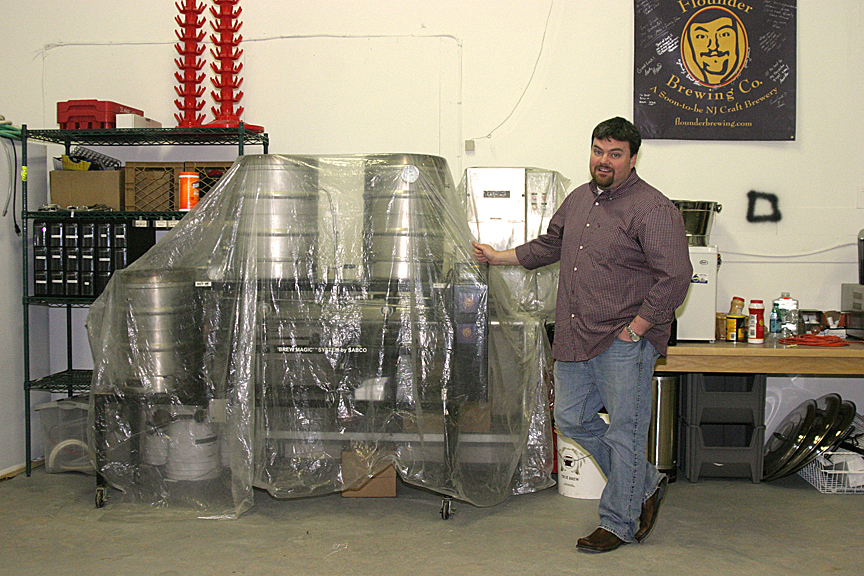
NJ green-lights Flounder Brewing

A Flounder founder: Jeremy Lees
One of the first things you notice when you settle into Flounder Brewing is the glassware on a trio of shelves behind the tasting room bar and the pictures on another shelf along the side wall.

The photos are special moments frozen in time; the pint glasses and mugs come from up and down the Northeast, across the country and even around the world: the 2009 Craft Brewers Conference in Boston; the SAVOR beer and food event in Washington, D.C.; a visit to Prague, Czech Republic; even a Pabst glass from a business trip to China, just to name a few.

From the looks of it, this could be almost any craft beer enthusiast's den, with a kegerator centerpiece to keep up the cheer among friends. After all, beer is a shared experience and speaks to good company.

Jeremy Lees, and his family partners in Flounder Brewing, wouldn't have it any other way. Their mantra is "Experience Your Beer. "Everything tells a story," says Jeremy, whose posterized image is the face of the company's logo. "That's what everything in here is trying to show, just remembering those events. I know a lot of what I was drinking when I was doing something cool."

Now the folks at Flounder Brewing will get a chance to extend Garden State beer drinkers an invitation to experience Flounder beer and create their own cool moments.

State regulators on Wednesday gave the official blessing to the tiny, 1-barrel brewery, following a 20-minute inspection of Flounder Brewing's facility located in a Hillsborough (Somerset County) business park. The Division of Alcoholic Beverage Control's approval raised the tally of licensed craft breweries in New Jersey to just shy of two dozen. (Flounder is the first licensee of 2012; more brewery projects are pending before ABC.)

The approval, long in coming  – over 18 months, and aided by a micro-loan through a program backed by Boston Beer Company – seemed a bit anti-climactic, but it was celebratory nonetheless.

After the inspection, Jeremy says he phoned his wife, Melissa, and a brothers, Mike and Dan (the brewery partnership also includes brother-in-law Greg Banacki Jr. and cousin William Jordan V). He planned to toast the end to the long and winding regulatory road with a beer later in the evening. (And as great as that news is, he says, there was more on tap: on Thursday, he and Melissa will learn the sex of the twins she's carrying.)

Despite the fresh licensing, don't look for beer from Flounder too soon. Give them a couple of months. There's some electrical work that remains to be done before they can heat up the brew kettle to turn out a planned honey amber ale and other brews they'll target for local markets.

Full Circle
For the Flounder crew, craft beer reaches beyond beverage. It's something metaphorically circular: It's living; it's conviviality and good times that create memories, and those memories create new reasons to get together and share beers in good company.

When he was living in Morristown, Jeremy would gather with his brothers to homebrew on Friday nights and play Brew-Opoly.

"As well as boiling (wort), we're sitting there playing Brew-Opoly – it's all microbreweries instead of the real estate," Jeremy says. "And then we moved to Lyndhurst, where my brother lives, which was also my grandma's house, so it was her garage, and we'd brew and barbecue, and after we finished brewing, we'd drink around the fire pit at night. It was just about us getting together."

Conviviality. Good times. Memories.

Beer is even an aha moment, about seeing the light.

Jeremy, with now-replaced brew setup
"Fat Tire is actually one of the first craft beers I ever had," Jeremy says, recalling his own epiphany. "I was about 19 years old, and I was (managing) this band in college. We were out in Boulder and we played at this little restaurant where the manager told us if he saw us drinking any beer he'd break our hands, but we could have a gig here. But meanwhile, we were drinking Fat Tire in the back room, and I'm like 'This stuff is great.' I'd just gone a year into college, where all you were drinking was Natty Light, and suddenly for the first time, I had Fat Tire."

(Speaking of "this is great," the memorable line by Stephen Furst, gleefully uttered during the chaotic parade scene in Animal House, the brewery borrows its name form Furst's hapless Delta House pledge character, Kent "Flounder" Dorfman.)

Beer also exists in defining moments.

Jeremy says he proposed to Melissa in the brewhouse of Dogfish Head's brewpub in Rehoboth Beach, Delaware, after coming up with a romantic scheme (via the Dogfish Head 360º Experience) that reached all the way up to owner Sam Calagione, who gifted the couple beers from his private stash (Worldwide Stout from 2002 and 2006, 120 Minute IPA from '06, Burton Baton from '05, and a 750 milliliter bottle-conditioned 90 Minute IPA)

"Shelter Pale Ale will always be one of my favorite beers, because I was drinking that waiting to propose to my wife," Jeremy says. "I want to make good beer, but I also want people to enjoy that beer and what they're doing. That's what you're trying to portray. You don't want people to just slam it back and get hammered. It's about enjoying your beer."

And experiences that create memories.

Monday, March 5, 2012

Guild bill clears Senate panel, gains sponsor

New Jersey's craft beer brewers on Monday move closer to gaining some long-sought regulatory relief they contend is vital to growing the state's 17-year-old craft brewing industry.

After hearing an hour's worth of testimony, a state Senate panel voted to advance legislation championed by the Garden State Craft Brewers Guild that would ease restrictions on the industry, such as allowing brewpub owners to have more than two locations.

"Every beer made in New Jersey that's sold in New Jersey, those dollars stay here," Flying Fish owner and guild member Gene Muller told the Senate Law and Public Safety Committee.

The full Senate could act on the legislation as soon as March 15th. The Assembly version of the bill is still pending in committee. (On Monday afternoon, Assemblyman Louis Greenwald, a Camden County Democrat and Assembly majority leader, signed on as a sponsor. The Assembly version of the legislation was introduced by Craig Coughlin, a Middlesex County Democrat.)

"This is an important bill. It creates jobs. It creates investment opportunities. It signals that New Jersey is again the innovation capital of the region. It's the right thing to do to maintain our leadership position and outcompete our neighbors," said Senate sponsor Tom Kean Jr., a Union County Republican, whose district includes Trap Rock brewpub and Climax Brewing, a production brewery.

The guild issued a statement later in the day on its Web site, noting the legislative process is far from over and renewed an appeal for support from beer drinkers.

"After a lot of give and take between the guild and representatives of the beer wholesalers, liquor stores, restaurant association and liquor distributors, an amended version of our legislation cleared the committee 5-0. One of the big reasons for the vote was that each committee member's office received more than 200 phone calls/emails from NJ consumers promoting the bill. We thank you for all your help," the message said.

The wholesaler and retailer groups used the committee hearing to rail against the legislation, and senators ultimately tossed a provision that would have allowed production breweries to sell beer through 10 off-premise retail salesrooms, a controversial freedom state wineries enjoy.

"The salesrooms came out. We heard from folks in the industry about their negative experience on the wine side. We decided to take those provisions out ... There's still enough in the bill that helps the industry expand and gives some of the privileges that neighboring states currently have that New Jersey doesn't have," the guild's lobbyist, Eric Orlando, said following the hearing.

Opponents also pushed for extending tax and monitoring rules that govern wine and liquor sold in New Jersey – namely a 24-hour warehouse hold on products – to apply to the proposed brewery regulation changes. Senators took that proposed amendment under advisement but did not act on it.

The wholesaler association likened the proposed salesrooms to so-called "tied houses" in which producers owned, or had a financial stake in, outlets where, by and large, only their beers were sold and served, thereby crowding out competition. They noted the three-tier system, the mercantile arrangement setup for alcoholic beverages after Prohibition, was designed to put a buffer between producers and retailers to prevent abuses that resulted from tied houses. 

The tied house argument was also leveled at brewpubs, with the beer wholesaler association contending that the pubs' very existence resulted from a weakening of the three-tier system.

Allowing brewpubs' owners to have more that two licensed establishments – the bill calls for 10 – would further erode the system, opponents said.

"We have one brewpub that's a Pizzeria Uno in this state. Well, what's to prevent every Applebee's from deciding they want to become brewpubs?" Bob Pinard, executive director of the Beer Wholesalers Association of New Jersey, asked the Senate panel. "So I think we ought to walk before we run with the numbers on this thing ... Go to three, do it like some other legislation that has been proposed, have it (graduated). See what happens. In five years, maybe you can go up to some other number."

Other objections apparently insinuated that economic development was being used as a way to outflank the three-tier system.

"The federal government created an exception that said, 'You can, supplier of beer, you can retail only if, and only if, your retail establishment is immediately contiguous to your brewery.' So they made an exception, and we in New Jersey went along with that exception, and we allowed them to have two," Jeff Warsh, a lobbyist for alcoholic beverage wholesalers, told the senators. "Now we're saying they can have 10 under the umbrella of expanding businesses, allowing small businesses to expand. That's a fair policy determination on your part, but you should know at that time that this itty-bitty little exception that was supposed to create a couple of brewpubs is now going to create 10 brewpubs, times as many owners as there are. So that tied house tiny little exception is becoming a very big exception."

Committee member Sen. James Holzapfel, an Ocean County Republican whose district includes Artisan brewpub in Toms River, batted down the notion of brewpubs proliferating if the legislation were approved. Each brewpub would be expected to obtain a consumption license from its host town, an expensive proposition given the six- to seven-figure prices for the licenses.

While the brewers guild had no objections to dumping the retail salesroom request, it stood firm on brewpub expansion. Guild members noted the irony that Triumph Brewing, the Princeton brewpub that worked to bring craft brewing to New Jersey in the 1990s, has not expanded in New Jersey since then, but went on to open two new locations in Pennsylvania, where the regulatory climate is friendlier.

Guild members also defended the three-tier system, saying they cannot grow their businesses without partnering with distributors to reach markets. But they also pointed out flaws in the three-tiered system: Though it was instituted as a consumer protection aimed at curbing abuses by big brewers, guild members said, over the years it has created unintended problems with access to markets for small-batch brewers. Most states have allowed exceptions, so-called "carve-outs," to the system to promote industry growth.

"Once you take the (salesrooms) out of it, every single item in this bill is currently legalized in all of the border states of New Jersey. That's New York, that's Pennsylvania, that's Delaware," testified Iron Hill owner Mark Edelson.

Iron Hill, which has nine locations spread among Delaware, Pennsylvania and New Jersey, is planning a second South Jersey location. Under current law, that would max out the company's investment in the Garden State. 

 "We're not cutting new ground here," he continued. "What were trying to do is be competitive in this market and make New Jersey more competitive ... None of the carve-outs proposed here are new and not currently – actively – being used to great effect in states, not only in the mid-Atlantic region, but across this country."


Sunday, March 4, 2012

The master brewer's bowler

Unibroue's Jerry Vietz at Iron Hill
Let's take it from the top ...

Unibroue's master brewer Jerry Vietz is, of course, best known for great beers that articulate the brewing traditions of Europe's (particularly Belgium's) Trappist monks.

But Jerry also has another signature that distinguishes him on the craft beer scene. His trademark bowler hat makes him easy to spy among the throngs of beer enthusiasts who crowd around him at meet-and-greets, angling for the chance to sample some of Unibroue's unique beers and hear him talk about what sets the Quebec brewery's ales apart.

Fresh off last Tuesday's (Feb. 28) beer dinner and tapping of Jerry Chris Mas, a Belgian-style spiced Christmas ale he teamed with Iron Hill's brewer Chris LaPierre to brew at the Maple Shade restaurant-brewery, Jerry wrapped up his visit in the New Jersey-Philadelphia market with an appearance at the Philly Craft Beer Festival on Saturday. (At Iron Hill and in Philly, Jerry also poured some Grand Reserve 17, among other beers .)

Catching up with him before the festival's start, Jerry shared a moment of his time to talk about his bowler (or bowlers, actually, since he has four of them) that he got from Montreal's famed hat shop Henri Henri.

"I don't always wear the bowler hat, but when I come in this market, since I've had pictures taken and on the Web site with the bowler hat, people are always asking for it," he says.

"I've been wearing hats for years. I have a wide collection at home. I have the classic hat, more like the Al Capone (fedora) style. I have many of them, different colors, different kinds, some have the ribbon, others not. I also have the beret ... "

Jerry at Philadelphia Craft beer fest
Of the 80-year-old hat shop, Jerry notes Henri Henri is credited with helping to popularize the term hat-trick among hockey fans (the term's origins are traced to the 1850s and the game cricket).

"When they were sponsoring games at the Montreal Forum, if any player a scored three (goals) they were given a hat," Jerry says.

Friday, March 2, 2012

Apples, IPA & getting in Over Head

Owner Michael Kane tops off a growler
There's beer in wooden barrels, beer in bottles and, of course, fermenting wort in the shiny stainless steel tanks off the brewhouse.

Kane Brewing, one of last year's additions to New Jersey's craft brewing landscape, has been a busy fledgling brewery. Since opening its doors last July, the Monmouth County ale-producer has been well received, and is running ahead of its own projections of where it would be in the Garden State's craft beer market at this point.
"At the holidays – the night before Thanksgiving, the night before Christmas Eve, because Christmas Eve was a Saturday – those nights were mobbed, probably two of our best days so far," says founder/owner Michael Kane, "and it was only a couple of hours that we were open."

And that's just in the tasting room, the cozy rally point for tours of the 20-barrel brewhouse, visible through the taproom's window. Outside the brewery's doors, busy translates to servicing between 70 to 100 draft accounts from northern Ocean County and along coastal towns in the brewery's home county, to select spots in North Jersey and oasis-like good beer bars in Sussex County.

"What surprises me is the number of accounts we're on," Michael says. "That's gone a lot better than we had forecast. You obviously hope for more, but the plan was to be on a lot less accounts than we are. The local restaurants and bars have been responsive to having a local beer on. They also enjoy the beer, too. A lot of people will try it because it's local, but they keep coming back for it because it's pretty good beer."

Outrunning your projections also means playing some catchup with cooperage and laying some plans for the approach of summer (the population in the shore area jumps sharply with the beach season). The brewery has been bumping up its stock of sixtels, buying those new, but looking for used half barrels to hold down expenses.

"We don't really want to bite the bullet and buy those new, so we're going to keep looking and stretch what we have for now. Cooperage is an issue," Michael says. "The summer is the concern, between the kegs and the capacity. It's a good problem to have, I guess."

Since opening, Kane has produced a clutch of brews, including some one-offs (to keep the tasting room's taps dynamic) and some specialty creations awaiting release. Others, of course, form the backbone of the brewery's beer lineup.

Head High (6.5% ABV), a West Coast-leaning IPA, is a Kane staple, dosed with Columbus and Chinook hops (boil), and Ahtanum, Citra and Centennial (late addition and dry-hop); the IPA has also appeared as a one-off with Zythos, a new blend of hops that Kane opted to give an audition. Afterglow (5.5% ABV), a rye pale ale, is another flagship brew.

"Our plan was to push out more variety," Michael says. "I think we got bogged down a little bit with the beers we have, just trying to keep up with the demand for those."

Variety is in the pipeline, though. So is an extended reach for the brewery, tucked in small business park off busy Route 35 in Ocean Township.

A Belgian wit is development, and distribution to the Princeton area (Kane self-distributes) is coming more into focus.  South Jersey? Well, that's a far-off story, one where some patience is asked. But it's not off the radar, however: Kane plans to be at the Atlantic City beer festival March 30-31. (They'll also be at Beer on the Boards festival on the Point Pleasant Beach Boardwalk March 24.)

As winter fades, some of the Kane brews are passing the baton.

Like the fall seasonal oatmeal brown, Drift Line (5.8% ABV), which proved popular enough to hang around for a winter encore. "The response was really good and the demand was there," Michael says, "and we kind of kept brewing it." But it's now ready to give up the stage.

Single Fin Belgian blond (5% ABV), Kane's launch brew from last July/August made with a well-attentuating Trappist strain from East Coast Yeast, is working its way back into the lineup for the summer.

But ahead of that is a recently released American extra stout, Port Omna (6% ABV) for St. Patrick's Day ("We're big fans of the celebrations that happen down here," Michael says); on the heels of Omna is an imperial IPA, Over Head, that's finishing up in the fermenters and timed for the end of this month; another brew, Malus (9.5% ABV), was racked off into 750-milliliter bottles, corked and caged, three weeks ago. Two hundred white-box cases of Malus are stacked around the brewery, bottle-conditioning now for release in due time.

"It's just a matter of waiting for them to do their thing," Michael says. "We have to make sure they're carbonated, make sure they taste right, get some labels on them. It's up to the beer whenever they're ready."

Besides being a specialty item for the market, the apple-infused Belgian strong ale was the crash-test dummy for a six-head, gravity-fed wine filler the brewery will use for bottling its barrel-aged and other unique brews. (The inaugural bottling went well, Michael says. The cork-and-cage 750s are Kane's only bottled offering; the lion's share of the beer is draft-only.)

The reddish-colored brew was made with a reduction of 100 gallons of freshly pressed apple cider, used like an addition of Belgian candy sugar in the boil, plus cinnamon and grains of paradise.

"It took us actually a couple of days to reduce (the cider) down. We ended up with 25 to 30 gallons," Michael says.

Meanwhile, a stand of just over a dozen whiskey barrels (Jim Beam), most of them filled with an imperial stout made last fall, sits along a brewery wall, just off the tasting room. (Recently, a Wild Turkey barrel was filled with Port Omna for aging.)

"It's 11% percent and change," Michael says of the imperial stout, racked into the barrels Oct. 10. "It will probably pick up a point in the barrels. They were pretty bourbony."

Thursday, February 23, 2012

Fish tanks

Guiding in a new tank
Flying Fish Brewing takes some more steps toward setting up its new home.

Three 150-barrel fermenters, plus a hot liquor tank, rolled in from Missouri on flatbed tractor-trailers to the brewery's new Somerdale site Wednesday and Thursday. (A pair of white grain silos, pictured at bottom, also arrived this week. Two more silos, for handling spent grain, are due soon.)

The 21-foot-tall tanks were hoisted via a crane through a 10-foot-square opening recently cut into the building's roof specifically for installation of the new tanks (and future tanks for that matter).

More tanks (fermenters and brights) are coming next week, as the shift in operations continues from the brewery's long-ago outgrown original home in Cherry Hill to the bigger digs of a former LP record pressing plant in Somerdale, about 7 miles to the south.

Crane begins to hoist fermenter
 The brewhouse arrived last month, and there's packing equipment inside, too. But make no mistake, there's still a lot left to be done before the 16-year-old South Jersey craft brewery will begin making beer in the new location.

The move is a juggling act, too, since production of FF's Farmhouse Summer Ale, a beer annually released in April for the warm weather months, needs to begin soon. That will happen at the Cherry Hill location, making it perhaps the final seasonal beer to be made at the brewery's founding location. Also, Exit 8, the newest brew in the specialty series, still needs to be bottled.

As they say, stay tuned.


Tuesday, February 14, 2012

AHA says it hit 30k milestone

AHA graphic
Membership in the American Homebrewers Association has topped the 30,000 mark, a milestone for the 34-year-old national organization based in Boulder, Colorado.

The not-for-profit organization is synonymous with the annual National Homebrewers Conference and Homebrew Competition, as well the Big Brew event held on the first Saturday in May that unites homebrewers around the world as they brew a chosen recipe to celebrate Homebrew Day.

The AHA's growth is being driven by a resurgence in the popularity of amateur brewing, says the Brewers Association, the parent organization for the AHA. The BA estimates there are more than 1 million homebrewers in the US; the AHA's current membership represents a sharp rebound from a decline during the first decade of the 21st century.

At its core, homebrewing represents something more that a hobby. Lest anyone forget, making beer at home is a serious undertaking for its practitioners, and it can't be said enough that today's homebrewer is tomorrow's craft brewer.

"Interest and participation in the AHA and the homebrewing hobby has resulted in the beginnings of most of today's craft breweries, as well as events like the Great American Beer Festival and, of course, many glasses of terrific beer," says BA president Charlie Papazian.

New Jersey is no exception to that.

Homebrew's spin on NJ
Most of the state's production breweries can trace their founding to homebrewing. And at many of the state's breweries, whether brewpubs or production breweries, the beers are made by someone who learned the art first as a homebrewer before taking on some kind of formal brewery training.

"I don't think we realized how dramatically the American Homebrewers Association would affect the beer world," Charlie says.

A New Jersey native who headed west to Colorado after graduating from Virginia Tech, Charlie is a central figure in American homebrewing. With the first issue of Zymurgy magazine, the monthly publication dedicated to the hobby, he co-founded the AHA with Charlie Matzen in late 1978, the same year federal government gave its blessing to striking a mash at home.

Matzen & Papazian
Thirty-four years later, homebrewing has become woven anew into the fabric of US culture. It was part of the country's Colonial culture, and during the 13-year failed experiment of Prohibition, home-made beer, by necessity, became common practice for those thirsty for a beer (and perhaps reluctant to frequent a speakeasy).

Today there are more than 1,000 homebrew clubs across the US, and last year saw nearly 7,000 entries in the AHA's National Homebrew Competition. Meanwhile only two states – Mississippi and Alabama – still raise an eyebrow at making beer at home.

These days, there are a lot of people taking Charlie Papazian's advice, free of any worries because they're relaxing with a homebrew.

Read AHA press release here.


Thursday, February 9, 2012

Flying Fish bottled up, but Exit 8 beer isn't yet

An overdue shipment of bottles is all that's keeping you from pairing Flying Fish Brewing's newest Exit Series beer with some aged gouda or roast pork, a couple of suggested foods from the brewers.

With one foot still in Cherry Hill and another in the new location of Somerdale, plus no new exit beer in sight for almost a year, Flying Fish put out word last week that the answer to the question of "What's the next exit?" would be a Belgian brown ale brewed with chestnuts and honey from local growers and apiaries in a nod to the state's farming region around Exit 8 and East Windsor Township.

(Memo to FF: Revisit this area in the fall with a nod to West Windsor and Grover's Mill, the site of the Martian landing in War of the Worlds and Orson Welles' 1938 Mercury Theatre radio broadcast that panicked the pants off everyone. Bet those folks could have used a big Belgian brown back then to help 'em settle down.)

After lighting up the Twiter-sphere with the heads-up on Exit 8, Flying Fish then followed up with word that the beer is ready to be bottled, if only they had the bottles: "Our bottle supplier said we’d get them in December. Then January. Now those really cool, really limited 750 ml bottles are supposed to arrive in another two weeks. Keep your fingers crossed."


Alas, Flying Fish being all bottled up and waiting for those bottles is a situation in which we all share some blame. The monster growth in craft brewing – thanks to folks drinking the beer – has  thrown some curves to the beverage container industry, with some suppliers struggling to keep pace with demand.

Beer details: 8.3% ABV. Hops – Mount Rainier, Chinook, Fuggles and Columbus.