Monday, March 12, 2012

A changing of the guard at High Point

A bittersweet moment at High Point Brewing's first open house of the year and the release its 2012 Ramstein Maibock.

The event on Saturday (3/10) was also a sendoff for head brewer Bryan Baxter, who's leaving to join Otter Creek Brewing, the Middlebury, Vermont, brewery known for Stovepipe Porter, Copper Ale, Wolaver organic beers, and now a component of Long Trail Brewing of Burlington, Vermont.

Before the doors opened for the Ramstein event, owner Greg Zaccardi gathered the brewery's volunteers and thanked Bryan for his dedication to High Point, presenting him with personalized 2-liter, German-style growler.

Bryan says Vermont had virtually become a second home, and the Otter Creek job he starts March 19th grew out of that.

"I've been going up there pretty much every summer with my fiance, and we always were stopping in. I got to know their brewmaster and their head brewer," he says. "It's an opportunity right now I can't refuse. It's a way bigger brewery. I'll be able to learn a lot of crazy stuff."

Bryan took over as High Point's brewer in 2008, when Paul Scarmazzo retired after a stroke. He quickly put his own stamp on the Ramstein wheat and lager beers, including the brewery's well-received seasonals. Ramstein Oktoberfest and Maibock earned top ratings by BeerAdvocate and RateBeer during his tenure.

"Bryan came in cleaning kegs, like everybody does, scrubbing kegs, working side by side with Paul, helping out and learning the importance of cleanliness and exact careful brewing techniques," Greg says. "He demonstrated he could do the job when Paul retired."

Leaving, Bryan says, is tough: "This is my home. Greg's my friend. He's not my boss, he's my friend. He gave me the opportunity to take over."

Alexis Bacon (at left with girlfriend Melody Bioletti), the assistant brewer under Bryan, now moves up to head brewer.


Friday, March 9, 2012

Brewery takes name from Jersey shore town

A  Pennsylvania craft brewery in development pays homage to a New Jersey beach town.

Robert Zarko and his brother, Tom, are longtime summer vacationers on Long Beach Island.

Robert, who has taken the title head brewer, says their Ship Bottom Brewery will produce some big stouts, well-hopped pale ales and a hefeweizen.

Like so many before him, Robert, 43, a computer consultant, took the homebrewer arc to commercial craft brewing. He traces his start to 1995 and a homebrew kit given a tryout at his in-laws' oceanside home in Ship Bottom, Long Beach Island's gateway town (the Route 72 causeway over Barnegat Bay ends at Ship Bottom) and home to the world-renowned Ron Jon Surf Shop's founding location.

The Zarko brothers still spend summers on the island – Robert in Ship Bottom, Tom in Surf City, the next town north.

"I've been homebrewing for 15 years, and in the last two years, I decided to go with a business," Robert says. "I got a real push from family and friends, did some local events; people said they really loved the beers."

Some of the brews, like the sessional Shoobie Pale Ale and Beach Patrol Hefe (5.4% and 4.8% ABV, respectively), take their moniker from the familiar Jersey Shore lexicon; others, Barnacle Bottom Stout (8.7% ABV) for instance, are straight-up nautical in name. An imperial IPA, at 11.8% ABV, is the biggest beer in Ship Bottom's lineup, while a seasonal pumpkin ale (9.7% ABV) and a black IPA (9.2% ABV) aren't far behind.

"We do pretty much anything," Robert says. "We have 10 flagship beers, from double IPAs, pumpkin ales and hefeweizens."

Their brewery, based in Delaware County, Pennsylvania, was founded in May 2011, and is in the process of obtaining licensing from federal and state regulators. Robert says he hopes to have that settled sometime this spring, barring any hitches. The Zarkos hope to enter the New Jersey and Delaware markets sometime after they're up and running in Pennsylvania.

In the meantime, like many a budding brewing enterprise, Robert and his brother have been working to create a buzz about their brand, doing meet-the-brewer events around their local bar scene.

Dilapidated house near Ship Bottom
Earlier this month, the two poured a brewer's reserve version (bacon and maple syrup) of Barnacle Bottom Stout  at the Philly Craft Beer Festival, plus a quadruple dry-hopped pale ale.

"I actually want to do a beer that pays tribute to the little house on Cedar Bonnet Island, the one that's falling down on the side of (Route 72). I just have to figure out a good name for that," Robert says. "I'm a big surfer, so I want to do some of the surf spots."

Wednesday, March 7, 2012

NJ green-lights Flounder Brewing

A Flounder founder: Jeremy Lees
One of the first things you notice when you settle into Flounder Brewing is the glassware on a trio of shelves behind the tasting room bar and the pictures on another shelf along the side wall.

The photos are special moments frozen in time; the pint glasses and mugs come from up and down the Northeast, across the country and even around the world: the 2009 Craft Brewers Conference in Boston; the SAVOR beer and food event in Washington, D.C.; a visit to Prague, Czech Republic; even a Pabst glass from a business trip to China, just to name a few.

From the looks of it, this could be almost any craft beer enthusiast's den, with a kegerator centerpiece to keep up the cheer among friends. After all, beer is a shared experience and speaks to good company.

Jeremy Lees, and his family partners in Flounder Brewing, wouldn't have it any other way. Their mantra is "Experience Your Beer. "Everything tells a story," says Jeremy, whose posterized image is the face of the company's logo. "That's what everything in here is trying to show, just remembering those events. I know a lot of what I was drinking when I was doing something cool."

Now the folks at Flounder Brewing will get a chance to extend Garden State beer drinkers an invitation to experience Flounder beer and create their own cool moments.

State regulators on Wednesday gave the official blessing to the tiny, 1-barrel brewery, following a 20-minute inspection of Flounder Brewing's facility located in a Hillsborough (Somerset County) business park. The Division of Alcoholic Beverage Control's approval raised the tally of licensed craft breweries in New Jersey to just shy of two dozen. (Flounder is the first licensee of 2012; more brewery projects are pending before ABC.)

The approval, long in coming  – over 18 months, and aided by a micro-loan through a program backed by Boston Beer Company – seemed a bit anti-climactic, but it was celebratory nonetheless.

After the inspection, Jeremy says he phoned his wife, Melissa, and a brothers, Mike and Dan (the brewery partnership also includes brother-in-law Greg Banacki Jr. and cousin William Jordan V). He planned to toast the end to the long and winding regulatory road with a beer later in the evening. (And as great as that news is, he says, there was more on tap: on Thursday, he and Melissa will learn the sex of the twins she's carrying.)

Despite the fresh licensing, don't look for beer from Flounder too soon. Give them a couple of months. There's some electrical work that remains to be done before they can heat up the brew kettle to turn out a planned honey amber ale and other brews they'll target for local markets.

Full Circle
For the Flounder crew, craft beer reaches beyond beverage. It's something metaphorically circular: It's living; it's conviviality and good times that create memories, and those memories create new reasons to get together and share beers in good company.

When he was living in Morristown, Jeremy would gather with his brothers to homebrew on Friday nights and play Brew-Opoly.

"As well as boiling (wort), we're sitting there playing Brew-Opoly – it's all microbreweries instead of the real estate," Jeremy says. "And then we moved to Lyndhurst, where my brother lives, which was also my grandma's house, so it was her garage, and we'd brew and barbecue, and after we finished brewing, we'd drink around the fire pit at night. It was just about us getting together."

Conviviality. Good times. Memories.

Beer is even an aha moment, about seeing the light.

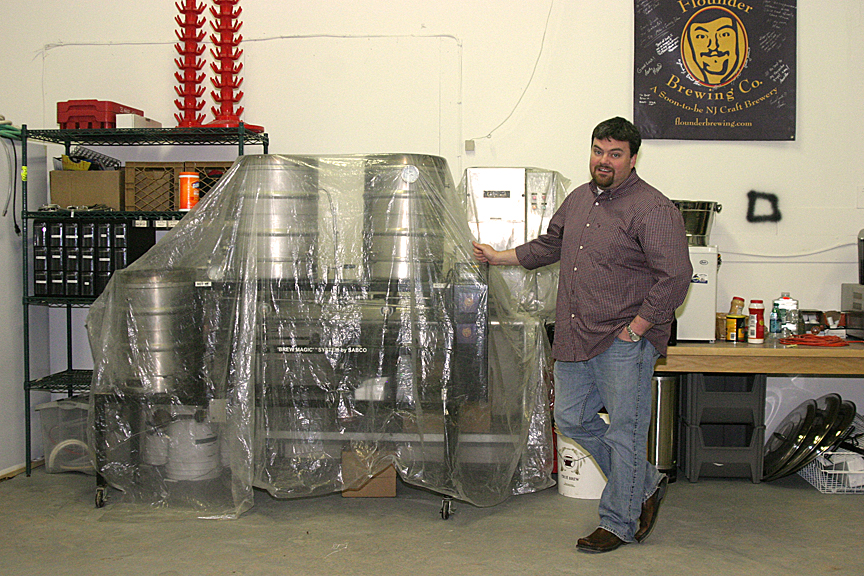
Jeremy, with now-replaced brew setup
"Fat Tire is actually one of the first craft beers I ever had," Jeremy says, recalling his own epiphany. "I was about 19 years old, and I was (managing) this band in college. We were out in Boulder and we played at this little restaurant where the manager told us if he saw us drinking any beer he'd break our hands, but we could have a gig here. But meanwhile, we were drinking Fat Tire in the back room, and I'm like 'This stuff is great.' I'd just gone a year into college, where all you were drinking was Natty Light, and suddenly for the first time, I had Fat Tire."

(Speaking of "this is great," the memorable line by Stephen Furst, gleefully uttered during the chaotic parade scene in Animal House, the brewery borrows its name form Furst's hapless Delta House pledge character, Kent "Flounder" Dorfman.)

Beer also exists in defining moments.

Jeremy says he proposed to Melissa in the brewhouse of Dogfish Head's brewpub in Rehoboth Beach, Delaware, after coming up with a romantic scheme (via the Dogfish Head 360ยบ Experience) that reached all the way up to owner Sam Calagione, who gifted the couple beers from his private stash (Worldwide Stout from 2002 and 2006, 120 Minute IPA from '06, Burton Baton from '05, and a 750 milliliter bottle-conditioned 90 Minute IPA)

"Shelter Pale Ale will always be one of my favorite beers, because I was drinking that waiting to propose to my wife," Jeremy says. "I want to make good beer, but I also want people to enjoy that beer and what they're doing. That's what you're trying to portray. You don't want people to just slam it back and get hammered. It's about enjoying your beer."

And experiences that create memories.

Monday, March 5, 2012

Guild bill clears Senate panel, gains sponsor

New Jersey's craft beer brewers on Monday move closer to gaining some long-sought regulatory relief they contend is vital to growing the state's 17-year-old craft brewing industry.

After hearing an hour's worth of testimony, a state Senate panel voted to advance legislation championed by the Garden State Craft Brewers Guild that would ease restrictions on the industry, such as allowing brewpub owners to have more than two locations.

"Every beer made in New Jersey that's sold in New Jersey, those dollars stay here," Flying Fish owner and guild member Gene Muller told the Senate Law and Public Safety Committee.

The full Senate could act on the legislation as soon as March 15th. The Assembly version of the bill is still pending in committee. (On Monday afternoon, Assemblyman Louis Greenwald, a Camden County Democrat and Assembly majority leader, signed on as a sponsor. The Assembly version of the legislation was introduced by Craig Coughlin, a Middlesex County Democrat.)

"This is an important bill. It creates jobs. It creates investment opportunities. It signals that New Jersey is again the innovation capital of the region. It's the right thing to do to maintain our leadership position and outcompete our neighbors," said Senate sponsor Tom Kean Jr., a Union County Republican, whose district includes Trap Rock brewpub and Climax Brewing, a production brewery.

The guild issued a statement later in the day on its Web site, noting the legislative process is far from over and renewed an appeal for support from beer drinkers.

"After a lot of give and take between the guild and representatives of the beer wholesalers, liquor stores, restaurant association and liquor distributors, an amended version of our legislation cleared the committee 5-0. One of the big reasons for the vote was that each committee member's office received more than 200 phone calls/emails from NJ consumers promoting the bill. We thank you for all your help," the message said.

The wholesaler and retailer groups used the committee hearing to rail against the legislation, and senators ultimately tossed a provision that would have allowed production breweries to sell beer through 10 off-premise retail salesrooms, a controversial freedom state wineries enjoy.

"The salesrooms came out. We heard from folks in the industry about their negative experience on the wine side. We decided to take those provisions out ... There's still enough in the bill that helps the industry expand and gives some of the privileges that neighboring states currently have that New Jersey doesn't have," the guild's lobbyist, Eric Orlando, said following the hearing.

Opponents also pushed for extending tax and monitoring rules that govern wine and liquor sold in New Jersey – namely a 24-hour warehouse hold on products – to apply to the proposed brewery regulation changes. Senators took that proposed amendment under advisement but did not act on it.

The wholesaler association likened the proposed salesrooms to so-called "tied houses" in which producers owned, or had a financial stake in, outlets where, by and large, only their beers were sold and served, thereby crowding out competition. They noted the three-tier system, the mercantile arrangement setup for alcoholic beverages after Prohibition, was designed to put a buffer between producers and retailers to prevent abuses that resulted from tied houses. 

The tied house argument was also leveled at brewpubs, with the beer wholesaler association contending that the pubs' very existence resulted from a weakening of the three-tier system.

Allowing brewpubs' owners to have more that two licensed establishments – the bill calls for 10 – would further erode the system, opponents said.

"We have one brewpub that's a Pizzeria Uno in this state. Well, what's to prevent every Applebee's from deciding they want to become brewpubs?" Bob Pinard, executive director of the Beer Wholesalers Association of New Jersey, asked the Senate panel. "So I think we ought to walk before we run with the numbers on this thing ... Go to three, do it like some other legislation that has been proposed, have it (graduated). See what happens. In five years, maybe you can go up to some other number."

Other objections apparently insinuated that economic development was being used as a way to outflank the three-tier system.

"The federal government created an exception that said, 'You can, supplier of beer, you can retail only if, and only if, your retail establishment is immediately contiguous to your brewery.' So they made an exception, and we in New Jersey went along with that exception, and we allowed them to have two," Jeff Warsh, a lobbyist for alcoholic beverage wholesalers, told the senators. "Now we're saying they can have 10 under the umbrella of expanding businesses, allowing small businesses to expand. That's a fair policy determination on your part, but you should know at that time that this itty-bitty little exception that was supposed to create a couple of brewpubs is now going to create 10 brewpubs, times as many owners as there are. So that tied house tiny little exception is becoming a very big exception."

Committee member Sen. James Holzapfel, an Ocean County Republican whose district includes Artisan brewpub in Toms River, batted down the notion of brewpubs proliferating if the legislation were approved. Each brewpub would be expected to obtain a consumption license from its host town, an expensive proposition given the six- to seven-figure prices for the licenses.

While the brewers guild had no objections to dumping the retail salesroom request, it stood firm on brewpub expansion. Guild members noted the irony that Triumph Brewing, the Princeton brewpub that worked to bring craft brewing to New Jersey in the 1990s, has not expanded in New Jersey since then, but went on to open two new locations in Pennsylvania, where the regulatory climate is friendlier.

Guild members also defended the three-tier system, saying they cannot grow their businesses without partnering with distributors to reach markets. But they also pointed out flaws in the three-tiered system: Though it was instituted as a consumer protection aimed at curbing abuses by big brewers, guild members said, over the years it has created unintended problems with access to markets for small-batch brewers. Most states have allowed exceptions, so-called "carve-outs," to the system to promote industry growth.

"Once you take the (salesrooms) out of it, every single item in this bill is currently legalized in all of the border states of New Jersey. That's New York, that's Pennsylvania, that's Delaware," testified Iron Hill owner Mark Edelson.

Iron Hill, which has nine locations spread among Delaware, Pennsylvania and New Jersey, is planning a second South Jersey location. Under current law, that would max out the company's investment in the Garden State. 

 "We're not cutting new ground here," he continued. "What were trying to do is be competitive in this market and make New Jersey more competitive ... None of the carve-outs proposed here are new and not currently – actively – being used to great effect in states, not only in the mid-Atlantic region, but across this country."


Sunday, March 4, 2012

The master brewer's bowler

Unibroue's Jerry Vietz at Iron Hill
Let's take it from the top ...

Unibroue's master brewer Jerry Vietz is, of course, best known for great beers that articulate the brewing traditions of Europe's (particularly Belgium's) Trappist monks.

But Jerry also has another signature that distinguishes him on the craft beer scene. His trademark bowler hat makes him easy to spy among the throngs of beer enthusiasts who crowd around him at meet-and-greets, angling for the chance to sample some of Unibroue's unique beers and hear him talk about what sets the Quebec brewery's ales apart.

Fresh off last Tuesday's (Feb. 28) beer dinner and tapping of Jerry Chris Mas, a Belgian-style spiced Christmas ale he teamed with Iron Hill's brewer Chris LaPierre to brew at the Maple Shade restaurant-brewery, Jerry wrapped up his visit in the New Jersey-Philadelphia market with an appearance at the Philly Craft Beer Festival on Saturday. (At Iron Hill and in Philly, Jerry also poured some Grand Reserve 17, among other beers .)

Catching up with him before the festival's start, Jerry shared a moment of his time to talk about his bowler (or bowlers, actually, since he has four of them) that he got from Montreal's famed hat shop Henri Henri.

"I don't always wear the bowler hat, but when I come in this market, since I've had pictures taken and on the Web site with the bowler hat, people are always asking for it," he says.

"I've been wearing hats for years. I have a wide collection at home. I have the classic hat, more like the Al Capone (fedora) style. I have many of them, different colors, different kinds, some have the ribbon, others not. I also have the beret ... "

Jerry at Philadelphia Craft beer fest
Of the 80-year-old hat shop, Jerry notes Henri Henri is credited with helping to popularize the term hat-trick among hockey fans (the term's origins are traced to the 1850s and the game cricket).

"When they were sponsoring games at the Montreal Forum, if any player a scored three (goals) they were given a hat," Jerry says.

Friday, March 2, 2012

Apples, IPA & getting in Over Head

Owner Michael Kane tops off a growler
There's beer in wooden barrels, beer in bottles and, of course, fermenting wort in the shiny stainless steel tanks off the brewhouse.

Kane Brewing, one of last year's additions to New Jersey's craft brewing landscape, has been a busy fledgling brewery. Since opening its doors last July, the Monmouth County ale-producer has been well received, and is running ahead of its own projections of where it would be in the Garden State's craft beer market at this point.
"At the holidays – the night before Thanksgiving, the night before Christmas Eve, because Christmas Eve was a Saturday – those nights were mobbed, probably two of our best days so far," says founder/owner Michael Kane, "and it was only a couple of hours that we were open."

And that's just in the tasting room, the cozy rally point for tours of the 20-barrel brewhouse, visible through the taproom's window. Outside the brewery's doors, busy translates to servicing between 70 to 100 draft accounts from northern Ocean County and along coastal towns in the brewery's home county, to select spots in North Jersey and oasis-like good beer bars in Sussex County.

"What surprises me is the number of accounts we're on," Michael says. "That's gone a lot better than we had forecast. You obviously hope for more, but the plan was to be on a lot less accounts than we are. The local restaurants and bars have been responsive to having a local beer on. They also enjoy the beer, too. A lot of people will try it because it's local, but they keep coming back for it because it's pretty good beer."

Outrunning your projections also means playing some catchup with cooperage and laying some plans for the approach of summer (the population in the shore area jumps sharply with the beach season). The brewery has been bumping up its stock of sixtels, buying those new, but looking for used half barrels to hold down expenses.

"We don't really want to bite the bullet and buy those new, so we're going to keep looking and stretch what we have for now. Cooperage is an issue," Michael says. "The summer is the concern, between the kegs and the capacity. It's a good problem to have, I guess."

Since opening, Kane has produced a clutch of brews, including some one-offs (to keep the tasting room's taps dynamic) and some specialty creations awaiting release. Others, of course, form the backbone of the brewery's beer lineup.

Head High (6.5% ABV), a West Coast-leaning IPA, is a Kane staple, dosed with Columbus and Chinook hops (boil), and Ahtanum, Citra and Centennial (late addition and dry-hop); the IPA has also appeared as a one-off with Zythos, a new blend of hops that Kane opted to give an audition. Afterglow (5.5% ABV), a rye pale ale, is another flagship brew.

"Our plan was to push out more variety," Michael says. "I think we got bogged down a little bit with the beers we have, just trying to keep up with the demand for those."

Variety is in the pipeline, though. So is an extended reach for the brewery, tucked in small business park off busy Route 35 in Ocean Township.

A Belgian wit is development, and distribution to the Princeton area (Kane self-distributes) is coming more into focus.  South Jersey? Well, that's a far-off story, one where some patience is asked. But it's not off the radar, however: Kane plans to be at the Atlantic City beer festival March 30-31. (They'll also be at Beer on the Boards festival on the Point Pleasant Beach Boardwalk March 24.)

As winter fades, some of the Kane brews are passing the baton.

Like the fall seasonal oatmeal brown, Drift Line (5.8% ABV), which proved popular enough to hang around for a winter encore. "The response was really good and the demand was there," Michael says, "and we kind of kept brewing it." But it's now ready to give up the stage.

Single Fin Belgian blond (5% ABV), Kane's launch brew from last July/August made with a well-attentuating Trappist strain from East Coast Yeast, is working its way back into the lineup for the summer.

But ahead of that is a recently released American extra stout, Port Omna (6% ABV) for St. Patrick's Day ("We're big fans of the celebrations that happen down here," Michael says); on the heels of Omna is an imperial IPA, Over Head, that's finishing up in the fermenters and timed for the end of this month; another brew, Malus (9.5% ABV), was racked off into 750-milliliter bottles, corked and caged, three weeks ago. Two hundred white-box cases of Malus are stacked around the brewery, bottle-conditioning now for release in due time.

"It's just a matter of waiting for them to do their thing," Michael says. "We have to make sure they're carbonated, make sure they taste right, get some labels on them. It's up to the beer whenever they're ready."

Besides being a specialty item for the market, the apple-infused Belgian strong ale was the crash-test dummy for a six-head, gravity-fed wine filler the brewery will use for bottling its barrel-aged and other unique brews. (The inaugural bottling went well, Michael says. The cork-and-cage 750s are Kane's only bottled offering; the lion's share of the beer is draft-only.)

The reddish-colored brew was made with a reduction of 100 gallons of freshly pressed apple cider, used like an addition of Belgian candy sugar in the boil, plus cinnamon and grains of paradise.

"It took us actually a couple of days to reduce (the cider) down. We ended up with 25 to 30 gallons," Michael says.

Meanwhile, a stand of just over a dozen whiskey barrels (Jim Beam), most of them filled with an imperial stout made last fall, sits along a brewery wall, just off the tasting room. (Recently, a Wild Turkey barrel was filled with Port Omna for aging.)

"It's 11% percent and change," Michael says of the imperial stout, racked into the barrels Oct. 10. "It will probably pick up a point in the barrels. They were pretty bourbony."

Thursday, February 23, 2012

Fish tanks

Guiding in a new tank
Flying Fish Brewing takes some more steps toward setting up its new home.

Three 150-barrel fermenters, plus a hot liquor tank, rolled in from Missouri on flatbed tractor-trailers to the brewery's new Somerdale site Wednesday and Thursday. (A pair of white grain silos, pictured at bottom, also arrived this week. Two more silos, for handling spent grain, are due soon.)

The 21-foot-tall tanks were hoisted via a crane through a 10-foot-square opening recently cut into the building's roof specifically for installation of the new tanks (and future tanks for that matter).

More tanks (fermenters and brights) are coming next week, as the shift in operations continues from the brewery's long-ago outgrown original home in Cherry Hill to the bigger digs of a former LP record pressing plant in Somerdale, about 7 miles to the south.

Crane begins to hoist fermenter
 The brewhouse arrived last month, and there's packing equipment inside, too. But make no mistake, there's still a lot left to be done before the 16-year-old South Jersey craft brewery will begin making beer in the new location.

The move is a juggling act, too, since production of FF's Farmhouse Summer Ale, a beer annually released in April for the warm weather months, needs to begin soon. That will happen at the Cherry Hill location, making it perhaps the final seasonal beer to be made at the brewery's founding location. Also, Exit 8, the newest brew in the specialty series, still needs to be bottled.

As they say, stay tuned.


Tuesday, February 14, 2012

AHA says it hit 30k milestone

AHA graphic
Membership in the American Homebrewers Association has topped the 30,000 mark, a milestone for the 34-year-old national organization based in Boulder, Colorado.

The not-for-profit organization is synonymous with the annual National Homebrewers Conference and Homebrew Competition, as well the Big Brew event held on the first Saturday in May that unites homebrewers around the world as they brew a chosen recipe to celebrate Homebrew Day.

The AHA's growth is being driven by a resurgence in the popularity of amateur brewing, says the Brewers Association, the parent organization for the AHA. The BA estimates there are more than 1 million homebrewers in the US; the AHA's current membership represents a sharp rebound from a decline during the first decade of the 21st century.

At its core, homebrewing represents something more that a hobby. Lest anyone forget, making beer at home is a serious undertaking for its practitioners, and it can't be said enough that today's homebrewer is tomorrow's craft brewer.

"Interest and participation in the AHA and the homebrewing hobby has resulted in the beginnings of most of today's craft breweries, as well as events like the Great American Beer Festival and, of course, many glasses of terrific beer," says BA president Charlie Papazian.

New Jersey is no exception to that.

Homebrew's spin on NJ
Most of the state's production breweries can trace their founding to homebrewing. And at many of the state's breweries, whether brewpubs or production breweries, the beers are made by someone who learned the art first as a homebrewer before taking on some kind of formal brewery training.

"I don't think we realized how dramatically the American Homebrewers Association would affect the beer world," Charlie says.

A New Jersey native who headed west to Colorado after graduating from Virginia Tech, Charlie is a central figure in American homebrewing. With the first issue of Zymurgy magazine, the monthly publication dedicated to the hobby, he co-founded the AHA with Charlie Matzen in late 1978, the same year federal government gave its blessing to striking a mash at home.

Matzen & Papazian
Thirty-four years later, homebrewing has become woven anew into the fabric of US culture. It was part of the country's Colonial culture, and during the 13-year failed experiment of Prohibition, home-made beer, by necessity, became common practice for those thirsty for a beer (and perhaps reluctant to frequent a speakeasy).

Today there are more than 1,000 homebrew clubs across the US, and last year saw nearly 7,000 entries in the AHA's National Homebrew Competition. Meanwhile only two states – Mississippi and Alabama – still raise an eyebrow at making beer at home.

These days, there are a lot of people taking Charlie Papazian's advice, free of any worries because they're relaxing with a homebrew.

Read AHA press release here.


Thursday, February 9, 2012

Flying Fish bottled up, but Exit 8 beer isn't yet

An overdue shipment of bottles is all that's keeping you from pairing Flying Fish Brewing's newest Exit Series beer with some aged gouda or roast pork, a couple of suggested foods from the brewers.

With one foot still in Cherry Hill and another in the new location of Somerdale, plus no new exit beer in sight for almost a year, Flying Fish put out word last week that the answer to the question of "What's the next exit?" would be a Belgian brown ale brewed with chestnuts and honey from local growers and apiaries in a nod to the state's farming region around Exit 8 and East Windsor Township.

(Memo to FF: Revisit this area in the fall with a nod to West Windsor and Grover's Mill, the site of the Martian landing in War of the Worlds and Orson Welles' 1938 Mercury Theatre radio broadcast that panicked the pants off everyone. Bet those folks could have used a big Belgian brown back then to help 'em settle down.)

After lighting up the Twiter-sphere with the heads-up on Exit 8, Flying Fish then followed up with word that the beer is ready to be bottled, if only they had the bottles: "Our bottle supplier said we’d get them in December. Then January. Now those really cool, really limited 750 ml bottles are supposed to arrive in another two weeks. Keep your fingers crossed."


Alas, Flying Fish being all bottled up and waiting for those bottles is a situation in which we all share some blame. The monster growth in craft brewing – thanks to folks drinking the beer – has  thrown some curves to the beverage container industry, with some suppliers struggling to keep pace with demand.

Beer details: 8.3% ABV. Hops – Mount Rainier, Chinook, Fuggles and Columbus.

Tuesday, February 7, 2012

Christening a new (sort of) vessel

Ale Street News publisher Jack Babin

There's a new, smaller player on the take-home beer scene in the US.

But this sporty, angular container has been around since the early 1990s in the British Isles, letting pub patrons in the UK take a couple pours of their favorite ales to go and settle in at home for drinking with dinner, a movie on the DVR or just over some conversation about the day.

It's called the Crafty Carton.
 

Ale Street News, based in Maywood in Bergen County, has partnered with the 2-pint container's company, LeisurePak, for a US rollout of the Crafty Carton. Ale Street hopes its 20-year standing in the craft beer industry can put the containers on the radar of bars, restaurants, brewpubs and breweries as a convenience option for take-home draft beer.

Contain your joy
Publisher Jack Babin unveiled the product at the International Beer Expo in Secaucus last Saturday, explaining its uses and space-saving advantages to curious festivalgoers who paused at Ale Street's booth to examine the demo cartons, which bear an array of British ale brands and logos.

"It's a spontaneous, inexpensive, biodegradable, easy to store – we can store 50 of these in 4 inches by 4 inches – it's a ready-to-use beer carton," Jack said an interview with Beer-Stained Letter at the festival.

The thin-cardboard containers are instantly reminiscent of milk cartons. Or Chinese food containers. The latter is a good reference, since you don't buy Chinese takeout to stick in the refrigerator for an extended stay. You eat it upon arrival. And with the Crafty Carton, you drink the beer, Jack says. (The containers struck us an option to glass pitchers in busy bars; nothing to run through the dishwasher, just chuck 'em into waste-paper recycling. It's not unlike setting a carafe of coffee on a table.)

"This is not long-term storage. I don't want to miscommunicate. This is a temporary container. This is designed for when you get home, to enjoy your beer safely," he says.

The containers aren't intended as competition for everyone's trusty glass half-gallon or 2-liter growlers, either. But rather, the quart cartons (remember, 2 pints equals a quart) should appeal to those tavern or restaurant patrons who would like another round but wisely conclude they shouldn't because they still need to  get home safely. With the Crafty Container, Jack says, those patrons can get that round to go and drink it at home. (There are carriers for the cartons to ensure they travel intact.)

"The pub owner is interested in this because they can sell two pints of beer they wouldn't sell otherwise," Jack reasons.

Crafty Container caught Ale Street's attention when its parent company, LeisurePak, placed advertising with the six-times -year brew newspaper. (The ad appears in the February/March issue). Jack says LeisurePak was then approached with the idea for a strategic partnership.

"We know virtually every brewery and brewpub. We not only know the names, we know the people behind them. We've been doing this for a long time," he says. "This (festival) is a launch, this is the very first place it has appeared in the United States. There will be a full rollout across the United States. We believe it's going to be a major convenience and a hit nationwide."

 Photos from the International Beer Expo in Secaucus

Beach Haus crew with sips of new ale


Matt Steinberg in the background
Faces in the crowd


Monday, February 6, 2012

NJ Beer Co. to brew Abbey Brown for Boaks

Boaks Beer has cut a deal for New Jersey Beer Company to be its second contract brewing location, and founder Brian Boak says making beer at the Hudson County brewery is on pace to start toward the end of February.

"They have a deposit for the first batch of beer. The grain's been ordered, so I would expect in the next two weeks we're going to brew a batch of Abbey Brown," Brian said as he staffed his booth at the International Beer Expo in Secaucus on Saturday. (Brian is pictured fourth on the right.)

Matt Steinberg, founder of New Jersey Beer Company, says his North Bergen brewery will try out the arrangement and stay with it so long as it's mutually beneficial.

Headquartered in Pompton Lakes, the Boaks brand launched four years ago with High Point as its contract brewer, producing a Russian imperial stout, Monster Mash (10% ABV), and a lineup of Belgian-style ales, including Abbey Brown (7% ABV), and lately a specialized version of that beer, Wooden Beanie, which has been aged on vanilla beans in whiskey barrels. This year is forecast to add a new label to the lineup, Jan's Porter, a beer that was supposed to come to market last year.

New beers aside, the immediate goal is to deal with keeping the pipeline full and flowing. An order for 50 new sixtels is expected to to help free up some tank space and keep inventory moving.

Craft beer's surging popularity has left capacity at a premium for a lot of breweries, including High Point. Keeping up with demand under such circumstances has been a challenge. So imagine an at-capacity brewery with contract clients, and those contract clients likewise seeing a spike in demand for beer.

That's why Boaks, with the help of High Point, began shopping around many months ago for an additional brewer with capacity for hire. Even with New Jersey Beer Company taking on a Boaks brew, Brian says he's looking to line up a third contractor.

"There's two large breweries being built at the moment, both 50 barrel brewhouses, state-of-the-art facilities. I'm trying to get into one of them," he says. "One is Susquehanna Brewing Company. I have no arrangement with them or anything ... They said they've been inundated with contract brewing requests. If I can get in there, that would be wonderful because that would allow me to have enough production where I could actually make this a full-time venture."

All of this isn't being viewed as a sign that Boaks should be siting a brewery location and shifting its business model to a full production brewery. Brian prefers to keep Boaks a contract beer company and points to some big names in craft beer that have taken advantage of that route for much of their existence.

"I'm going to be the gypsy brewer," he says. "Look at Brooklyn Brewery. Look at Sam Adams. I don't think it's a bad model."

A winter without icebock

In Kulmbach, Germany, the Bavarian locale said to be the birthplace of eisbock, it's a bitter -2 degrees Fahrenheit today, with a forecast high of 10 degrees. Over the next couple of days it's not going to get much warmer, not breaking out of the teens.

That's perfect weather for turning doppelbock into its richer, bigger alter ego, eisbock: exposing the kegged beer to the elements, letting it partially freeze and drawing off a core of concentrated beer from an outer layer of ice.

Four thousand miles across the Atlantic, here in New Jersey, that's what High Point Brewing, makers of the Ramstein brand, has been doing since the year 2000, turning its 9.5% ABV Winter Wheat Doppelbock into a velvety eisbock, strong but balanced and smooth, a few ticks higher in alcohol.

But not this year.

The uncharacteristically mild winter of 2012 has thawed any hopes this season of having Ramstein Ice Storm, the name of High Point's draft-only eisbock. It's simply been to warm, says High Point owner Greg Zaccardi.

Icestorm is the casualty of a dearth of consecutive days dropping down to the 20-degree temperature range (or colder) needed to produce the beer that the Butler brewery has made annually as gesture of appreciation to its loyal followers.

"It's not a profit-making beer. It's really a beer we do to say thank you to the year-round fans," Greg says.

The weather truly has the final say.

"It's not some phony marketing ploy," he says. "We really have to rely on Mother Nature to get involved in the brewing process and bring us enough cold weather to make the beer possible. We don't use some alternative form of refrigeration. It's done in the real traditional German way."

Ordinarily by now, Ice Storm would be in the sixtels. Last year, a snowy winter with plenty of cold days, High Point took the unprecedented step of brewing 15 barrels of wheat doppelbock specifically for making eisbock.

That was the initial plan for this year, but heavy demand for the doppelbock meant a portion of the final batch of the seasonal run, brewed around Christmas, would be needed to meet draft orders for wheat bock.

By last week, with a continued upswing in temperatures to 50 and even 60 degrees, all bets were off on the eisbock. The remaining Winter Wheat would remain just that – Winter Wheat.

"This year a lot of people are happy they don't have to shovel their driveway out 15 times. The price for that is, we're not able to make eisbock."

Friday, February 3, 2012

Change is good

Building a Beer-Stained Letter website – an actual live dot-com – around the blog Beer-Stained Letter has been a project in the works for a while now.

And now it's here.

Briefly speaking, this blog page remains an integral part of things (see the link on the home page), and it's where items about New Jersey's craft brewing industry (Brewery News) will continue to be posted, as well as features about folks in the industry (Beer People) and events (Beer Life) will be posted.

There are some other items, too: A spotlight on new (read that as cool) beers from out of state coming into the New Jersey market (Incursions) and heading off to see the green grass, so to speak, at breweries in other states (Excursions).

Thanks for the support over the years. Onward and upward.

Thursday, February 2, 2012

Meadowlands fest back for 2nd round

If math isn't your best subject, well don't worry, this is beer-drinker math, so it will be some simple division and multiplication.

Event promoter Starfish Junction stages nine beer festivals in a year and serves 37,546 gallons of beer in that time. So, how many pints would that stand on the bar?

Answer: 300,368.

Poured into shaker glasses placed side by side, it's enough pints to circle the Earth at the equator about 1,600 times.

By any count, it's a lot of beer. (See the chart for some more stats. Kegs are most likely a mix of halves, quarters and sixtels.)

And come Saturday, Starfish Junction gets a jump on tallying some figures in Secaucus, with its second edition of the International Great Beer Expo at the Meadowlands Exposition Center.

Veterans of beer festivals know the drill well: Start with lighter styles and work your way up to the hoppier brews, and remember to drink plenty of water to stay hydrated.

For fresh faces in the crowd, Joe Chierchie, sales and marketing manager for Starfish Junction, has some advice: pace yourself; there's a lot of beer, and some of it is strong.

"The alcohol content is higher, the beers are heavier, and for first-timers it can sometimes be a surprise," Joe says.

Also, don't go with the just usual suspects or familiar-sounding brands.

"Keep your options open, this is a tasting event," he says. "If you're not a stout guy keep an open mind, give it a try."

Friday, January 27, 2012

Barrelhouse stout & porter, all jazzed up

Just a quick a calendar item, from Cricket Hill's Friday brewery tour ...

The Fairfield brewery makes its bourbon-barrel-aged imperial stout and a likewise-conditioned sour porter available at this evening's open house.

Time: 5-7 p.m.
Place: Cricket Hill Brewery, 24 Kulick Road in Fairfield
Phone: 973-276-9415

Wednesday, January 25, 2012

The stuff that helped build brands

Whenever brewery history and New Jersey are uttered in the same breath, the names Ballantine and Krueger invariably come to mind, two breweries that called Newark home as far back as the mid-19th century.

Come Sunday, you can get a visual taste of that kind of past while you sip the present.

The Garden State chapter of Brewery Collectibles Club of America holds its annual winter swap at the Polish American Cultural Foundation in Clark, an event that promises to connect the region's rich brewing industry past with today's beer fans of all walks. (Time: 10 a.m.-5 p.m. Address: 177 Broadway. Admission for general public: $5)

Trays, glassware, signs, tap handles, bottle openers, coasters, labels, and of course beer cans – the tactile stuff that joined forces with flavors to build brands – will be in abundance for collectors to buy, sell, trade, or reminisce over while they sip pints of today's craft beers paired with hearty Polish cuisine.

"I love the craft beer stuff," says Jack McDougall, 64, president of the 100-member Garden State chapter, "but I still like to think back to the days when I was drinking Rheingold or Schaefer. It's got a good feeling to me."

Closing in on four decades, collectors have been coming together for the meets. McDougall, now retired from the Exxon Bayway refinery, remembers his first, in 1977 at Princeton Day School, a gathering that featured 400 tables of memorabilia, or breweriana as it's called.

"It was all cans back then, and trade only, no money changing hands," he says.

A good find back then would have been flat-top cans from the 1950s, like a woodgrain Shaefer can. (It should be remembered that New Jersey lays claim to introducing canned beer to America almost 70 years ago, thanks to the Gottfried Krueger Brewing Company.)

McDougall's can collection numbers 1,000, with five times that many coasters (his cans are boxed up, though, not on display at home). Back in the day, a co-worker who was doing some home remodeling stumbled upon some Krueger Ambassador cans and gave them to McDougall.

"It was a premium brand by Kreuger in the '40s and '50s. It had an illustration of Bavarian dancers," he recalls. "When Narragansett bought (Krueger), they stopped brewing it."

No swap would be complete without beer itself, and at this one look for some Magic Hat, as well as some Jersey-brewed offerings from Cricket Hill and Climax Brewing, and possibly others. (McDougall says club members often show up with growlers from brewpubs they made excursions to.)

Climax Brewing owner Dave Hoffmann, a longtime supporter of the event, is sending a sixtel of Bavarian Dark Lager (5.2% ABV, a beer he pulled out of production (it's a dying style, he says) years ago but brewed again recently at the behest of Paul Kermizian, one of the owners of Barcade (Brooklyn, Jersey City and Philadelphia).

"It's like the real deal. It's got that real nutty, chocolaty, malty Bavarian dark lager taste," Dave says. "It's real balanced, easy to drink, and it's real dark. When you look at it, it's like my Nut Brown Ale.

"I used to make it all the time, but all of a sudden it started not selling. So I stopped making it, and Kermizian was all upset because that was one of his favorite beers that I made."

And now for the Mad Men moment:


Tuesday, January 17, 2012

There yet? Nope, but making progress


A million-plus bucks worth of custom fabricated steel arrived in Somerdale on Monday and was promptly moved into place, as Flying Fish Brewing makes progress on its move from Cherry Hill, the original home of the craft brewer now widely known for the Exit Series beers.

Folks at Flying Fish project being in business at the new location around May or June. But make no mistake, setting up a 50-barrel automated brewhouse to feed fermenters three times that capacity is no small feat. So that projection is obviously subject to how the installation of everything goes.

The components that arrived on Monday, following a fortnight trans-Atlantic voyage, were the lauter tun, mash tun, whirlpool and kettle, which join a new kegger that arrived a while ago.

About the video: It's a tongue-in-cheek take on the new equipment's arrival, seen through the prism of silent film. Special thanks to Kevin MacLeod of Incompetech, who always seems to have the right music available for quirky video projects.

Friday, January 13, 2012

Something to pore* over

Prohibition Did What?
Via: Rehab International

This tumbled into the InBox last week, one of those offers of use as a way to promote the creators ...

It's visually entertaining, although if you want to quibble, the actual date of the 18th Amendment's ratification (not passage) was Jan. 16th 1919 (New Jersey wouldn't ratify it until three years later, practically bringing up the rear), with the stipulation Prohibition would not take effect until January 17th 1920.

*Yes this is the correct one; it's pore, not pour, in this case.

Wednesday, January 11, 2012

Sam C, a real advocate for beer, speaks

By now, you've at least heard, if not read, that Sam Calagione opened a shaken-up bottle of shut-yer-yap, spraying the grousing beer geek-noscenti in a BeerAdvocate post.

Actually Dogfish Head's founder was quite tactful in his takedown of those whose faceless forum commentary on the beers they drink can muddy the point of whether they liked them or not, or turn shrill when they feel the need to opine that something has grown too popular. (Actually, just saying you liked a particular beer can seem like a confession these days.)

Quite often that stuff comes across as turgid prose or some flowery mental masturbation to beer porno.

In any case, there's not a lot to add to what Sam says, other than this: fixating on brussels lace and how decanting into sparkling glasses of beer-clean quality, the russet brew produced a rocky tan head (you can substitute tan with alabaster), well that just sucks all the oxygen out of the drinking experience.

Maybe it's time to just count to 10, relax, and simply have a beer. Enjoy it. And back away from your keyboard.

Tuesday, January 10, 2012

NJ homebrew permit is dead. Kaput. Gone.

It's official: New Jersey homebrewers are no longer legally obligated to pony up 15 bucks to the state to make their beer.

Governor Chris Christie has signed legislation to eliminate the 21-year-old permit requirement that most homebrewers had said fuhgettaboutit to in the first place, either because they never knew about it, or they had reservations about getting the state involved in their lives and their much-loved hobby.

On Monday without comment, Governor Christie signed the legislation that was introduced in spring 2011. The signing is noted on the governor's web site, amid a collection of other bills also getting his signature that day.

(If you're a craft beer enthusiast in the Garden State, it's hard to ignore the fact that Chris Christie has been a friend to beer since taking office in 2010. Last May he signed a proclamation for American Craft Beer Week in New Jersey; his lieutenant governor, Kim Guadagno, made a trip to Flying Fish Brewing last fall; and now the elimination of the homebrewing permit. That's more than any governor has done to give beer a boost since craft brewing was sanctioned in New Jersey in 1993.)

Homebrewing has had the blessing of the federal government since thoroughbred horse racing last had a Triple Crown winner (Affirmed), when Congress exempted 200 gallons made for personal consumption from taxation. New Jersey lawmakers said yes to the hobby 13 years later, in 1991.

However, there was a catch to Trenton giving its blessing, something that New Jersey homebrewing enthusiast Ed Busch, at the time a member of the American Homebrewers Association board of governors, saw as an unavoidable trade-off for getting lawmakers to go along with the idea officially green-lighting people making beer at home. (It should be remembered that after Prohibition, states were given great authority to regulate alcoholic beverages within their borders, and that Alabama still does not allow homebrewing, while Oklahoma finally relented in 2010.)

Thus the permit was born in the same breath as Trenton's proclaiming that making up to 200 gallons of homebrew per year was legal (echoing the federal law), thus giving Garden State homebrewers cover from overzealous local code enforcement officers who wanted to play revenuer.

Joe Bair, who opened his Princeton Homebrew shop in 1995, on Tuesday applauded the end of the permit, saying Ed had always envisioned it being scrapped at some point. Sadly, Ed died about five years ago, never seeing his intuition play out as reality.

"Ed Busch said it would eventually get changed, and I'm sure he's happy in his grave that it has," Joe says.

The biggest problem with the permit law, Joe says, was never the $15 fee imposed on homebrewers, but rather their taking a hit on their rights against search and seizure. Getting a permit meant state alcoholic beverage regulators could pay a call on you whenever they wanted.

"People were surprised when they got their permits in the mail to find that out," Joe says.

To the state's credit, the Division of Alcoholic Beverage Control kept its distance from homebrewers. Still, the existence of the permit requirement, though often obscure, turned homebrewers who knew of the obligation into scofflaws when they ignored it.

"It wasn't because they didn't want to pay the money," Joe says. "It was they didn't want to give up their rights against search and seizure."