Friday, October 15, 2010

From fledgling Flying Fish to Pinot Noir

Flying Fish hit a milestone this week, brewing a 5,000th batch of beer – a chocolate stout that will mark the sixth stop (Exit 13) in its well-received Exit Series of brews.

Since brewing began in August/September 1996, thousands of barrels of beer have been kegged or bottled and sent out the doors of the Cherry Hill brewery to markets in Delaware; Maryland; Pennsylvania; Washington, DC; and of course New Jersey.

A few brewers have come and gone during those 14 brewing years, while current (and longtime) brewer Casey Hughes is a well-known face of Flying Fish to many people. Also in that decade and a half, FF has picked up some national recognition for its Belgian-style beers, high honors for its Exit 4 American Trippel and Abbey Dubbel.

To mark the occasion of the 5,000th batch, it seemed fitting to track down the brewer who helped launch the brand that founder Gene Muller conceived as a "virtual microbrewery" on the Web in 1995 and grew into New Jersey's largest craft beer name at 12,000 barrels annually.

Joe Pedicini, a Berkeley Heights native, came to Flying Fish in spring 1996 from Deschutes Brewery in Bend, Oregon, and joined by assistant brewer Rick Atkins, struck the first mashes that would become the extra pale ale and extra special bitter with which FF entered the marketplace. (That's Joe at left with his 18-month-old daughter, Una.)

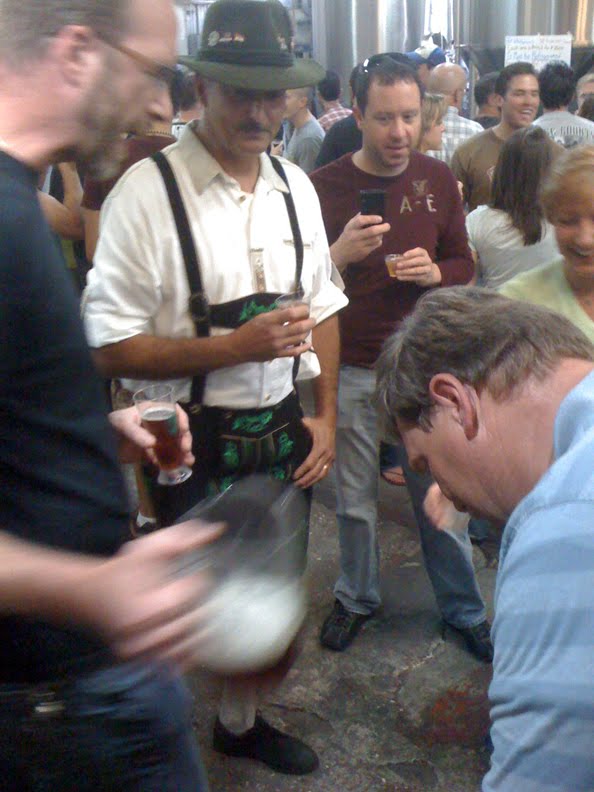
A quite tasty porter, the Abbey Dubbel, a Belgian farmhouse ale and Hopfish IPA would round out the lineup during Joe's two-year stint at FF. The porter, bottle-conditioned back in the early days, was phased out several years ago, then brought back as a winter seasonal imperial espresso porter. While the recipes – chiefly the hops used – have changed for the XPA and ESB, those beers are stilll cornerstones of Flying Fish's beer offerings and were among the brews legendary beer writer/explorer Michael Jackson sampled during a brewery visit when FF's beermaking operations were a mere six months old (see top photo; that's Joe on the left, Gene Muller at right).

Now calling Brooklyn home, Joe has turned his zymurgist's attention to winemaking, an interest he developed from both his family heritage (from Italy's southwest coast) and spending some of his post-FF days working for New York auction houses, connecting buyers to rare wines.

For his own label, Montebruno, Joe produces small-batch artisanal Pinot noir, using Oregon grapes grown organically and sustainably. His first commercial batch of Oregon Pinot noir was bottled in 2003, and these days he spends a lot of time shuttling between the Willamette Valley and New York. On the heels of bottling some vintage 2009 in Oregon, Joe took some time last week for a Q&A, reminiscing a little bit about Flying Fish and discussing Montebruno Wines.

BSL: Where did you come up with the name Montebruno?
JP: Montebruno is a tribute my grandmother on my mother's side; it's her maiden name.

BSL: Wine is in your heritage. Your father made wine, right?
JP: On my father's side, the region where they emigrated to the States from is called Campania. They all had vineyards and made wine. It was just an ordinary-life kind of thing; they didn't own a private-label winery, but they'd grow grapes and make wine for themselves and sell grapes to a local cooperative.

BSL: Talk a little about how you chose Oregon vineyards.
JP: I sort of researched places in the country, other than Napa Valley and California, places that would be interesting to grow (grapes) and make wine that would be unique. At first, my research took me to the Finger Lakes in upstate New York. Then I considered going back and visiting some of the family vineyards in Campania, and then I realized that I have this beautiful network of friends and now family in Oregon.

So I said to myself, I really love Pinot noir and I have roots in Oregon because of how much time I spent out there. So I started looking back in that direction and managed to find these great sites I've been working with, and took my production from 50 cases in 2003 (pausing briefly) I just got back a few weeks ago from Oregon where I bottled 850 cases of 2009.

BSL: Your focus on wine is not that far from the approach of craft beer, as far as scale goes, it seems.
JP: It's kind of along the lines, if you can compare it in the beer world, it's very much a hand-crafted, small-production process. Just about every aspect is done by hand.

BSL: With the grapes themselves, you're actually inspecting and hand-selecting what gets used?
JP: Absolutely. I have several vineyards that I lease. There are blocks within these vineyards that are exclusively used for my label.

All the fruit that I source is grown sustainably, bio-dynamically or organically. I'm a huge supporter of that, and it's a big movement in Oregon right now. The approach isn't supposed to end at the farming of the fruit once it's in the winery. Everything that I do is done in a very Old World, sort of bio-dynamic approach where there's no additives, there's no preservatives. There's no means of doing anything funny to extract something that isn't there naturally in the grape. It's really just a pure expression of the fruit that was sourced from a beautiful, beautiful site in Oregon.

BSL: Can you talk about the uniqueness of wine as it relates to its place of origin?
JP: In the wine world, the interesting thing about it is, there is a sense of place in what you're making. You have this fruit you harvest from a place, and you turn it into wine, and there is a sense of identity where that fruit came from and there's no other wine that can taste exactly like it.

BSL: Let's turn our attention to beer. You still have an appreciation for great beer ...
JP: Oh, God yeah.

BSL: What are some of the really good beers that you think are on the landscape now?
JP: There are so many great producers. I would hate to be specific and leave anybody out. It's really more about the mood I'm in. Sometimes I still love a properly poured draft Guinness, and I still love a nice hoppy (pauses) There's a brewery here called Sixpoint that makes a Bengali IPA that's really nice. They are successfully growing in a market that was dominated by Brooklyn Brewery for so many years.

It's amazing when we think back to just a few years ago how different the landscape was with beer and how lucky we are right now. There's just so many great producers now, so many great choices.

BSL: Do you still have occasion to brew, either at home or commercially?
JP: I still brew at home. My brother-in-law has a nice little set-up at his apartment. Actually yesterday we brewed what's going to be a cask bitter ...

BSL: What do you think of the explosion of hops, all these different varieties of hops?
JP: It really seems, especially out West, they're just trying to make these IPAs bigger and bigger and hoppier and hoppier. They're kind of hard for me to drink. I think they're a little bit out of balance. I look forward to the day when things come back to reality a little bit.

BSL: Let's talk about Flying Fish. You might be surprised to see just how big the brewing and packaging space has become. What do you recall from the start-up days?
JP: I met Gene at the microbrewers conference up in Boston in '96. When he decided to hire me, that space was empty. It was just offices in the front and a big warehouse in the back. The conference was in March, and during that summer we just started bringing equipment in and setting it all up. I always appreciated the fact that Gene just totally trusted my decisions, as far as formulations and procedures of the brewery and how to run things there. I looked at it like it was my own brewery.

BSL: Talk a little about getting the brewhouse going and working out the bugs.
JP: The first time we fired up the system (to test it), there was a little bit of a glitch in the grain handling process. We ended up leaving behind a certain portion of the grist that was supposed to go into the mash tun back in the hopper and we weren't aware of it. When we took our initial gravities, they were way lower than we anticipated. That was the hop angel. The second batch, we made a pretty successful XPA. We wanted to do a large-scale batch using the yeast strain we chose; we wanted to make sure it met the profile we were looking for.

BSL: Flying Fish has grabbed some acclaim of late with the Exit Series beers themed to the Turnpike exit identity often associated with Garden State residents. Have you had occasion to try any of the Exit Series beers?
JP: You know, I have not. I've seen them and I think it's a cool marketing concept, and I'm really happy they're still doing some great experimentation. I think one of them was a (Belgian) Trippel, wasn't it?
BSL: They called it American Trippel. It was a gold medal winner last year at the Great American Beer Festival.
JP: They won a gold last year? Oh, that's awesome.
BSL: The Abbey Dubbel won silver the year before.
JP: That's awesome.

BSL: Beer Hunter Michael Jackson made more than one visit to Flying Fish, but you were there for his first tour of the brewery and sampling of beers back in March 1997.
JP: He was very complimentary; he really liked the ESB. He said 'Man I could put down a few pints of that.' I thought that was a good compliment. It was a nice reward, coming from the standpoint of, here we are, we have this new product and new brewery, we're putting in massive hours, and we're really busting our asses, and then he comes by, tastes the beers and he likes 'em, and it makes you feel good about all the effort.

BSL: Finally, what's next for you in the wine world, where do you take Montebruno?
JP: There's lots of cool vineyard sites becoming accessible, and we're sort of assessing that and we're hoping to maybe get a 10- or 15-acre property that we can call our own.

Thursday, October 14, 2010

Beers to swell by

Aggregator moment again ...

The online magazine The Daily Beast reaches out via email to Beer-Stained Letter with a link to their post on "The 50 Most Fattening Beers."

Here's what they say are the tops for straining the belt and some others that are a little friendlier (the list doesn't mine the craft vein all that much, but The Beast does say they pulled from the big domestics; and alas, their yardstick was most calories and carbs for least amount of alcohol content).

Top Worst:

  • Boulevard Brewing's Unfiltered Wheat Beer (155 calories, 35 carbs and 4.4% alcohol)
  • Leinenkugel's Berry Weiss (207 calories, 28 carbs, 4.8% alcohol)
  • Grolsch Blonde Lager (120 calories, 15.8 carbs, 2.8% alcohol)
Least Worst:
  • Schaefer (142 calories, 12 carbs, 4.6% alcohol)
  • Guinness (125 calories, 10 carbs, 4% alcohol)
  • Blue Moon Pumpkin Ale (180 calories, 14.7 carbs, 5.8% alcohol)
Make what you want of it. But if you're seriously looking at calories and beer, take a glance over at Peter Kennedy's Simply Beer.

Wednesday, October 13, 2010

The route to Exit 13 ...

Was paved with 4,999 batches of beer at Flying Fish.

Exit 13 (Elizabeth), an import/export chocolate stout, is batch No. 5,000, with production beginning this week using Belgian chocolate. Due out in December, it's the sixth beer in the Exit Series and the second stout to be brewed in the Exit lineup.

A year ago this time, Flying Fish turned out an export stout made with New Jersey oysters (the first actual Garden State ingredient) that's still grabbing some attention, even though it's getting hard to find on store shelves. Exit 1 Bayshore Oyster Stout was featured in the Atlantic last month.

Elizabeth, by the way, was home to nearly a dozen breweries between 1878 and 1939, with City Brewery Company becoming City Products Company during the 13 years of Prohibition. (After the enactment of the 18th Amendment, breweries did what they could to survive, some making soda, others making near beer, while others made malt extract for brewing at home.)

Given that Flying Fish just rolled the brewing hit counter to 5,000, we have something special planned in a couple of days to mark that milestone.

Meanwhile, there's a new face at Flying Fish. Mike Donohue, formerly of 21st Amendment Brewery in San Francisco, returned to the East Coast (his dad taught school in Camden) as FF's second-shift brewer, an overlap shift that's been in play at FF for two-thirds of the Cherry Hill brewery's 15-year existence.

Mike replaces Lawrence George, who took a brewing job in his home state of New York. The Flip video below is from an Oct. 2 Saturday afternoon tour. It was Mike's first occasion to meet and greet Fish fans.

Wednesday, October 6, 2010

Here a fest, there a fest, everywhere a fest

A busy weekend gets rolling on Thursday in Jersey City and wraps up in along the Delaware in Lambertville and in a place once known as German Valley.

So hang on, because here it comes:

Jersey City hosts its fifth annual Oktoberfest from 4 p.m. to midnight along Grove Street. As far as beer goes, this one is the domain of Samuel Adams Octoberfest and Yuengling. They're obviously not Jersey brews, but Sam Adams Octoberfest on draft is worth putting in your glass.

If you're a fan of this event, you can do your part to introduce the organizers to some of the home-state fall seasonals: Flying Fish's Oktoberfish, Hoffmann Lager Beer Oktoberfest and Ramstein's Oktoberfest. Toss in River Horse's Hipp-O-Latern Imperial Pumpkin Ale, too.

The thing to note about the event is, it wasn't that long ago that a pass down Grove Street was a tour of a moribund city neighborhood – empty store fronts and boarded-up buildings. Some condo development plus the addition of bars and restaurants has helped revive area, turning up the buzz on South Grove.

Down the Shore, Toms River has a brewpub, Artisan's, making those who live in the county seat of Ocean County lucky that fresh beer is only as far as a trip to the corner of Bay and Hooper avenues.

On Friday, Arstisan's pours a flight of its house-made beers, paired with a five-course meal that is chef Steve Farley's interpretation of hearty German cuisine, from appetizers to a main course of braised short ribs (with spätzle, applesauce, red cabbage and potato pancakes) that gets paired with brewer Dave Hoffmann's Oktoberfest beer.

Beer writer and PubScout Kurt Epps emcees, and the Fire House Polka Band provides the entertainment.

Saturday is the busiest day of the week, featuring a cask ale event in Middlesex County and two other Jersey brewer events.

Uno Chicago Grill & Brewery in Metuchen holds the fall answer to its spring cask ale event. It's pay as you go, with a purchase of tickets at the bar that are redeemed for pours of beer in either 10-ounce or pint portions. Food orders from Uno's menu are also available for purchase.

This marks the fifth time Uno brewer Mike Sella has assembled a lineup of great ales that includes cask versions of some of his house brews and beers from the tri-state region and beyond. In March, the event featured the likes of Weyerbacher's Hops Infusion and Blithering Idiot (Easton, Pa.); Sixpoint's Bengali IPA and Righteous Rye (Brooklyn); and Uno's Scotch Ale and Gust N Gale Porter; this time Mike will have a casked Oktoberfest out there as part of the house offerings.

"We've had something from Tröegs each time ... Weyerbacher, River Horse ... I always have something from Climax, and I will again. Last time we had two from Sixpoint, which I may be able to come up with again. Last time they actually helped us out, and the guy who owns the Brazen Head (bar) in Brooklyn helped us out. He loaned us two of his pins, and that's how we got (Sixpoint) in."

On prior occasions, the event has been spread over two days. But there's a caveat here: Its popularity has become such that the beers have sold out on the first day. So figure on Saturday being your best shot. It begins at noon.

Follow your compass a little bit north and west and you'll find a preview of High Point Brewing's Winter Wheat Doppelbock at the brewery's monthly open house and tour, from 2-4 p.m. Other beers available for tasting and growler purchase will be Ramstein Golden Lager and Blonde. The doppelbock usually comes out in November and is the beer that High Point uses to make its incredibly good Icestorm eisbock when winter finally arrives. The brewery announced Wednesday on its Facebook page that its top-rated Oktoberfest beer had sold out. Alas, if you missed it you have to wait until next year.

Speaking of Oktoberfest, the weekend wraps with a pair of fall observances – River Horse Brewing's two-day gig in the brewery's back lot, and Long Valley Pub and Brewery's annual fest on the patio of a centuries-old stone barn that houses the brewery and restaurant (which underwent some renovations last year.)

The folks at River Horse know how to entertain, and twice a year – at Lambertville's ShadeFest and the brewery's Oktoberfest – they make a show of it. Like ShadFest, the fall event is a pay-as-you-go affair, with a brew in a commemorative pint glass available for purchase for 7 bucks and refills for $4.

At ShadFest, brewer Chris Rakow was running the fretboard on a Paul Reed Smith guitar, fronting his band as part of the entertainment. Look for that again this weekend, plus plenty of food from vendors.

And don't forget, Triumph Brewing's New Hope brewpub is just a short stroll over the bridge to the Union Square plaza.

Meanwhile, Long Valley's party settles in with a pumpkin ale and Oktoberfest brews on its patio on Sunday, beginning at noon, with music from Mama's Stew. This event has quite a following and is usually well attended.

Officially a part of Washington Township in southwestern Morris County, the Long Valley hamlet was known as German Valley from its founding during Colonial Days until World War I, when a German reference to anything in this country was certain to invite a backlash of hostility and prompt a name change. (Incidentally, World War I, and the subsequent anti-German sentiment, were catalysts for the advent of Prohibition, with the dry factions ardently pointing out that most of the brewers in the US at that time were German or of German lineage.)

And then there is this item from Peter Kennedy over at simplybeer.com, a tasting of Garden State beers (Ramstein, New Jersey Beer Company, Boaks Beer and Cricket Hill) from 3-5 p.m. Sunday at Halo Lounge, in Rutherford. The event benefits the Meadowlands Museum.

Tickets are 40 bucks and can be purchased by contacting the museum (201-935-1175 or e-mail meadowlandsmuseum@verizon.net).

Lastly, NJBeerEvents has a calendar round-up here.

Monday, October 4, 2010

Everything orange

Aggregator moment, redux ...

Jersey John Holl writes at CraftBeer.com of Oktoberfest's seasonal competition, pumpkin beer.

And a swing by Iron Hill-Maple Shade this weekend revealed that brewer Chris LaPierre will be tapping a gourd full of pumpkin ale on Oct. 23rd. Three versions of the ale will be pouring that day.

Among the two imperial versions that day: A bourbon barrel-finished one that was brewed in September 2009 with molasses and Belgian candy sugar. It sat in the barrel a couple of months, Chris says.

And he notes: There's only one sixtel of it.

Sunday, October 3, 2010

A beer book built around flavors

Three years ago, during an interview with the US Beer Drinking Team at a Beer Institute gathering, Boston Beer's Jim Koch was asked what beer he'd drink if his Samuel Adams brand were unavailable to him. Deflecting the question, Koch said, "I'll remember what my (brewmaster) dad said, 'Jim, all beer is good. Some beer is better, but all beer is good.' "

Craft beer writer Andy Crouch of BeerScribe – he's also a BeerAdvocate columnist and a Boston-area lawyer – doesn't necessarily share his fellow New Englander's take on beer as a whole.

"I don't know that all beer is necessarily good," he says during a telephone interview. But Crouch, whose new book, Great American Craft Beer (Running Press), hit the shelves in August, says there is some really great beer being made in nearly every state of the US these days, in practically every compass point. A much wider reach than its predecessor, The Good Beer Guide to New England (2006, University Press of New England), Crouch's latest book navigates the American brewing landscape in more than 300 beer profiles that will surely tempt readers to reach for a brew along the way.

And for those keeping score, among the 200 or so breweries spotlighted in Great American Craft Beer, New Jersey's Flying Fish (and its 2008 GABF silver medal-winning Abbey Dubbel) and High Point Brewing (Ramstein Classic and eisbock) get mention among the profiles and style notes.

Andy took some time last week for a Q&A, discussing how the US has become a brewing nation like never before and reminding us that some beers can be appreciated for their fewer – not more – ingredients.

BSL: Why did you write this book?
AC: I'd written a previous book called The Good Beer Guide to New England. That was a travel guide to the region in which I live. And then I wanted to write Great American Craft Beer, I wanted to try and broaden the audience for American craft beer, break beer down, not so much by style and incredibly geeky detail, but do it in a way that was much more approachable for people, build a book around flavor, flavors that people are already familiar with. I think we got to do that with this book. I'm hoping the public agrees and enjoys it as well.

BSL: This may seem like a silly question, but you actually did taste every single beer that's profiled in the book ...
AC: The book is based upon beers that I have tasted over the past 10 years or so. I've been writing about craft beer for 10 years, so I'm very familiar with all of these brands and have tasted them a number of times over the years, and more recently talked to some brewers about some beers that had a particularly good reputation that I had not tried yet. So that's where the reviews in the book come from.

BSL: How many beers are actually noted in the book?
AC: There are about 350 beers that are covered and profiled in the book.
BSL: From how many breweries?
AC: That is a good question. I don't actually know the full answer to that. But I would guess the number is somewhere around 200. There are beers from almost every single state. I think there's one or two states that might not be listed. We tried to get a good cross-section of everything across the country.

BSL: The question then becomes, where in the United States is there no beer?
AC: There are certain states that have taken longer than others to come along. There are some southern states for which craft brewing is still not particularly well represented. There are some states like South and North Dakota that are fairly limited. North Dakota might be another state that doesn't have an entry. They frankly just don't have a lot of brewing going on there. Certainly there are going to be some places that are underrepresented ...

BSL: As far as the United States goes, are we the global stage for beer nowadays?
AC: Yeah, I think that really has become the case. The US right now is really quite a leader in brewing in a way it really hasn't been perhaps ever in its history. Right now, some of the most exciting things happening in the world of beer are indeed happening here in the United States. We have probably the widest breadth of styles and different kinds of beer of every conceivable style, including many that have never existed before, and have some world-class brewers who really are on par with some of the greatest brewers that the classic brewing nations have to offer.

BSL: Craft beer drinkers like to seek holy grails. They like beers that are sort of touchstones; they like to go to them. So do you envision this book as sort of a travel companion?
AC: I think it can be. But in this day and age I don't know that people have to particularly travel too far in a lot of parts of the country for great beer. Great beer seems to be more and more coming to them.

BSL: Beer is a way of traveling to places without actually having to go to them. Certain styles represent certain geographic regions of the country and the world. That's more true now than ever, right?
AC: I think so. Beer and brewing is really about place. While I think it can be done, I don't think sort of armchair drinking is the way to go. As brewers start to move around the country with their distribution into new markets, certainly the book can work as a guide for individuals who want to learn more about particular styles or particular breweries. But I also recommend that people get out and visit these breweries as well because the beer tastes best when it's tasted fresh. And I also don't think beer can be fully divorced from the surroundings in which it comes from.

BSL: Doesn't it say something about beer's place now at the table that you're defying convention, so to speak, by explaining beer to people, the complexity, parsing the flavors? Because the notion that beer is bubbly, slightly bitter and supposed to be yellow (in color) ... That's still ingrained in a lot of people's viewpoint.
AC: Well, the big brewers spent a lot of money over decades drilling into people's minds that beer was not about flavor, was not about the differences in the products themselves, and they sort of became these very much interchangeable widgets. If you were at a bar and a particular beer kicked, and the pub owner didn't have any more of that particular brand, he wouldn't bother to change the (tap) handle. They would just throw on whatever else they had and nobody was the wiser. Nowadays, you really can't do that. People are getting around to trying all these different beers and beginning to realize flavor is where it's at. I think it's time we start talking about (it) in that way, even though for a good portion of the population this is going to be something new to them. So I think the book tries to approach this, not just from a beer geek perspective – though I think there's plenty in the book to satisfy that audience as well – but also just to introduce and try to broaden the audience for craft beer.

BSL: Do you think Budweiser is a dying brand?
AC: There's always going to be a place for the macro brands. They obviously have an economy of scale; they are humongous producers, so they have a lot of clout in the distribution system and obviously in marketing, so I think they'll be around for a long time. I don't think we're going to see them go away. But I think brands such as Budweiser – it's having its own trouble ... been on decline for the better part of a decade. You know there's been the new campaign recently that they're going to try to give away Budweiser free on a particular day. You know that is a tough gig for the folks at Anheuser-Busch InBev. But with that said, light beer continues to sell particularly well, so I think those light beer brands are going to be around for a long time. (But) even the big breweries realize, that while they may not be losing a whole ton of market share to craft beer, they are losing dollars to craft beer, and they're beginning to play a lot more, much more, in the craft beer market, and I expect we're going to see a lot more of that in the years to come.

BSL: You profile two New Jersey beers in the book, Flying Fish Dubbel and High Point's Ramstein Classic. With Ramstein Classic, you refer to dunkelweizen as a little understood category. Why do you think dunkelweizen is that way?
AC: I think German styles overall tend to be a little bit misunderstood, and dunkelweizens in particular. They mix two styles that aren't really that well understood by consumers. With the advent of Blue Moon by Coors, they're beginning to understand sort of cloudy, yeastier beer, such as Belgian-style wit beer, and German-style hefeweizen a little bit more. But dunkel is something they never really understand, so when you mash these two together ... I would say even in Germany when I travel there, this is not a style necessarily particularly well understood. I think it's one of those ones where you mix some sort of caramel malt flavors with some toasted flavors, with some unusual banana and clove notes, it's kind of an odd drinking experience. But I think it's one that's pretty wonderful and pretty interesting across the board. But I think the public generally doesn't quite know what to do with these beers sometimes.

BSL: With extreme beers, the super-hopped and higher alcohol, do you think they are starting to play themselves out, are people coming back around to something that's a reliable beer, one they can always have in their glass and be comfortable with?
AC: I think that has played itself out to some extent. As to how far, it's sort of hard to say. I think that people are beginning to come back around a little bit to wanting a flavor experience they can revisit with some frequency. A lot of the times, these big beers, as you noted earlier, tend to be sort of holy grail beers where people seek them out and move on to the next conquest. It was a very interesting experiment. I'm glad that we went through it and got to experience it. But nowadays, I think, people are hopefully coming back a little bit more to their senses and wanting some more everyday, drinkable, approachable beers. Whether that's with lagers or session beer or ones with simpler numbers of ingredients, I think it's hard to say. As I said in the book, just because your beer is simpler in ingredients doesn't mean that it doesn't have complexity and character in its own right. Some brewers can do fantastic things with a single hop variety, or one or two malt varieties, as opposed to having to always put in 18 different kinds of hops, eight different kinds of malts and fermented in barrels with four yeast strains. Sometimes simple is better, and it certainly can be as characterful as some of the crazy complex offerings we've enjoyed over the last few years.

Saturday, October 2, 2010

Office trolley

An aggregator moment ...

Nate Schweber
, whose name some folks may recognize from New York Times bylines, takes a beer snapshot of Westfield for patch.com, and highlights the Union County town's watering hole, the Jolly Trolley, which sets up pints these days under its corporate banner, The Office Beer Bar & Grill. (The item also is in today's news feed column on the right; Nate also fronts the band New Heathens, who have a couple of albums to their credit – Hello Disaster and Heathens Like Me.)

The Office wades into craft beer deeper than just being a chain of craft beer friendly bars. The folks there also sponsor competitions for the brew-it-yourself crowd, Homebrew Wars, in which winners get to go commercial and make scaled-up versions of their beer at High Point Brewing in Butler.

A West Coast-style IPA turned in by Ian Burgess and Brett Robison landed in the winners circle of the most recent Homebrew Wars. The beer is scheduled to go on tap at Office locations during the week of October 18th.

Thursday, September 30, 2010

Great minds collaborate – maybe jam, too

Do a Web search on brewing collaborations and you'll find plenty of brewers and breweries that have put their collective minds and talents together to produce imaginative beers.

Oregon beer-makers Deschutes Brewery and Hair of the Dog Brewing have a collaboration brew due out in 2011. And here in New Jersey, Flying Fish's Exit 6 Wallonian Rye is the effort of the Cherry Hill brewery working with Nodding Head (Philadelphia) and Stewart's (Bear, Delaware) brewpubs earlier this year.

We're thinking of another collaboration that COULD (all caps because it hasn't even been brought up) produce a great beer and a musical tie-in to boot: River Horse in Lambertville and High Point in Butler, two breweries whose mash tuns are manned by quite capable guitar players.

First of all, neither brewery has been approached with an idea to collaborate (that we know of), so let's make that clear. We're not reporting something, we're suggesting something.

The collaboration would work this way: Pick a beer style (a weizenbock or a dunkel of some sort), refine the idea, brew it. Chris Rakow, guitarist-brewer at RH, and Bryan Baxter, guitarist-brewer at High Point, take things a step further and put their musical minds and fretboard chops together on a tune, too.

Easier said than done of course. But imagine the rocking release party for the beer.

Beer Here? Where have you been, SL?

Not to go too far with this, because having more voices in the village square that is craft beer is a great thing.

And that's a sincere comment.

But The Star-Ledger of Newark and its online entity nj.com do deserve a thumbs down for their sudden interest in the craft beer scene with the column Beer Here and for not knowing that Port 44 Brew Pub in Newark is New Jersey's newest brewery.

SL says New Jersey Beer Company is the newest. The North Bergen brewery fired up the kettle this past spring. Port 44 began brewing its lineup of ales in August. It's a quibble yes, but isn't SL a Newark newspaper?

A couple more quibbles: The recycled use of "New Brewski" as a nickname for the state. That moniker was tossed out in 2008 when SL launched its monthly magazine, Inside Jersey, which featured a column that pretty much slammed the state's brewpubs. (Afterward the magazine seemed to care more about wine than beer, save an article by Jersey Brew author Mike Pellegrino about Jersey's beer past, and a back-page item about the Krueger brewery and canned beer being born in the Garden State.)

And didn't SL sponsor the beer festival at Monmouth Park over Labor Day weekend? (That was a festival, that while it had contract-brewed beers with state ties, none of the craft brands actually brewed at home were represented; yet Beer on the Pier last week in Belmar had five Jersey-based brewers there.)

Sadly, this seems more like a dash for advertising dollars (look for the SL hotdog mobile to show up at every festival on the calendar) than genuine interest and a keen read of the marketplace, since New Jersey has had a viable (and yes, now growing stronger) craft beer industry for 15 years.

But newspapers are slow to react (which is why they're dying, and this newfound love of beer sort of reminds us of how the Asbury Park Press newspaper cold-shouldered Bruce Springsteen until he was obviously too big to ignore. However, it's not always the case: Eric Asimov and The New York Times didn't wait until the Brewers Association announced that craft beer was a $7 billion a year industry).

In all fairness, this is the early goings for SL's effort. Stay tuned.

FOOTNOTE: Yes SL did do that silly beer-tie in to the NCAA tournament (March 2oo9 comes to mind), and Climax Brewing owner Dave Hoffmann's Helles got a nice bounce from it. But we seem to recall that tasting panel put styles like IPAs, pale ales and imperial stouts side by side in the same judging session. Make no mistake, Dave's beers are solid and he deserves props, but folks who are seriously into beer would call a foul for the mashup.

Speaking of growlers ...


Some raw video footage of growler filler at Iron Hill, shot to test a new Flip Ultra video camera. So basically this one's for the idly curious.

Nothing truly spectacular here, except the beer, which by the way, was an Oktoberfest.

Wednesday, September 29, 2010

Jersey-wide distribution for Boaks

The Garden State is proving sunny for Boaks Beer, the Pompton Lakes-based beer company that Brian Boak started with a white van, a storage facility in Wayne and a contract with a brewery.

Two-plus years ago, if you called Brian on his cell phone, he'd probably answer from the driver's seat of that van, en route to or from Pennsylvania, where he would truck to a distributor kegs and cases of his Belgian brown and imperial stout brewed at Butler-based High Point Brewing, better known as the makers of the Ramstein beer brands.

Pennsylvania represented a real foot in the door of the beer industry for Brian, who at the time had a handful of New Jersey accounts and was doing bigger business west of the Delaware River.

That was then, this is now. Growth for Boaks has swung to Brian's home state.

New Jersey now represents the lion's share of business for Boaks Beer and its top-seller Belgian-style Two Blind Monks, Monster Mash imperial stout and Abbey Brown, another Belgian style, that will soon see a limited-release, barrel-aged version.

"Jersey represents about 65 percent of business right now," Brian says. "That is a swing. But that’s mainly because, first I was just distributing myself in New Jersey and I was having a distributor in Pennsylvania. Now I have two distributors – Kohler distributes me in northern New Jersey, and Hunterdon distributes me in central and southern New Jersey. Just adding central and southern was a whole lot of business I could not get by myself.

"We are available in all of New Jersey, from northern Bergen County to Ocean County, all the way down to Cape May."

But Brian has his sights set a lot farther south than where Delaware Bay and Atlantic Ocean both bathe the state's coastline. Entering the draft and bottle markets of Maryland and Washington, D.C., figures into a game plan that also points north and west to New Hampshire and Michigan

"Soon as I lock down Maryland and D.C., I’m going to go after Virginia. But soon as I lock down one more state, I’m going to order another fermenter," he says.

In April 2009, Brian bought a 30-barrel fermenter that was installed at High Point, where all of Boaks brands are brewed, kegged and bottled. High Point brewed 90 barrels for Boaks last year. Brian says volume is already up this year and could hit 150 barrels by year's end.

Meanwhile, he's jumped on the whiskey barrel band wagon with Wooden Beanie, a stock of Abbey Brown aged in Jack Daniel’s barrels with Madagascar vanilla beans. The beer hit the barrels around the end of August; it's still aging – at just over a month now – and goes to distributors in a matter of days. (Brian says he'll have some of the beer at the Sippin' by the River festival in Philadelphia on Sunday.)

"I had always liked some of those oak-aged porters and all the other beers out there that are oak-aged, and I drink Jack Daniel’s. So, I was like 'Let’s play with this,' ” he says.

But there's some more backstory to Wooden Beanie.

"What actually happened is, Abbey Brown is a beer that hasn’t been out in a while, and the kegs were a little overcarbonated, so I had to figure out a way to (degas) them," Brian says. "So this Abbey Brown is going to be a special treat for people, because it actually is about a year old. It is a well-aged, 7 percent Belgian brown ale that is then aged in Jack Daniel’s barrels with the vanilla beans."

Tuesday, September 28, 2010

Down in the valley

Bucolic Sussex County gets another beer festival this weekend, but folks behind The Best of the BrewsFest are looking beyond the inaugural event that will be held under that banner on Saturday.

Specifically, the festival at Hidden Valley ski resort in Vernon Township (Sussex County) is being viewed as a chance reclaim some of the past glory for the state's northern half, harkening to the days when the Garden State Craft Brewers Guild would hold its summer festival at Waterloo Village in Stanhope.

Coming on the heels of August and September beer events at Crystal Springs Golf Resort in Hamburg, Best of the Brews is not an official Guild-organized event, but it is expected to feature a beer/brewery lineup that's built on seven Jersey-made brands from the Guild's membership roster.

Best of the Brews is also expected to feature some beers accented with regionally grown hops – Garden State Harvest IPA from JJ Bitting brewpub (Woodbridge), Catskill Hop Harvest by Port 44 Brew Pub (Newark), and Wet Hop NJ Pale Ale by festival organizer Cricket Hill (Fairfield). Port 44, the Garden State's newest brewing entity, began pouring its house-made ales in August and Best of the Brews marks the brewpub's first festival pouring.

"We have 10 breweries showing up. We're going to have some food, and we're going to have a good time," says Rick Reed of Cricket Hill.

The Guild "used to have a beautiful show up at Waterloo. It would attract 1,200 to 1,500 people," Rick says. "All of a sudden it went away, and it was replaced with the tour down on the (USS New Jersey) battleship in Camden. North Jersey got robbed of a great beer show. So we're trying to resurrect the North Jersey beer show."

The Guild's last festival at Waterloo was 10 years ago. A change in stewardship over Waterloo Village pushed events like concerts and beer festivals to the sidelines. On top that, the facility has had to deal with financial issues.

The Guild did hold a fall festival, nicely augmented with a cask ale station, in Newark two Octobers ago. But some sharply compressed planning time – and the festival date falling on an NFL Sunday that saw the Giants playing at home – unfortunately made for an anemic turnout.

"We tried to do it at Newark Bears stadium, but they were between owners and they went bankrupt. The Guild got financially screwed, and so that didn't work out," Rick says. "We (Best of the Brews organizers) found Hidden Valley, a ski resort at the base of a mountain that's just a beautiful venue for a beer thing."

Rick says organizers are cautiously optimistic about the turnout for Saturday. But there is competition for the beer drinkers' stomach space and festival dollar: Oktoberfest events at the Headliner bar in Neptune (Monmouth County) and the Blue Monkey Tavern in Merchantville (Camden County), not to mention the annual Kennett Square beer festival in Chester County, Pa., and Sipping By the River in Philadelphia the next day.

"We're hoping for a crowd. We know the first year is going to be small. All we're trying to do is plant the seed for a revival of the North Jersey show. Hopefully in three or four years, we'll be back to the 1,200 to 1,500, and North Jersey will get its beer show back."

Monday, September 27, 2010

Getting into the growler game

Four-packs, sixpacks, bomber bottles, 12-ounce singles and now growlers.

These days, the yardstick by which you judge a great package store that's big into craft beer may not just be a selection of brews as wide as the US. It may include whether the establishment has a state license to fill jugs with take-home draft beer.

For a long time in the New Jersey craft beer scene, filling growlers has been the province of the dozen brewpubs spread across the state and a couple of production breweries (High Point in Butler and Cricket Hill in Fairfield) that offer them as an option to the two sixpack maximum allowed for retail sale at breweries.

One one brewery, Climax in Roselle Park, bottles exclusively in the half-gallon containers, using a filler system that founder Dave Hoffmann, a former machinist, built himself.

But nowadays some of the big discounter package goods stores in the Garden State are tapping into the market, capitalizing on a thirst for draft beer from Jersey brewers and craft brewers whose labels are hot tickets among beer enthusiasts.

Count the two Joe Canal's Discount Liquor Outlets on Route 1 in Islen (Woodbridge) and Lawrenceville among those establishments with taps dispensing take-home draft in proprietary growling-bulldog-monogrammed glass. Refill prices range from about a fin to 16 bucks depending on the brand of beer.

"We started in the Lawrenceville store at the end of June, and end of July over here," Michael Brenner, the stores' general manager, said last week. "We do a decent business."

(You'll find growler stations at other independently owned Joe Canal's in South Jersey, i.e. West Deptford.)

"Craft and microbrews are popular to begin with. They're getting more so," Brenner says. "There's as much interest in the different styles and regions where they come from, as we see in the wines. Folks are talking about it; they're exchanging notes, and it's a lot of fun."

Brenner says patrons are able to keep up with what's available from the taps by signing up with the stores' email notification program. The two stores, which also sell koozies to keep the jugs cold, have even scored some choice, hard-to-get brews for growler fills. "We had (Founders) Kentucky Breakfast Stout. We had a sixtel in both locations," Brenner says.

The beer sold out lightning quick. "It was great; it got a lot of people talking" Brenner says.

To help drive sales, store crews sold the empty jugs at a recent craft beer festival in Trenton. A Princeton marketing firm created the logo that's emblazoned on the brown glass.

"We think that this is such an interesting and unusual thing that you don't see every day that we wanted to brand it separately," Brenner says.

Besides hot-ticket crafts, the stores also put on some of more familiar brands, like Samuel Adams Summer Ale and Blue Moon, Brenner says, "because we want this to be accessible for everybody."

Saturday, September 25, 2010

Another one in development - update

Looks like the brewing of craft beer is returning to Ocean Township in eastern Monmouth County.

Followers of New Jersey-brewed craft styles will remember Ocean Township as the home base of Heavy Weight Brewing, the Tom Baker enterprise that earned acclaim for artisanal beers like the imperial porter Perkuno's Hammer, Lunacy Belgian golden ale and Cinderbock lager.

Tom shuttered the brewery in 2006, pulling up stakes to cross the Delaware into Philadelphia, opening the brewpub Earth Bread + Brewery in the city's Mount Airy section a couple years later.

But now entrepreneur Michael Kane says he's signed a lease for space in Ocean Township to house Kane Brewing Company.

Back in the spring, Michael had his eye on a site a few miles south in Manasquan, winning some favor among town officials but encountering flak from some ill-informed town residents who stridently opposed the proposed venture.

Hence he opted for another site where he could brew the line of Belgian and American ales envisioned in his business model.

Meantime, Michael's in the process of setting up a Web site and working on licensing and procuring equipment.

Thursday, September 23, 2010

Märzen chronicles, Book III (or yet again)

Oktoberfest is a short season, but the beer that distinguishes it from other fall observances deserves a lot of mention.

So here's some more, specifically, a spotlight on a couple of interpretations of the style that are worth your stein and leisure time.

It just went on tap at Uno Chicago Grill & Brewery in Metuchen a few days ago, and the Oktoberfest that brewer Mike Sella turned in this season is richer than Warren Buffet and more enjoyable than watching Jon Stewart riff on Glenn Beck's chalkboard, kabuki histrionics.

In fact, it's also a taste of two seasons: Clocking in at over 7% ABV, the beer has all the signatures of Oktoberfest but a middle flavor and coppery color that hints at doppelbock.

Mike's brew is also proof that you can take an ale yeast and bend it to a lager will. He used an American ale yeast and fermented at 58 degrees. If you didn't hear him cop to that, you'd never know it. (Yeah, other brewers have done this, too, but sometimes you still get that ale nose in the beer. Not here, Mike's is malty and lager-clean.)

Not quite a hundred miles down the Garden State Parkway from Uno, Tim Kelly set up the Tun Tavern in Atlantic City with some of his finest work since taking over as the brewer there in 2007.

Like Mike's fest beer, Tim's 6.6% ABV, noble-hopped Oktoberfest will have you time-traveling to March. By your second round, you'll swear you've poured a Maßkrug of doppelbock. (Honestly, that second glass will feature a middle flavor quite reminiscent of Salvator. And by the way, Tim did use a lager yeast.)

Tim's an ambitious brewer and has turned in some interesting Belgian styles for the Tun (a brown he made a couple Christmases ago tasted great at yuletide, but a filled-to-the-rim growler of it we aged until February became a really superior beer). For his first try at an Oktoberfest at the Tun, Tim reached for toasty melanoidin signatures and attempted a decoction mash.

"I'll never do that again," he says, with some self-deprecating humor.

The beer was fine. But problem was the Tun's brewing system isn't set up to do decoctions. Tim (with the help of Flying Fish head brewer Casey Hughes, as we recall) used buckets to ladel a portion of the grist from the mash tun into the kettle to be boiled, then back into the mash.

A regular five- or six-hour brew day thus grew by more than a couple of hours, a noble effort for a payoff that could still be attained by infusion mash means and some Munich and aromatic malts, as his efforts this season ably demonstrate. (That's not a swipe at decoction; try High Point's Ramstein fest beer to taste what decoction can do.)

Look for Tim's Oktoberfest at the Central Jersey Beer Fest on Saturday. Or better yet, head to the Tun. And Uno.

Woodbridge, Belmar & Iron Hill's F.red

Turnpike Exits 4 and 11 figure big into the beer picture on Saturday, but the day has nothing to do with the Flying Fish Exit Series beers theme-brewed to those numbers.

Exit 11 on the turnpike is Woodbridge, where the 4th edition of the Central Jersey Beer Fest runs from 1-5 p.m. About an hour's drive south, in Maple Shade off Exit 4, Iron Hill brewpub will be hand-bottling and making available for sale some well-aged Flemish red ale.

On top of that, there's a worthy beer gig at the Shore where more Jersey beers will be poured.

Woodbridge
Parker Press Park, along Rahway Avenue, just past the bend in Main Street, is once again the location for the JJ Bitting brewpub-sponsored Central Jersey Beer Fest. From its debut in 2007, this has been a charity event, and this year's proceeds will benefit a cancer-stricken mother of two from Woodbridge and American Legion Post 87.

Jersey brews at the event, according to organizer and Bittings owner Mike Cerami, will include brewpubs Harvest Moon (New Brunswick), Tun Tavern (Atlantic City) and host JJ Bittings; production brewer Cricket Hill (Fairfield); and Boaks Beer (contract brewed at High Point in Butler) and East Coast Beer Company (contract-brewed in New York). Rounding out the list will be beers from Brooklyn, Blue Point, Ommegang, Erie Brewing, Boston Beer, and Doc's Cider.

There will also be food vendors and live music.

Admission is $25, and $15 for designated drivers. Unlike last year, no tickets will be available at the gate (you can buy them at Bittings on Main Street).

If you were at last year's event, you may recall things got a little testy when the admissions outpaced the beer. In order to keep things running smoothly this go-round, ticket sales will cut off at 800.

The park is spacious, with plenty of shade trees. Plus you'll find picnic tables to relax and take a load off. Travel tip: There's construction planned to commence very soon on Route 9 in the area, so coming in on Routes 1 and 35 may be the best path. NJ Transit is a good bet, too, since the train station is a bottle cap's toss from the park.

Maple Shade
The folks at Iron Hill always have something up their sleeve. This time, it's a bottling party for a 9-month-old, barrel-aged Flemish Red tricked out with wild yeast and bacteria to give it a tang that's worth writing home about. (It's a pay as you go event.)

The brewpub will be tapping some F.red (5.3% ABV, 20 IBU), as it's called, while it packages the beer (made in December 2009 and stored in Beaujolais barrels since the headwaters of this year) in corked and caged 750 ml bottles, labeled, signed and numbered by head brewer Chris LaPierre (who's a big fan of sour beer styles) and assistant brewer Jeff Ramirez.

Bottles will then be available for sale at the bar.

FYI: This deep red ale is a bottle-conditioned beer, so the bottle you buy must be stored until it carbonates naturally (Chris recommends a couple of months, or even letting it mature for years).

From Chris' note to mug club members: "This will be a couple of firsts for us: our first beer available in bottles and the first time we’ve done an entire batch of sour, wood-aged beer in Maple Shade."

Belmar:
With this festival, Beer on the Pier, look for Jersey brews from Climax (Roselle Park, go for Dave Hoffmann's well-regarded Oktoberfest and his IPA) and Artisan's brewpub (in Toms River where Dave is the hired consultant/brewer), Cricket Hill, River Horse, New Jersey Beer Company (North Bergen, makers of 1787 Abbey Single and Garden State Stout), and East Coast Beer Company and Hometown Beverage. Hometown, like East Coast Beer Company, is a shore-based contract brewer. East Coast is based in Point Pleasant Beach, while Hometown, the purveyors of New Jersey Lager (as well as New York Lager and Pennsylvania Lager), is based in Manasquan and closing in on a second anniversary in the beer business.

Both Cricket Hill and East Coast Beer are doing double duty on Saturday. Newly minted in the beer scene, East Coast is a co-sponsor of the event with BeerHeads and the borough of Belmar, and just brought its Beach Haus pilsner to market (it's brewed by Genesee in upstate New York) late last month.

"We actually sold through 650 cases in three weeks. We’re thrilled; we're just starting off and we're at the higher end of expectations," says East Coast founder John Merklin. Saturday's event is part of a marketing blitz that has seen the company hit nine craft beer events or tastings in those three weeks.

John says the company has message beyond the flavor and style of its beer, a pre-Prohibition pilsner. "This is not a summer seasonal. It's regional; it's a reflection of the region ... a direct reflection of being at the Shore. The analogy I'm using is the Beach Boys, (hearing them) you know what it's like to be in California," he says.

Beer on the Pier, Belmar Marina, Route 35.
VIP Tent: 1-3 p.m
. General Session: 2-6 p.m

$40 online; $50 Gate; $60 VIP (soldout); 
$10 designated drivers. (A portion of the proceeds go to benefit the Monmouth County Foodbank.)
Food from 10th Ave Burrito, Mr. Shrimp, Crab Shack, Jacks Tavern, Federico's Pizza.
More info (732) 681-2266

Wednesday, September 22, 2010

The region

As goes New York City and its environs, so goes New Jersey ...

New York's third annual Craft Beer Week begins Friday. Find details here.

Cheers.

Tuesday, September 21, 2010

Singles scene

Some Jersey singles (top shelf) mingling.

Meanwhile, this is worth a read. And this is curious. (They're from news feed at right.)

Monday, September 20, 2010

Wurst case scenario

For a moment, set the märzen aside.

Because there's also plenty of hearty food rolled into this 2 1/2-week thing called Oktoberfest.

And you don't have to be in Münich to find it.

Try Toms River for some of that Old World flavor.

Detlev Barsch's business, D.A. Barsch German Butcher Shop, is tucked inside in brown, single-story building along Route 9, in the northern part of town where used car dealerships practically outnumber the people.

(Incidentally, for beer in Toms River, it's along Route 9 that you'll find the more well-stocked packaged goods stores, not busy, main-drag Route 37 into Seaside Heights.)

German food is Detlev's life; the butcher profession is a family affair, going back to when he lived in Oranienburg, Gemany, just north of Berlin.

“We had a sausage factory with 150 employees … we had our own store and our own delivery trucks," Detlev says, his voice gently seasoned with a German accent. "I learned my profession in Germany. In competition, I was the best butcher in all of Berlin in 1968; I was No. 3 in all of Germany, and my mother was the only female master butcher for 15 years in all of Germany."

Detlev, 62, has been plying his profession in New Jersey for decades (he came to the US in 1970), and many people remember him from the German butcher shop in Forked River (Lacey Township), about a half-hour drive south of Toms River.

"I started off with the whole family in Forked River. In the '80s, I sold the business to my brother (Wolfgang), then I started my own business on a dairy farm in upstate New York. I had a butcher shop there, Hamden German Butcher," he says.

A flood in 1996 pretty much devastated Delaware County, New York, and Detlev returned to New Jersey, working for his brother for about 10 years. He opened D.A. Barsch 2 1/2 years ago.

Standing behind his shop counter, he flips the calendar page from September to October. The Saturdays of the months are marked with catering orders. Predictably, this time of year is busy, and finds his shop lining up area retirement villages, German-American clubs and anyone else planning a fall fest event with bratwurst, knackwurst, sauerbraten, schweinshaxe, potato pancakes, red cabbage and other traditional German and European foods.

But Oktoberfest has gained an even wider reach as a time to entertain.

"The younger generations that spent time in Europe, they just throw a party for their friends and want to make it an Oktoberfest," Detlev says.

Saturday, September 18, 2010

Märzen chronicles, Book II

Dave Hoffmann probably brews more Oktoberfest beer than any other brewer in New Jersey.

With turns at two different breweries – his own Climax brewery in Roselle Park and as the hired brewmaster for Artisan's brewpub in Toms River – Dave has churned out barrel after barrel of the fall seasonal, tailoring the brews for different markets.

Across North Jersey, the beer made under his Hoffmann lager label is a rich, hearty brew like the seasonal German imports his dad, Kurt, enjoyed years ago; the version Dave just put on the taps at Artisan's is quite malty, too, but dialed back just a notch. (That's Dave pictured at last year's fest dinner at Artisan's. This year's is set for Oct. 8th)

In either case, Dave hews zealously to his German heritage, making true-to-style märzens – "not much bitterness, not much hop flavor but very toasty, very caramelly" – that you can't get these days from the deutscher breweries known for creating the style in the first place.

"A lot of the Oktoberfests coming out of Germany, they don't even resemble Oktoberfest," Dave says. "I don't know what the hell they are, some kind of generic fest beer. It's not really true Oktoberfest beer.

"They're not orange any more; they're straw-colored because most of the breweries got away from brewing traditional Oktoberfest beers. Me, as a German and as a brewer, I feel I have to brew it according to the style definitions."

And brew he has: 36 barrels made around mid-summer at Climax were sold in a week. Another 12 barrels will be ready the first week of October, kegged off and bottled in 64-ounce growlers. (By comparison, Dave brewed 28 barrels of Oktoberfest last year, and production at Climax Brewing is up 40 to 50 percent so far this year.)

"I could have sold another three tanks of Oktoberfest if I had them. For some reason this year, people are into Oktoberfest beers, and they're flying out the doors."

German beer is in Dave's DNA. The son of an immigrant father and mother born in the US to German parents, Dave (who's fluent in German himself – "If I spoke German to you, you'd never know I was American," he says) remembers his dad's stock of Spaten, Dinkelacker and Mönchshof. When Dave started homebrewing 20-something years ago, he mimicked those brews to help satisfy his dad's thirst for a taste of back home.

"Whatever seasonals those breweries made, that's what was in the fridge," he says. "That's what I got weaned on. That's what I drank. I know what the Oktoberfest tasted like 25 or 30 years ago because I drank 'em, because my dad had 'em all the time."

ELSEWHERE
Just for the f*cking hell of it.

Monday, September 13, 2010

Fall classic


Some scenes from High Point Brewing's 2010 Ramstein Oktoberfest debut on Saturday. Video was shot using an iPhone.

Friday, September 10, 2010

Port 44 and Hizzoner Corey Booker


Some video footage of Port 44 Brew Pub's grand opening about a month ago.

Nice to see Mayor Booker supports craft beer. (And FYI, the footage was shot by the city)

Now, respectfully speaking, do us a real favor, Mayor Booker, and patronize Port 44, become its friend. Here's why: Maybe someone else will think of Newark as good spot for a brewpub.

After all, Newark used to be home to lots of breweries.

Märzen chronicles

When you flipped the calendar page from August to September, you probably reset your palate from summer beers to something chewy and malty.

Never mind that there are pumpkin ales on the shelf right now. Märzens – Oktoberfests – are the beers that remind you that fall is the best season of the year.

And with this style, New Jersey interpretations aren't to be ignored. In fact, you'll find some exceptional ones made in the Garden State, in North and South Jersey. Over the next couple weeks, you'll see them highlighted here.

First up is High Point's draft-only Ramstein Oktoberfest. The Butler brewery's oldest lager brand has developed a substantial following over the past decade and earned a top rating on BeerAdvocate. The 2010 version debuts this Saturday at the brewery's September open house (from 2 p.m.-4 p.m.)

Like all but one (Revelation Golden Lager) of High Point's 11 beers, its Oktoberfest is the product of decoction mashing, an Old World brewing method whose origins predate thermometers and its goal aims to maximize efficiency in the conversion of grain starches to sugars. But the process also creates malty flavors that are rich and memorable.

"It's the difference between sauté and quick blanch," says High Point founder Greg Zaccardi.

The brewing process, in which a portion of the grain is pulled aside, boiled it, then returned to rest of the mash, takes longer than the infusion-mash methods other Jersey brewers use to make great beers of their own. Decoction also costs more in crew time and utilities.

"The finished product is worth it. We hope people get it, and I think they do," Greg says.

As a business, High Point was born a wheat beer company, and the decoction process was more suited to producing those styles. "Our brewhouse was custom designed for wheat beers," Greg says.

Over time, the brewery shifted its emphasis from wheat beers to embrace other styles, including pilsners and Vienna lagers. The brewery's Oktoberfest was originally tailor-made for a now-closed German restaurant in Atlantic Highlands in Monmouth County.

The Ramstein märzen quickly outgrew those beginnings, and the 140 barrels brewed this season – with an early start in June instead of July like past years – reflect a 30-plus percent increase in production from last year.

"It's draft-only, and it sells out draft-only," Greg says. "The way our brewery is set up, packaging draft beer is better for everybody, for the brewers, for the brewery, for the beer drinkers, for the distributors, for the retailers. We don’t at this point have a need to bottle it. It’s a short season … Fresh beer from a keg is great for Oktoberfest."

Thursday, September 9, 2010

www.beerstainedletter.com

An update on the site housekeeping:

There are now three ways to find us in cyberspace: www.beerstainedletter.com, www.thinkjerseydrinkjersey.com and of couse, the URL that started it all, www.beerstainedletter.blogspot.com.

There are more changes coming down the pike as BSL heads toward its fourth year on the Web. The use of the new dot-com addresses, as simple as it seems, is important. And simplicity really is the key.

Thinkjerseydrinkjersey has a certain ring to it, a catch-phrase flavor (and a mantra if you ask us); beerstainedletter has always been the name of the blog, a word play upon tear-stained letter.

But blogspot has always seemed rife with incoherence, a foreign sound (ever try to tell someone over the phone that your Web address isn't simply www-dot-name-dotcom but rather www-dot-name-dot-blogspot-dotcom?). The change was way overdue.

But now done.

Cheers.

Nice cans

An event note: Brewerania collectors have encamped at the Valley Forge Convention Center in King of Prussia, Pa., to show off their latest discoveries and swap stories and mementos regarding all things beer.

Members of the Brewery Collectibles Club of America have been at it since Thursday, bringing with them about 1 million beer cans, plus coasters, openers and lighted signs.

You can join their gathering this Saturday for the general trade session, from 10 a.m. to 3 p.m. (There may be a small admission charge; the convention center is located on North Gulph Road, and of course there will be beer to drink.)

The BCCA has been holding these canventions going on nearly 40 years now – the first was held in St. Louis back in 1971 when a couple hundred members gathered at a Holiday Inn and showed off their wares from their cars.

This year's soiree coincides with the 75th anniversary of canned beer, which many a can collector knows hails from Newark and the Gottfried Krueger Brewing Company. The BCCA has held a series of commemorations for its canonized container that culminate at this year's canvention.

Monday, September 6, 2010

Dot com'n soon

In the coming days, Beer-Stained Letter will be accessible as www.beerstainedletter.com.

Why the change? It just makes sense.

In the world of Worldwide Web indexing and getting noticed, dot-com does better than blogspot at marking the spot. After the change is made, you'll still be able to find the blog at www.beerstainedletter.blogspot.com.

To be sure, this is just some housekeeping. But down the road look for some more changes at how Beer-Stained Letter provides original, premium – written and video – content about New Jersey's craft brewing industry.

Cheers.

Monday, August 23, 2010

'Untraditional for a traditional brewery'

High Point Brewing will soon roll out the 2010 version of its Ramstein Oktoberfest.

Followers of the Butler brewery know the märzen speaks to German traditions of noble hops and a decoction mash for a rich, malty beer. And in a growing Ramstein tradition, the draft-only festbier will be debuted at the brewery's September open house (Sept. 11 this year, 2 to 4 p.m.).

But sometimes tradition can use a little standing on its head, like the West Coast turn High Point took with its draft-only golden lager, another malty Ramstein brand that holds the No. 2 spot behind its top-seller Blonde weiss beer. (The golden lager is brewed as Ghost Pony lager for the Harvest Restaurant group across North Jersey. Charlie Schroeder, brewmaster at Trap Rock, part of the Harvest chain, makes a house version Ghost Pony for the Berkeley Heights brewpub.)

For High Point's Aug. 14th open house, Revelation Golden Lager was jazzed up with a load of Centennial hops left over from a homebrew contest the brewery co-sponsored with The Office Beer Bar & Grill. (High Point scaled up the winning pale ale recipe and brewed it for The Office's several locations.)

"For a long time, we've been known as a brewery that makes very malt-driven beers that are traditional in the German way of making beer," says High Point owner Greg Zaccardi. "I guess what we did a was something very untraditional for a traditional brewery."

Greg explains the late-summer open house feature this way:

"I took an immeasurable amount of Centennial hops and put it into a keg ... then we filled it up with Golden Lager." The citrusy Centennials are "very untraditional for a German beer. It was a total redesign on the aroma and flavor of our traditional lager."

At the open house, unfiltered versions of Revelation – with and without the Centennial hops – were on tap for the monthly brewery tour-takers.

A few diehard Ramstein fans made the grapefruit-hop face upon tasting the West Coast version, but the brew still found favor among the crowd.

"I think it was a big surprise for everybody, including myself," Greg says. "We got a number of people interested in trying it; we sold a number of growlers. I thought it was a great way to explain to people in taste terms what hops can do to beer."

FOOTNOTES: Pictured up top is Ron Clark of Oakland, who makes the obelisk-like taphandles for High Point.

A shout-out to Chuck Kady (left) of Wayne, who sported a Kentucky Ale T-shirt (the brewery is located in Lexington, Ky.).

Chuck was three months beyond a pass through the Bluegrass State, where he visited his brother-in-law, who's stationed at Fort Knox and lives near Brandenburg, Ky.

Moonstruck

MillerCoors is looking to gin-up its craft beer holdings by creating a division dedicated to that enterprise. Read all about it here.

Why is this happening?

Because even in the dismal economy we're all enduring right now, there's a taste for variety, and we'd argue that bland beers have offered no comfort. Yet the craft beer labels do. And as the Brewers Association has pointed out, craft beer sales are up 12 percent for the first six months of the year, while overall beer industry sales volumes are down almost 3 percent from the same period last year.

Mega-brewer MillerCoors has picked up on not just that but the fact that its own labels in that market segment – Blue Moon and Leinenkugel – have performed well.

The Blue Moon portfolio is a veritable brand slate of lunar phases. Besides the Belgian white that is Blue Moon, there's Honey Moon, Harvest Moon and Full Moon, all satellites of planet MillerCoors, which has seen its core labels Coors Light and Miller Lite go flat as far as sales are concerned.

Is this a small step for MillerCoors, or a giant leap into a craft beer street fight? We'll just have to wait and see.

It's worth mentioning, though, that some of those brands under MillerCoors control are transition beers and have let Bud, Miller and Coors drinkers take flight from their old mainstays and go a little deeper toward fuller-bodied beers and different styles. The more adventurous drinkers keep climbing toward the revved up IPAs and other exotic craft beers, especially, we've noticed these days, the younger beer drinkers, the folks with no real or memorable attachment to the labels their parents and grandparents stocked the fridge with.

Stay tuned.

Wednesday, August 18, 2010

Latvian link

Beer-Stained Letter gets a mention (more like a link) from a Latvian beer blog.

Credit lies in video, the stone beer piece featuring homebrewer Maris Kukainis of Cherry Hill. Maris is of Latvian descent and did a stone beer with a ancestral slant.

The blog Labs Alus, which means "Good beer" in Latvian (or so says the Google translator site), embedded the video with a link to BSL under a heading Latviešu akmeņu alus no ASV, which translates as Latvian stone beer from US.

Kinda cool.